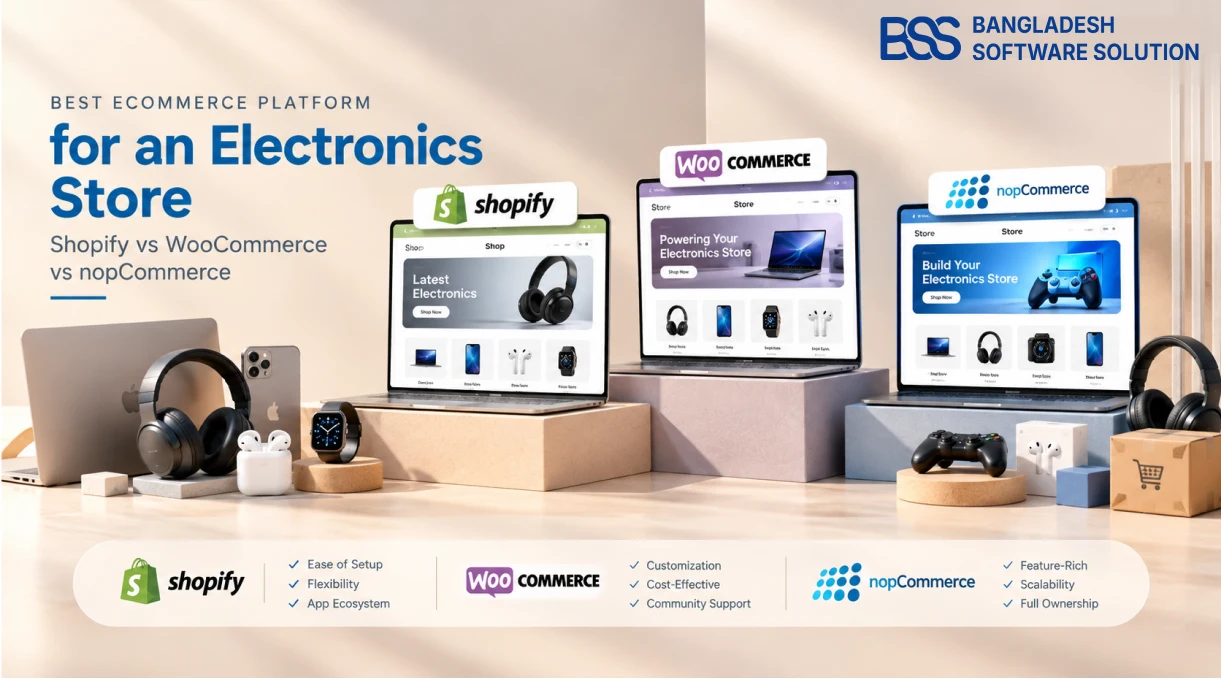
Ask ten electronics store owners why they picked their platform and eight of them will mention how easy setup was. Almost none of them will mention what happens to that platform's fee structure once they're selling $600 phones and $1,200 laptops at a 15% margin instead of $25 t-shirts at 60%. That gap is where a lot of electronics sellers quietly overpay for years without noticing.
This isn't a feature-checklist comparison of Shopify, WooCommerce and nopCommerce can all technically sell a phone case. The question worth actually answering is which one holds up once your catalog is spec-heavy, your average order value is high, and every percentage point of transaction fee is coming straight out of a margin that was never generous to begin with.
What this comparison covers: real 2026 pricing and fee structures for all three platforms, what changes specifically for an electronics catalog — variants, spec data, comparison shopping and where each platform's total cost of ownership actually lands once you're past the launch phase.
Every number below is pulled from each platform's own pricing pages or documentation, not estimated.
What Actually Matters for an Electronics Catalog
Before comparing platforms line by line, it helps to be specific about what electronics does differently than the median online store, because the three things below are where the platforms genuinely diverge.
Shopify: Fastest to Launch, Fees That Never Stop
Shopify's 2026 pricing runs Basic at $39/month ($29 billed annually), Grow at $105/month ($79 annually), and Advanced at $399/month ($299 annually), with Shopify Plus starting at $2,300/month on a three-year term. If you use Shopify Payments, there's no extra transaction fee beyond the card processing rate roughly 2.9% + 30¢ on Basic, dropping slightly on higher tiers.
The catch for electronics specifically: if you use any payment gateway other than Shopify Payments — a real consideration if you already have a merchant account, need a specific regional processor, or want to avoid Shopify holding your payment data — Shopify adds its own surcharge on top: 2% on Basic, 1% on Grow, 0.6% on Advanced. On a $1,000 order, that's $20, $10 or $6 disappearing before card processing is even factored in, on every single sale, indefinitely.
Shopify also doesn't ship a native product comparison tool, you're installing an app for that, which is one more monthly line item and one more thing that can break on a theme update.
WooCommerce: Free Core, Real Costs Elsewhere
The WooCommerce plugin itself costs $0 — no license fee, no revenue share, no per-transaction platform surcharge. What you pay for is everything the plugin doesn't include: hosting, an SSL certificate, a theme, and whichever extensions your catalog needs. A realistic production store runs somewhere between $500 and $3,000+ a year depending on hosting tier and how many premium plugins you stack, and that's before payment processing, which sits at the standard card rate of roughly 2.9% + 30¢ regardless of your order size.
For an electronics catalog, that flexibility cuts both ways. WooCommerce has no native comparison tool either — you're adding a plugin, same as Shopify but because you own the hosting and the code, nothing about your product-page structure is locked behind a pricing tier. The tradeoff is that security, backups, PCI compliance and uptime become your responsibility rather than a vendor's.
nopCommerce: No Platform Fee, Ever — But You Own the Stack
nopCommerce's core platform is free to download and self-host, with no monthly fee and no transaction fee on any sale, at any volume. It's licensed under the nopCommerce Public License - a GNU AGPLv3-based license that requires a "Powered by nopCommerce" notice in the footer unless you purchase a removal key. Optional premium support runs $499 for three months or $999 for a year if you want a vendor to call when something breaks, but nothing about running the platform itself takes a percentage of your revenue.
The detail that matters most for this specific comparison: nopCommerce ships with a native Compare Products feature built into the core platform, not bolted on as a third-party app. Shoppers can add items to a comparison list and view specs side by side without you installing anything extra — a real structural advantage for a category where comparison shopping is the default behavior, not an edge case.
What this actually saves at scale
A store doing $50,000/month at a 2% third-party gateway surcharge is losing $1,000/month - $12,000/year to a fee that simply doesn't exist on a self-hosted platform. Even accounting for hosting and support, that gap widens every month your revenue grows, because the platform fee scales with revenue and the hosting cost mostly doesn't.
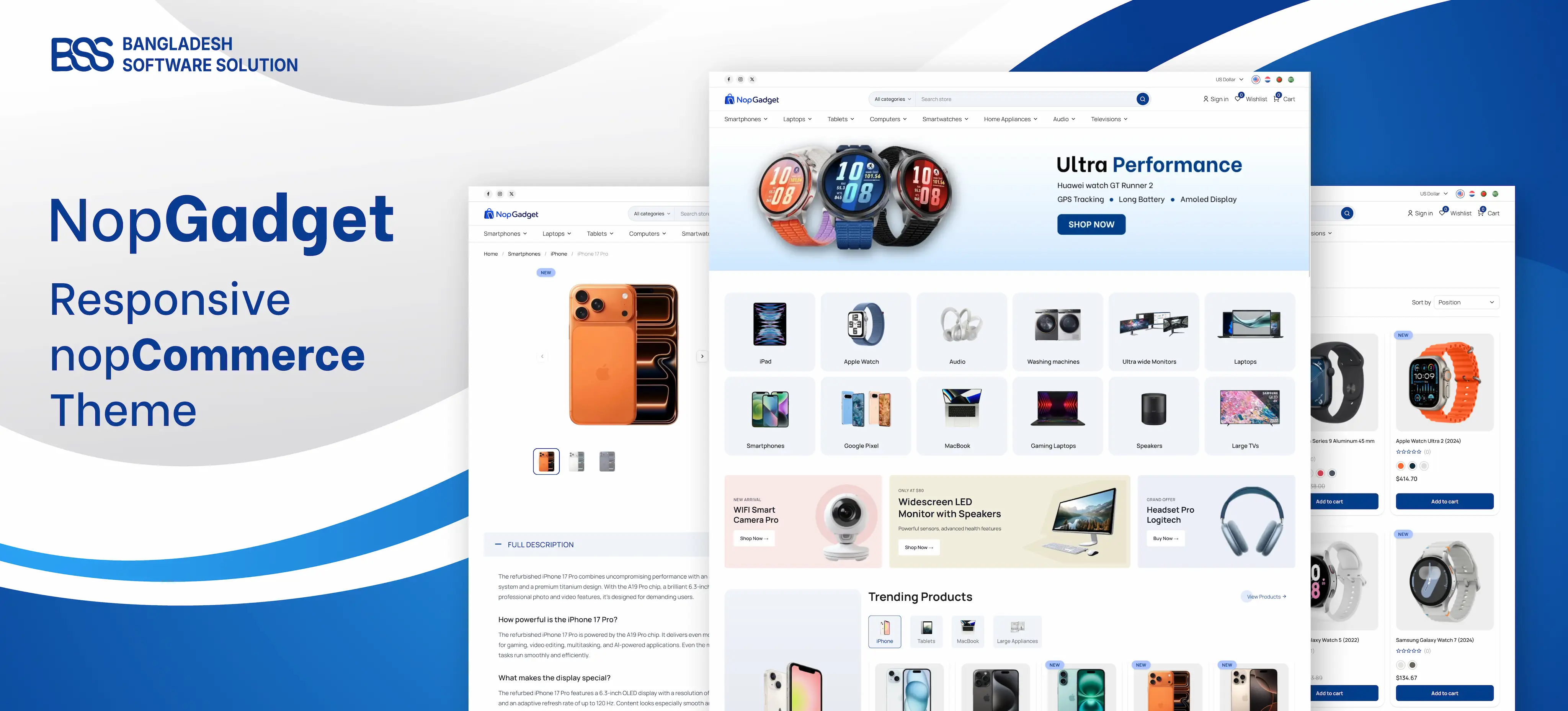
The honest tradeoff is setup time: nopCommerce runs on ASP.NET Core and needs a proper hosting environment, not a one-click signup. That's exactly the gap a pre-built electronics theme closes. NopGadget is a tech-focused nopCommerce theme built specifically for gadget and electronics stores, and it ships as an 18-plugin bundle a visual editor, an advanced theme builder, product comparison tooling, dynamic image galleries, flexible payment options and multi-carrier shipping through Sendcloud for $79 rather than the $600 list price, which is a meaningfully faster starting point than assembling the same stack plugin by plugin.
Worth calling out on its own: if your catalog genuinely needs comparison shopping to go further than the built-in tool, BSS Advanced Product Compare adds a contextual widget on the product page that automatically suggests comparison candidates from the same category and similar specs that you can see it live on a real iPad listing on the NopGadget demo store.
Side by Side
| Platform | Core platform cost | Transaction fee | Native comparison tool | Best fit |
|---|---|---|---|---|
| Shopify | $39–$399/mo (Plus from $2,300/mo) | 0.6%–2% on third-party gateways; $0 with Shopify Payments | No — app required | Fastest launch, low technical overhead |
| WooCommerce | $0 core; ~$500–$3,000+/yr real TCO | $0 platform fee — card processing only | No — plugin required | Flexibility on a WordPress foundation |
| nopCommerce | $0 core; self-hosted infrastructure cost | $0 platform fee, at any volume | Yes — built into the core | High-AOV, spec-heavy catalogs at scale |
That WooCommerce figure comes from HTTP Archive's May 2026 crawl of the measurable web with Shopify at 4.76% by the same methodology — different tracking services report very different numbers depending on whether they count the whole web or only top-tier sites, so treat any single market-share stat as directional rather than definitive.
The platform that looks cheapest at launch is rarely the one that's cheapest at the order volume you're actually trying to reach.
BSS Engineering
How to Actually Decide
Run your own numbers before you commit — the checklist below is the same one we walk through with electronics sellers evaluating a migration.
Before you pick a platform
-
Calculate your actual average order value and margin, then model each platform's fee structure against your real monthly revenue, not a launch-month estimate.
-
Check whether you need a payment gateway other than the platform's own, that's where Shopify's surcharge tiers matter most.
-
Test a comparison flow on each platform's demo store with a real multi-spec product, not a simple T-shirt.
-
Be honest about in-house technical capacity: self-hosting saves money but needs someone who can own hosting, backups and updates.
-
Project your fee cost at 3x current volume, not just today's. That's where the gap between hosted and self-hosted platforms widens fastest.
A Full Electronics Storefront, Not Just a Theme
Visual editor, advanced theme builder, native product comparison, dynamic image galleries, flexible payment options and multi-carrier shipping via Sendcloud — 18 plugins bundled with the theme built for gadget and electronics stores, at $79 instead of $600.
Frequently Asked Questions
Final Thoughts
None of these three platforms is objectively "best". They're solving different problems. Shopify buys you speed and a polished app ecosystem in exchange for a fee structure that follows you at every revenue tier. WooCommerce trades that fee structure for hosting responsibility you take on yourself. nopCommerce asks for the most setup effort up front and then, for the rest of the store's life, never takes a cut of a single sale.
For a category where margins are already thin and average order values are already high, that last part is the whole argument. If you're evaluating the self-hosted route, NopGadget is built to remove the setup friction that usually makes nopCommerce feel like the harder choice — and our team is glad to walk through your specific catalog and margins before you commit to any platform.