A shopper opens ChatGPT on their phone: "Find me an ergonomic leather chair under $400 with adjustable lumbar support and express delivery."
Within three seconds, ChatGPT renders an interactive carousel of three product cards with images, prices, and buy links. None point to your store, even though your warehouse holds twenty units at $349.
That moment captures the biggest shift in retail traffic since the transition from desktop directories to mobile Google search. When buyers ask conversational models for buying advice, they bypass traditional search engine results pages entirely. Understanding how AI transforms ecommerce SEO is no longer an academic debate; it is an urgent operational requirement for every growing brand.
At BSS, our development team spent months auditing how large language models index retail storefronts. Getting into ChatGPT shopping requires a coordinated technical strategy: semantic JSON-LD, deliberate bot governance, structured feeds, and edge caching.
Here is our engineering blueprint for turning your nopCommerce 5.0 store into an authoritative source for conversational AI answers.
How ChatGPT Search Discovers and Evaluates Store Products
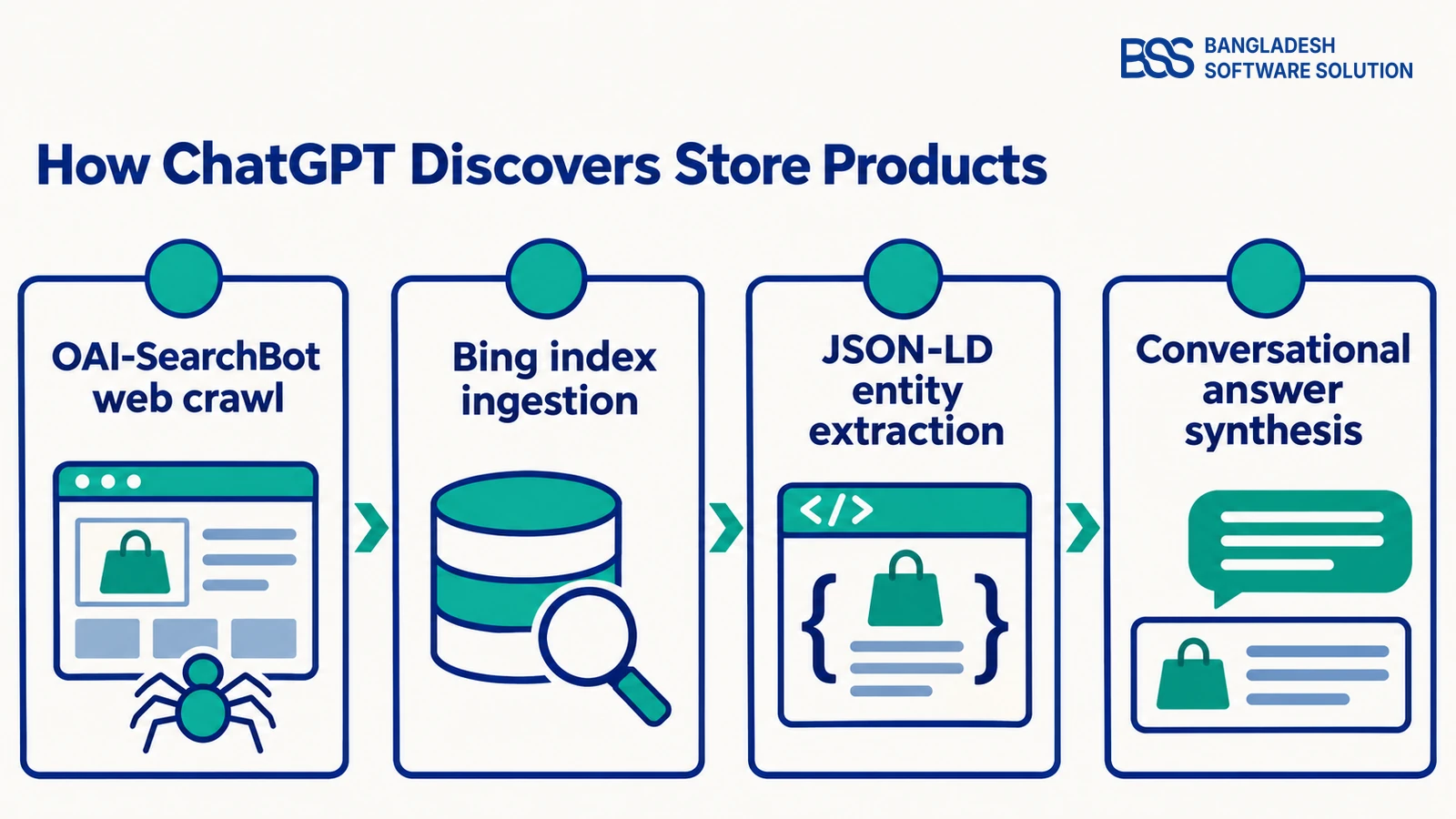
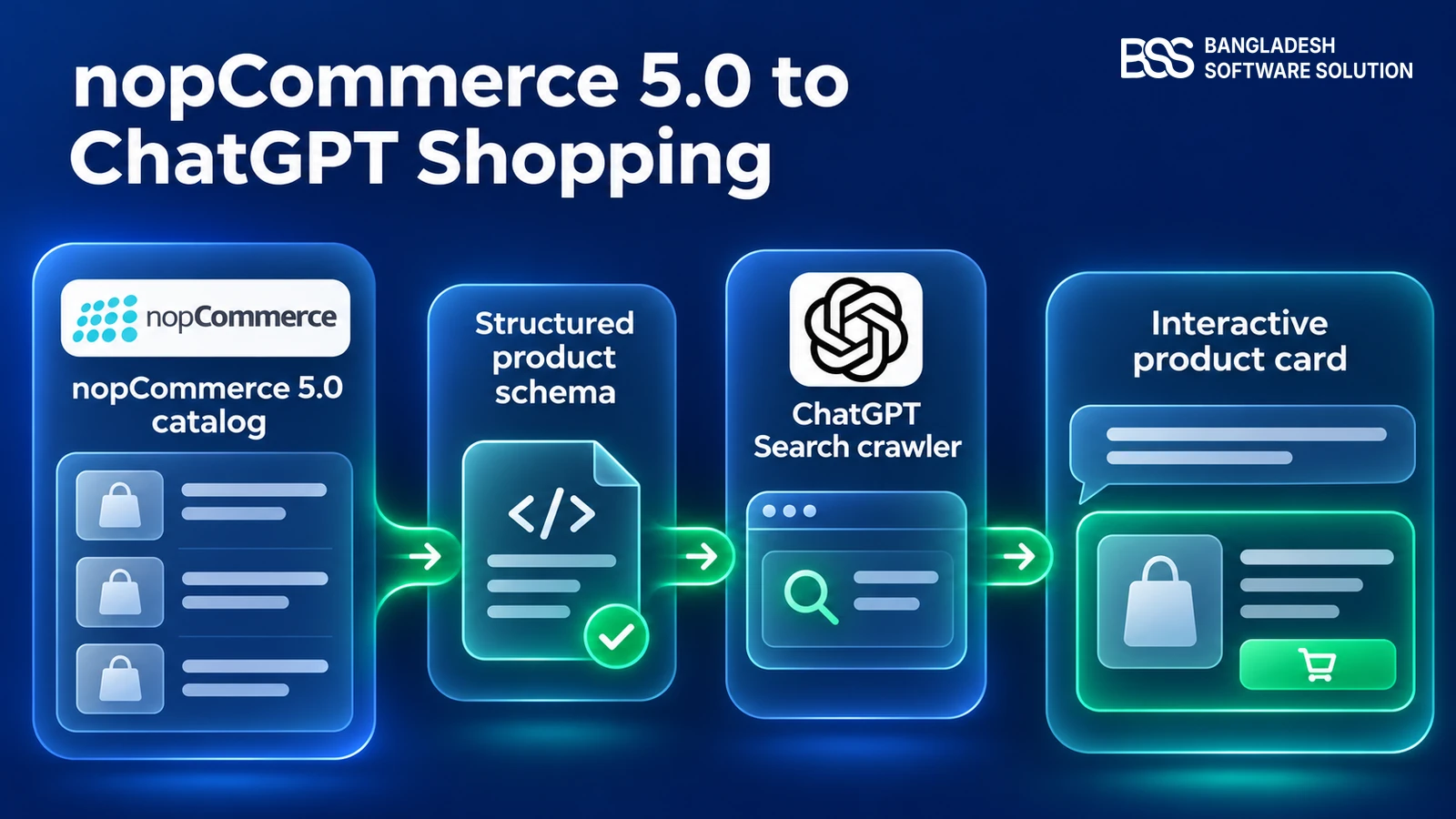
To win placement in conversational recommendations, you first need to understand how ChatGPT Search processes retail information. ChatGPT does not browse your store like a casual human visitor, nor does it merely match keyword strings like legacy search engines. Instead, it operates through a four-stage ingestion pipeline that synthesizes search engine indexing with direct neural extraction.
The core AI mechanism: ChatGPT Search pairs real-time web retrieval via Bing and dedicated crawlers with internal language synthesis to extract verified retail entities.
If a product entity lacks structured pricing, GTIN validation, or clear shipping policies, the neural model discards it to prevent generating hallucinated shopping answers.
When an inquiry hits the conversational interface, ChatGPT evaluates candidate products against strict confidence thresholds. The model prioritizes sources that offer unambiguous data points, verifiable merchant credentials, and fast page response times. Ambiguity is penalized instantly, because an AI model will never risk showing an out-of-date price or an out-of-stock item to an active shopper.
In our store audits at BSS, we notice that many merchants invest thousands of dollars into visual photography and blog copywriting while leaving their machine-readable catalog layer completely neglected. If an AI crawler cannot instantly parse your product attributes without running complex client-side scripts, your products remain invisible to AI-driven shoppers.
Automate product metadata generation, entity tagging, and semantic category descriptions built specifically for AI search engines.
View the pluginWant your nopCommerce catalog structured for AI search? Our engineering team configures complete AI search schemas, merchant feeds, and crawler policies.
Talk to a nopCommerce expertProduct Schema in nopCommerce 5.0: Feeding AI Real-Time Truth
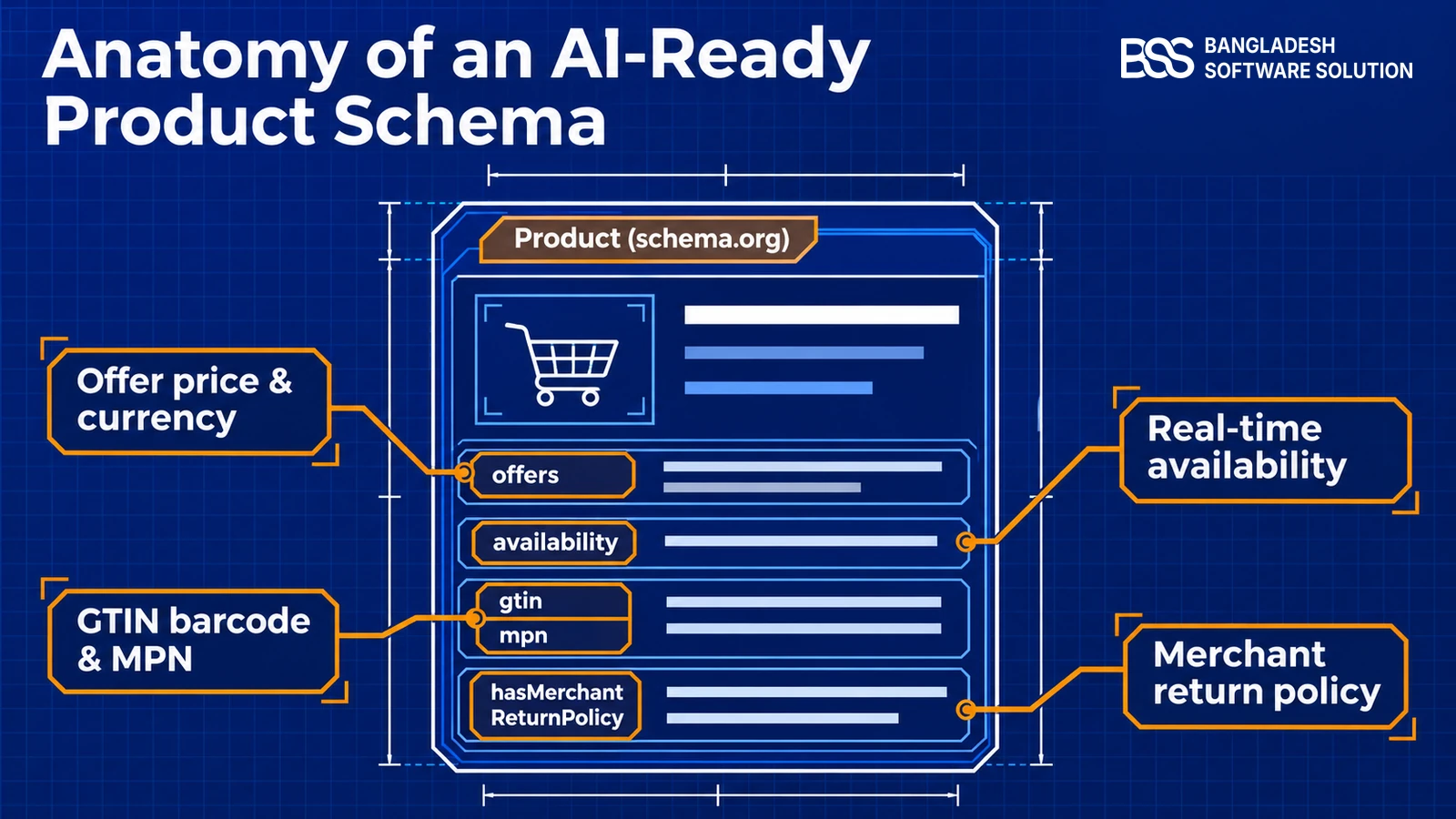
Now that you know how ChatGPT discovers products, the foundation of AI visibility is your structured data layer. While human buyers visually appreciate clean typography and generous white space, conversational AI engines depend entirely on semantic JSON-LD entities. If your schema is incomplete or syntactically invalid, the crawler moves on to a competitor whose data is unambiguous.
In nopCommerce 5.0, default product views render basic schema markup, but out-of-the-box templates often miss the advanced merchant attributes required by modern recommendation engines. To qualify for ChatGPT shopping carousels, your product markup must define full Product and Offer properties, including explicit global identifiers and return policies.
Here is an example of an AI-optimized JSON-LD script block that provides all required signals for conversational shopping crawlers:
{
  "@context": "https://schema.org",
  "@type": "Product",
  "name": "Ergonomic Executive Leather Chair",
  "image": [
    "https://store.bssoln.com/images/uploaded/products/chair-main.webp",
    "https://store.bssoln.com/images/uploaded/products/chair-side.webp"
  ],
  "description": "High-back ergonomic leather desk chair with 3D lumbar support and pneumatic height adjustment.",
  "sku": "CHAIR-EXEC-01",
  "gtin13": "0123456789012",
  "brand": {
    "@type": "Brand",
    "name": "ErgoOffice"
  },
  "offers": {
    "@type": "Offer",
    "url": "https://store.bssoln.com/ergonomic-executive-leather-chair",
    "priceCurrency": "USD",
    "price": "349.00",
    "priceValidUntil": "2026-12-31",
    "itemCondition": "https://schema.org/NewCondition",
    "availability": "https://schema.org/InStock",
    "seller": {
      "@type": "Organization",
      "name": "BSS Store"
    },
    "shippingDetails": {
      "@type": "OfferShippingDetails",
      "shippingRate": {
        "@type": "MonetaryAmount",
        "value": "0.00",
        "currency": "USD"
      },
      "shippingDestination": {
        "@type": "DefinedRegion",
        "addressCountry": "US"
      },
      "deliveryTime": {
        "@type": "ShippingDeliveryTime",
        "transitTime": {
          "@type": "QuantitativeValue",
          "minValue": 1,
          "maxValue": 3,
          "unitCode": "DAY"
        }
      }
    },
    "hasMerchantReturnPolicy": {
      "@type": "MerchantReturnPolicy",
      "applicableCountry": "US",
      "returnPolicyCategory": "https://schema.org/MerchantReturnFiniteReturnWindow",
      "merchantReturnDays": 30,
      "returnMethod": "https://schema.org/ReturnByMail"
    }
  }
}
Notice the inclusion of shippingDetails and hasMerchantReturnPolicy. Modern AI agents are frequently asked questions like "which store offers free two-day delivery?" or "can I return this within 30 days?" Having these properties in your structured markup allows the model to confirm qualifying terms with mathematical certainty.

When auditing client stores at BSS, we frequently find valid schema that omits itemCondition or priceValidUntil, causing AI crawlers to drop product cards during price volatility checks. If you need clean schema deployed across your entire catalog, our team can implement it via custom plugins or our nopCommerce customization services.
Bot Governance: Configuring robots.txt, llms.txt, and Server Caching
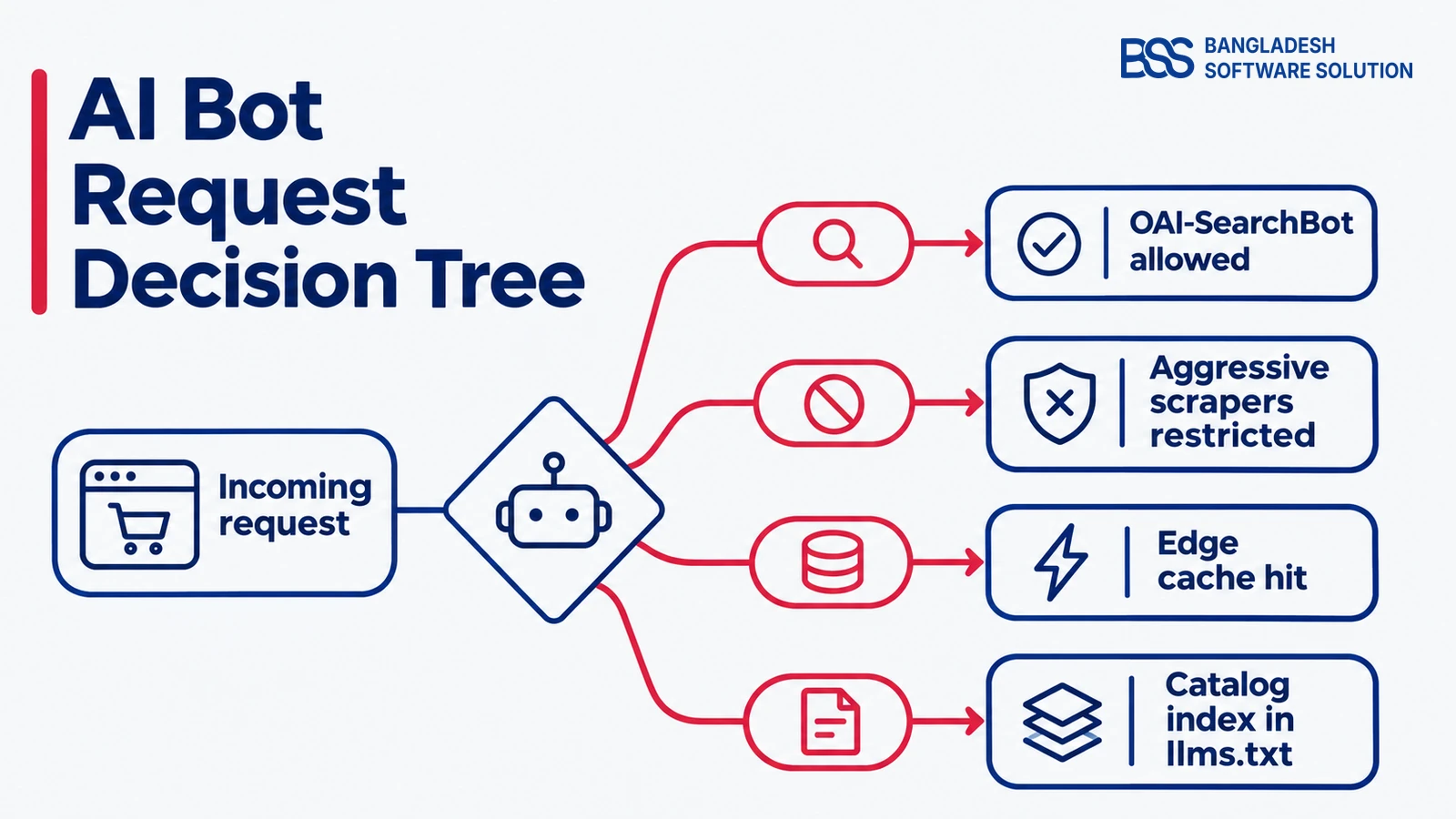
Even the most sophisticated schema is useless if AI search bots cannot access your storefront. A widespread issue across nopCommerce stores stems from overzealous security configurations. In an attempt to prevent scraping and denial-of-service spikes, store owners inadvertently block the very bots responsible for commercial recommendation indexing.
OpenAI operates multiple distinct web agents with completely different purposes. Understanding this distinction is vital for protecting your server resources while maximizing commercial visibility.
To ensure OAI-SearchBot has clean access to your catalog without indexing cart or checkout paths, configure your robots.txt file in nopCommerce as follows:
# Allow ChatGPT Commercial Search indexing
User-agent: OAI-SearchBot
Allow: /
Disallow: /cart
Disallow: /checkout
Disallow: /orderdetails
Disallow: /customer
Disallow: /admin

# Allow user-initiated conversational browsing requests
User-agent: ChatGPT-User
Allow: /
Disallow: /cart
Disallow: /checkout

# Manage AI foundation model training scrapers
User-agent: GPTBot
Disallow: /admin
Crawl-delay: 5
In addition to robots.txt, adopting the emerging /llms.txt standard gives conversational models a lightweight markdown sitemap of your core categories, brand values, and top-selling SKUs. Placing an llms.txt file in your root domain provides a fast, plain-text directory that models can digest in milliseconds.
Watch out for cold cache bottlenecks
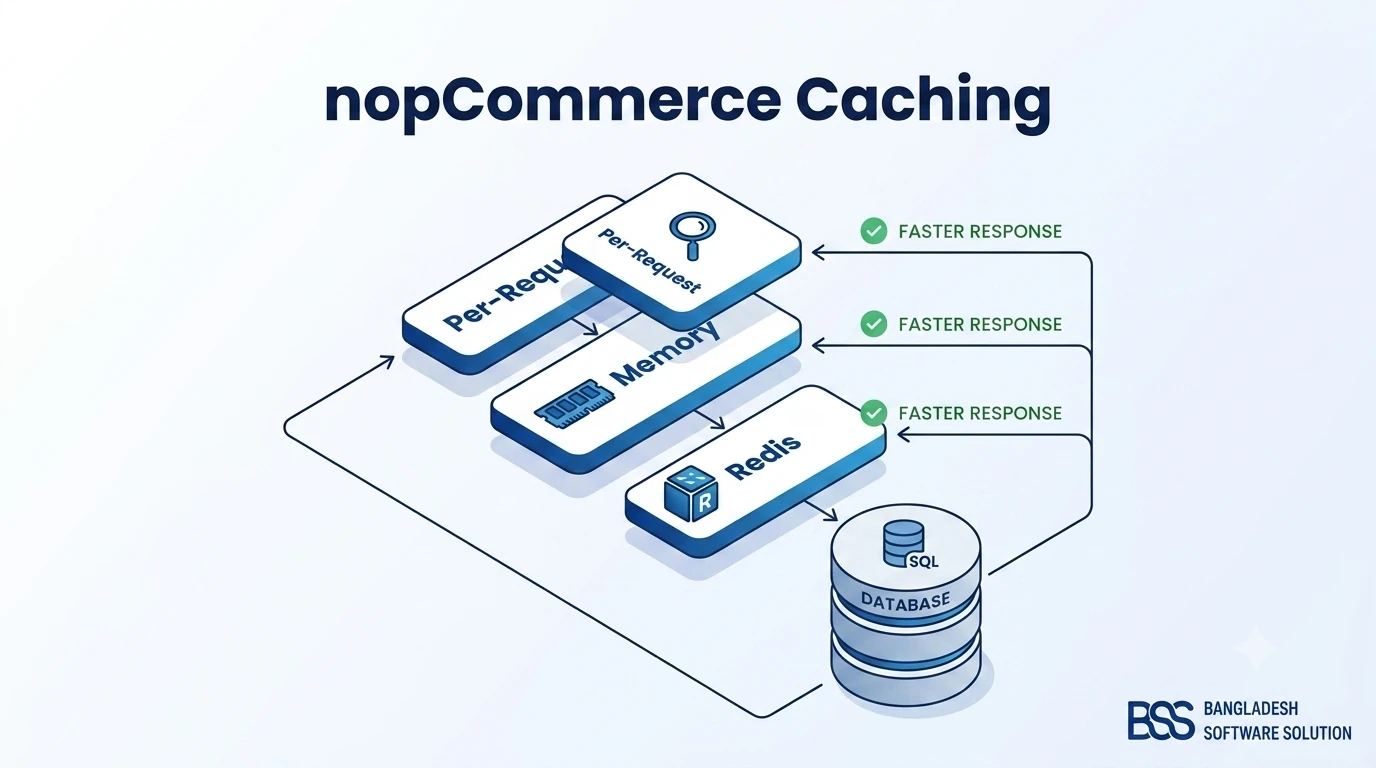
AI search bots crawl at higher concurrency than human visitors. If every crawler request forces nopCommerce to execute cold SQL queries and uncompiled Razor views, your server response time will spike, causing bots to abort visits. Pair your bot permissions with robust server memory and Redis caching as outlined in our nopCommerce caching guide.
Configuring edge caching, rate limits, and bot firewall rules without breaking storefront security requires careful balance. If your infrastructure team is stretched, you can hire a .NET developer from BSS to tune your server rules, optimize database indexes, and guarantee fast crawler throughput.
Connecting nopCommerce 5.0 to Google Merchant Center and Bing Feeds
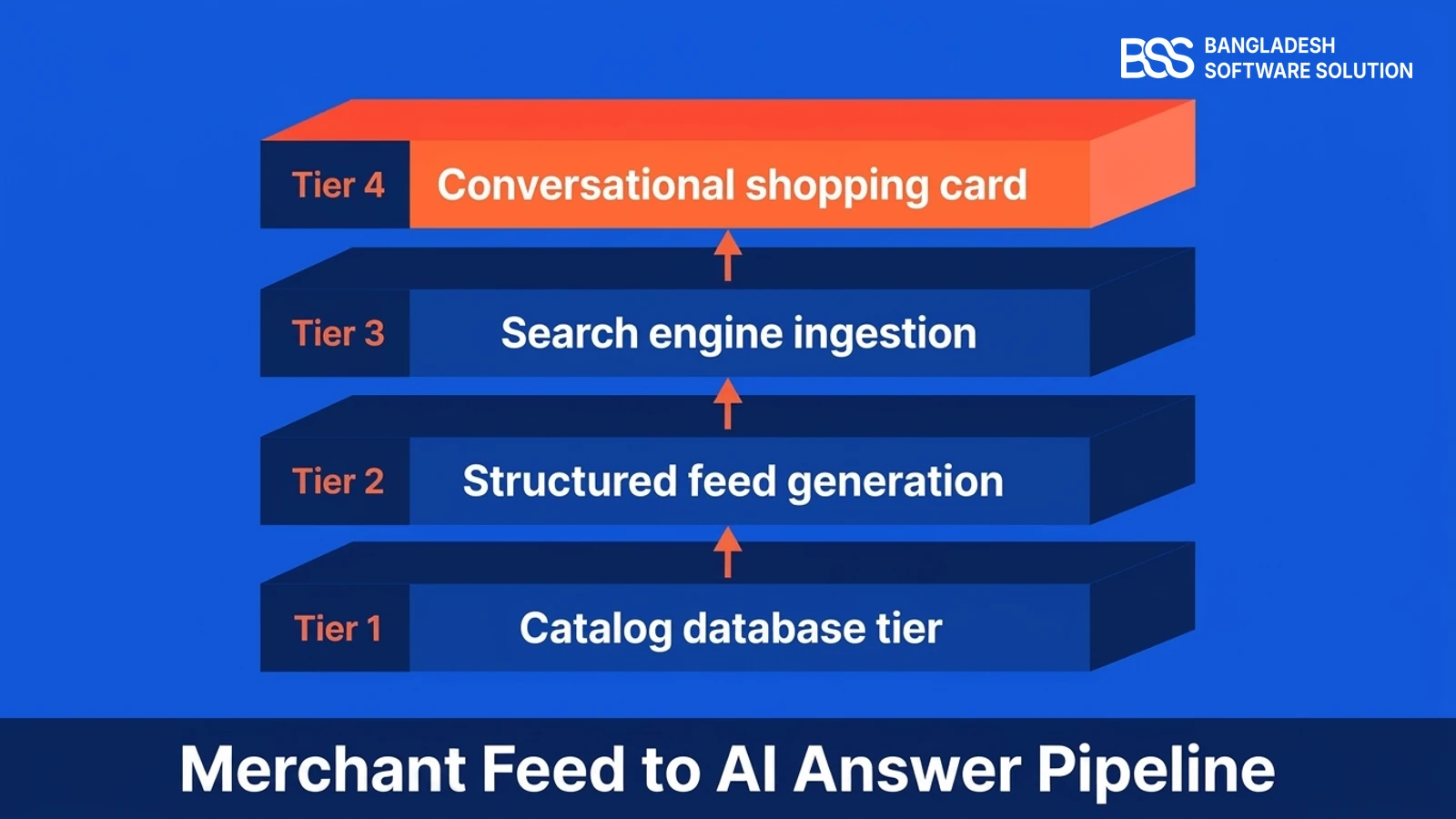
While on-page web crawling handles real-time verification, commercial AI engines rely heavily on aggregated merchant feeds for catalog scale. ChatGPT Search utilizes Microsoft Bing's shopping index and merchant partnerships to discover matching products across millions of online storefronts.
If your nopCommerce store already synchronizes cleanly with Google Merchant Center and Microsoft Merchant Center, you are halfway to appearing in AI answers. The challenge is ensuring that your feed output remains perfectly synchronized with your live storefront database.
AI search engines do not browse catalogs like curious humans; they ingest structured feeds and verify real-time claims against live schema.
BSS Engineering
When selecting a feed architecture for nopCommerce 5.0, evaluate your store's size and price volatility against these three common approaches:
| Feed Method | Update Frequency | Server Overhead | AI Readiness Impact |
|---|---|---|---|
| Native Scheduled XML | Once every 24 hours | Low background task | Medium impact |
| Automated Sync Plugin | Real-time inventory triggers | Negligible asynchronous | High impact |
| Direct API Ingestion | Instant webhook push | Requires middleware | High impact |
To eliminate discrepancies between your feed and your live storefront, your feed generator must capture variant-level pricing, promotional expiration dates, and tier pricing accurately. If you need inspiration on structuring extensions, explore our rundown of essential nopCommerce 5.0 plugins for administrative automation.
In our enterprise store deployments at BSS, multi-currency stores often fail to show product cards in AI chats because the feed currency doesn't match the customer's geo-location. Resolving currency detection at the edge ensures AI agents see accurate local pricing, which we routinely resolve through custom nopCommerce development.
The AI Readiness Audit: 5 Steps to Test Your Store in ChatGPT
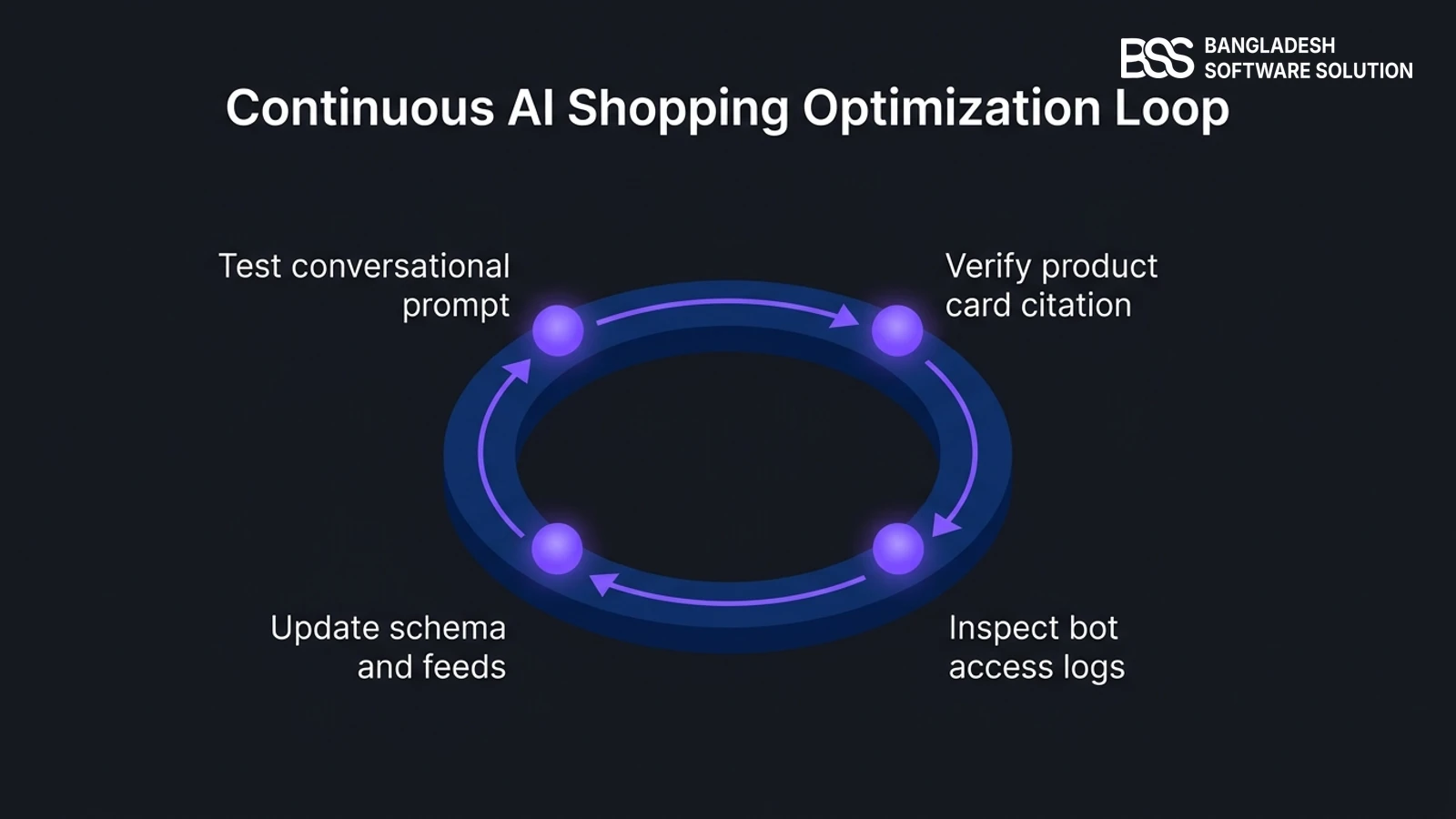
Optimizing for conversational AI is not a set-and-forget task. Because model weights and retrieval algorithms update continuously, maintaining top placement in AI shopping carousels requires an ongoing testing rhythm. You need a reliable framework to audit your store's visibility and detect citation drop-offs before sales are affected.
Follow this five-step audit checklist every month to verify how AI models perceive your nopCommerce 5.0 catalog:
Monthly AI Shopping Audit Checklist
-
Test Conversational Prompts: Run natural buyer queries in ChatGPT Search (e.g., "best [category] with fast shipping") and record whether your brand appears in product cards or citation footnotes.
-
Inspect Google & Bing Merchant Status: Verify that zero critical errors exist for price mismatches, missing GTIN barcodes, or invalid shipping zones.
-
Validate Rich Results Schema: Run live product URLs through the Schema.org validator to confirm zero missing properties in Offer, ItemCondition, and ShippingDetails.
-
Audit Web Server Bot Logs: Check your web server access logs for
OAI-SearchBotuser-agent requests and verify they receive HTTP 200 responses with low latency. -
Monitor AI Referral Traffic in GA4: Track incoming referral sessions originating from
chatgpt.com,perplexity.ai, andcopilot.microsoft.comto measure conversion rates.
Running a comprehensive catalog audit across thousands of complex SKUs can require dozens of engineering hours. BSS can audit your store architecture, verify schema compliance, and configure your feeds through our nopCommerce store setup and optimization services.
Need a nopCommerce Developer? Hire the BSS Team
From custom plugins and theme work to full-store builds and performance tuning, our dedicated nopCommerce engineers ship production-grade code. Tell us what you need and we'll match you with the right developer.
Frequently Asked Questions
Final Thoughts
Let us return to that customer shopping for an ergonomic leather desk chair. When your nopCommerce 5.0 store publishes unambiguous JSON-LD schema, grants clean access to OAI-SearchBot, synchronizes with Microsoft Merchant feeds, and responds in under 200 milliseconds, the conversational outcome changes completely.
Instead of watching competitors capture the sale, your chair appears in the primary recommendation slot. The customer sees your exact $349 price, reads your verified two-day delivery promise, clicks the product card, and checks out on your store without friction. Conversational AI is not replacing ecommerce; it is rewarding merchants whose stores provide clean, machine-verifiable truth.
Our certified .NET engineers build high-performance nopCommerce stores, custom plugins, and complete AI search integrations.
Book a free consultation