"nopCommerce or WooCommerce?" is one of the most common questions we hear from store owners planning a new build or a replatform — and the honest answer is that they aren't really the same kind of product. One is a full ASP.NET Core application you host and control; the other is a plugin that turns WordPress into a shop. Choosing well is less about which is "better" and more about which matches your team, budget, and growth plans.
At Bangladesh Software Solution (BSS) we build plugins, themes, and custom stores on nopCommerce every day, so we'll be upfront about our background — but this guide is written to be genuinely balanced. WooCommerce is an excellent platform for a huge number of stores, and we'll say exactly where it wins. Below we compare the two across architecture, features, performance, cost, security, and the kind of store each is actually built for.
nopCommerce vs WooCommerce at a Glance
If you only read one section, read this one. Here is the short version before we get into the detail.
The quick verdict: Choose WooCommerce if you want the fastest, cheapest start, are already on WordPress, or run a content-first store with a manageable catalog. Choose nopCommerce if you need a developer-controlled, high-performance .NET platform for a large catalog, B2B rules, multi-store, or strict data ownership.
Neither is a wrong choice — they simply optimise for different things. The rest of this article explains why, so you can match the platform to your situation instead of to the hype.
If you are also weighing open-source against hosted SaaS, our nopCommerce vs Shopify comparison is a useful companion read.
What Each Platform Actually Is
The biggest mistake in this comparison is treating both as interchangeable "shopping-cart software." Their foundations are completely different, and almost every practical difference flows from that.
In other words: nopCommerce is a store that can host content; WooCommerce is a content platform that can host a store. Keep that framing in mind for everything below.
Feature-by-Feature Comparison
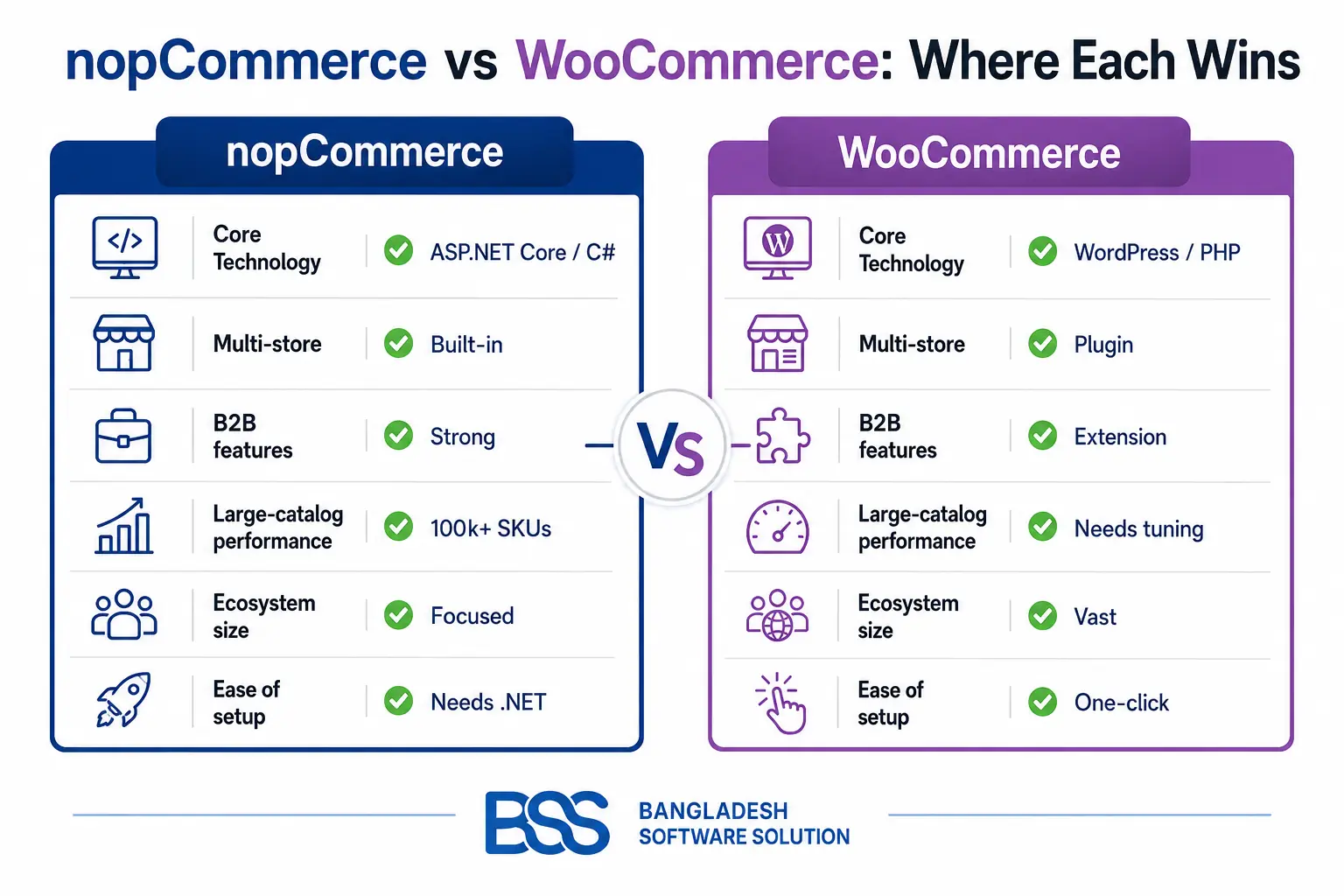
Both platforms cover the e-commerce essentials — products, carts, checkout, discounts, taxes, and shipping. The differences show up in what is included by default versus what needs a plugin, and in how far each scales before you hit a wall.
| Capability | nopCommerce | WooCommerce |
|---|---|---|
| Core technology | ASP.NET Core / C# | WordPress / PHP |
| License cost | Free & open source | Free & open source |
| Multi-store | Built in | Needs a plugin |
| B2B / quotes / tiered pricing | Strong, built in | Extension required |
| Large-catalog performance | Handles 100k+ SKUs | Needs tuning past ~10k |
| Ecosystem size | Focused marketplace | Vast (WordPress) |
| Ease of setup | Needs .NET hosting/dev | One-click on any host |
| Content / blogging | Basic, built in | Best in class (WordPress) |
| Hosting requirements | .NET runtime (Win/Linux) | Standard PHP hosting |
Under the Hood: Architecture & Extensibility
How you extend each platform is where development teams feel the difference most. nopCommerce is a compiled, strongly-typed application; WooCommerce is an interpreted, hook-driven one.
How each is extended
- nopCommerce — C# plugins that implement well-defined interfaces, compiled against the app. Type-safe, testable, and fast at runtime, but they require .NET skills. We walk through the whole process in our guide to creating a nopCommerce 4.80 plugin.
- WooCommerce — PHP plugins using WordPress's actions and filters ("hooks"). Enormously flexible and quick to prototype, with tens of thousands of ready-made extensions, but plugin quality varies widely and conflicts are common.
A typical nopCommerce plugin registers its services in a dependency-injection container — closer to enterprise application development than to WordPress theming:
public class PluginStartup : INopStartup
{
    public void ConfigureServices(IServiceCollection services,
                                  IConfiguration configuration)
    {
        services.AddScoped<IMyStoreService, MyStoreService>();
    }
    public int Order => 11;
}
The trade-off in one line
WooCommerce's hook system makes it faster to start and easier to find an off-the-shelf plugin; nopCommerce's compiled architecture makes it faster to run and easier to keep maintainable as complexity grows. Neither is universally "better" — it depends on whether your bottleneck is time-to-launch or long-term engineering control.
Performance & Scalability
Raw performance depends far more on hosting, caching, and how cleanly a store is built than on the logo on the box — but the platforms do have different ceilings and different failure modes.
If you are chasing a specific performance problem, platform choice is rarely the root cause — configuration is. Our deep-dive on diagnosing and fixing nopCommerce high memory usage shows how a single garbage-collection setting can cut memory 40–60%, and the same "measure before you blame the platform" logic applies just as well to WooCommerce.
Need a nopCommerce Developer? Hire the BSS Team
From custom plugins and theme work to full-store builds and performance tuning, our dedicated nopCommerce engineers ship production-grade code. Tell us what you need and we'll match you with the right developer.
Total Cost of Ownership
Both platforms are free to download, so the sticker price is a distraction. The real cost is hosting plus development plus maintenance over a few years.
WooCommerce starts cheaper: it runs on inexpensive shared PHP hosting, and a small store can go live with a paid theme and a handful of extensions. Costs creep up through premium plugins (many are annual subscriptions) and the developer time to keep WordPress, WooCommerce, and every plugin updated and compatible.
nopCommerce typically costs more up front — .NET hosting and developer time are pricier, and more tends to be custom-built — but there are no per-feature subscription stacks, and a well-architected store often costs less to maintain at scale. For teams without in-house .NET skills, a specialist partner such as our nopCommerce development services is usually part of the equation.
Don't forget the "free" tax
On both platforms, "free and open source" means you own updates, security patches, and backups. Budget for maintenance from day one — the stores that get into trouble are almost always the ones that treated launch as the finish line.
Which Should You Choose?
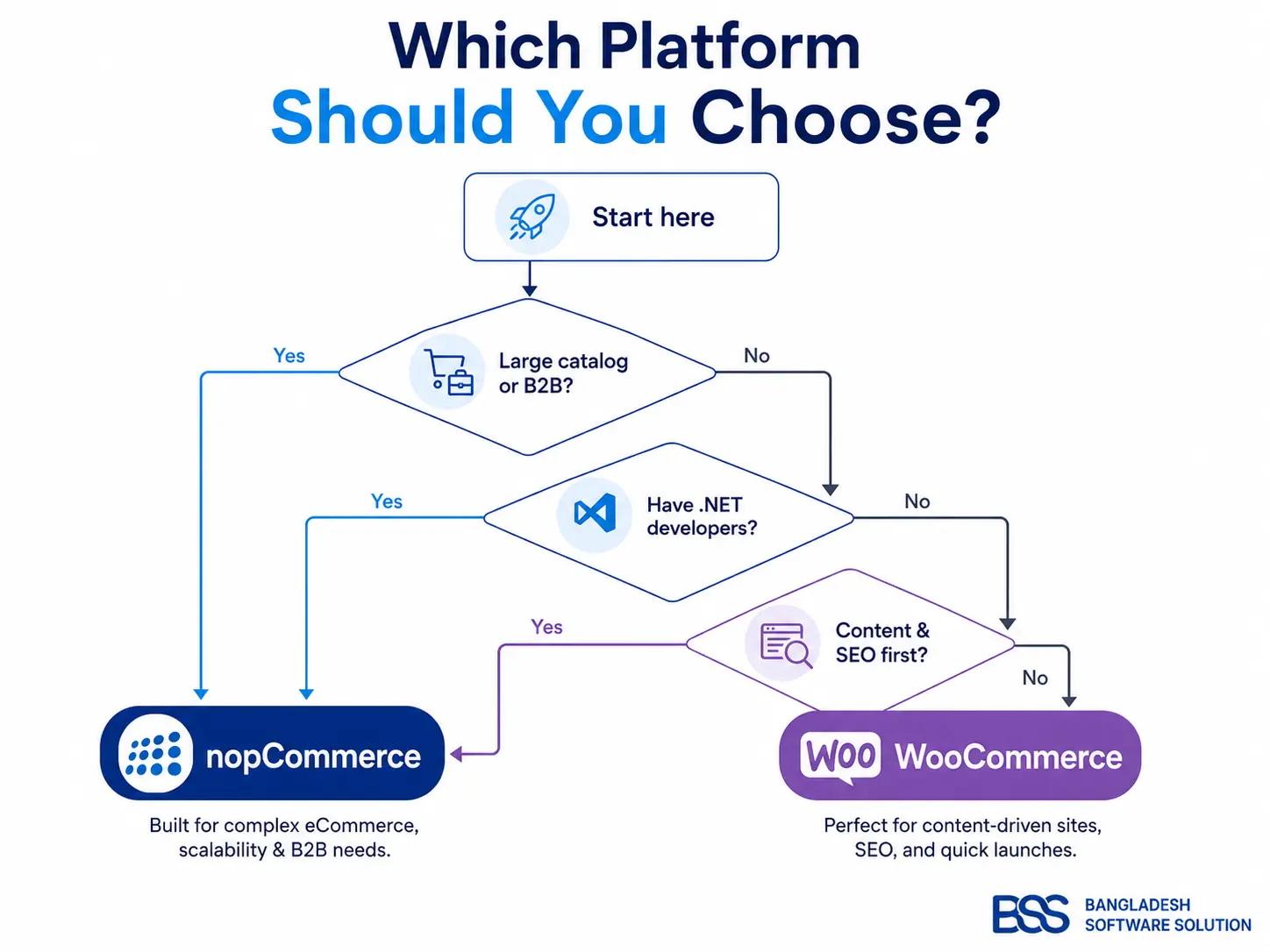
Strip away the marketing and the decision usually comes down to a few concrete questions about your store and your team.
Choose nopCommerce if…
- ✓You run (or plan) a large catalog, B2B pricing, or multiple storefronts from one back office.
- ✓You have .NET developers — or a nopCommerce partner — and want full control of your code and data.
- ✓Performance under real concurrent load and long-term maintainability matter more than time-to-launch.
Choose WooCommerce if…
- ✓Content and SEO are central, or you are already running on WordPress.
- ✓You want to launch quickly and cheaply with a small-to-mid catalog.
- ✓You value the largest possible ecosystem of ready-made themes and extensions.
Security & Maintenance
Security on any self-hosted platform is a shared responsibility: the software provides the tools, but you own the configuration and patching. Here the two differ mainly in surface area.
Because WooCommerce inherits WordPress's popularity, it is also the most-targeted stack on the web — not because it is inherently insecure, but because attackers automate against the platform that runs such a large share of the internet. A WooCommerce store's safety depends heavily on keeping WordPress core, the theme, and every plugin patched. nopCommerce presents a smaller, more uniform surface: fewer third-party moving parts, strongly-typed code, and updates that come from a single vendor. In exchange, you need someone comfortable deploying .NET updates.
The takeaway is not "one is secure and one is not" — both are secure when maintained and both are vulnerable when neglected. Match the platform to the maintenance capacity you actually have.
Frequently Asked Questions
Final Thoughts
nopCommerce vs WooCommerce is not a winner-takes-all fight — it is a fit question. WooCommerce is the pragmatic choice for content-first and fast-launch stores with the largest ecosystem behind them. nopCommerce is the stronger foundation for developer-controlled, high-scale, B2B, and multi-store commerce on the .NET stack.
Be honest about your catalog size, your team's skills, and your growth plans, and the right platform usually picks itself. If that answer is nopCommerce — or you are weighing a migration — our team at Bangladesh Software Solution has spent years building on it, and we are happy to help you scope it out.