On October 21, 2026, the open-source security community issued emergency patches for two critical remote code execution vulnerabilities in the PHP runtime core. Tracked as CVE-2026-109618 and CVE-2026-109619, and collectively nicknamed PHP2Shell, these flaws carry a severe CVSS 9.2 rating. The disclosure triggered immediate panic across the e-commerce industry, where millions of digital storefronts run on PHP engines.
When an exploit targets application plugins, store owners can often isolate the offending extension or deploy targeted firewall rules. However, because PHP2Shell attacks the underlying language interpreter, attackers can compromise unpatched servers before e-commerce business logic or firewalls even inspect the incoming payload. Platforms like WooCommerce, Magento, and Shopware found themselves exposed to unauthenticated server takeovers.
For online merchants who chose nopCommerce, the situation could not be more different. Built on Microsoft's modern .NET framework, nopCommerce operates with zero PHP dependencies and complete architectural isolation. In this guide, we break down how the October 21 vulnerabilities work, examine their negative impact on online retail, and explore why .NET provides durable structural protection.
The October 21 PHP Vulnerabilities: Inside CVE-2026-109618 and CVE-2026-109619
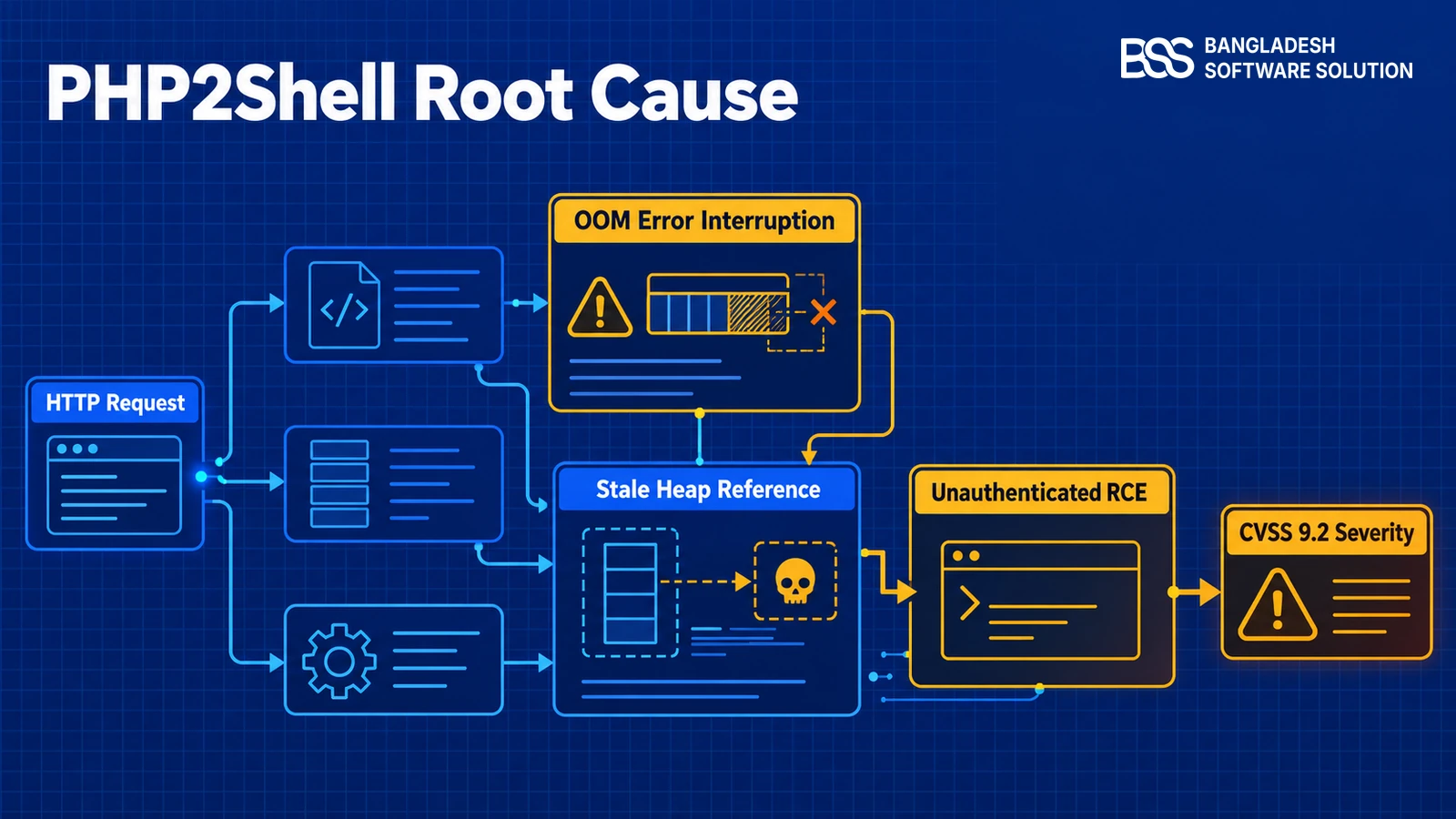
To understand why PHP2Shell is so damaging, you have to look beneath standard web scripts at the C runtime that executes PHP code. The vulnerability stems from how the PHP interpreter handles unexpected memory exhaustion and cleanup cycles during active HTTP request processing.
Key fact: The PHP2Shell vulnerabilities carry a critical CVSS 9.2 severity rating. They allow unauthenticated remote attackers to trigger memory corruption and execute arbitrary system commands with the privileges of the web server process.
Because the flaw executes at the interpreter level, standard content management system updates cannot resolve the issue without upgrading the host server's binary packages.
The first flaw, CVE-2026-109618, occurs when an out-of-memory error interrupts PHP while internal request tracking structures are only partially initialized. When the interpreter subsequently attempts to clean up the request, it treats invalid, uninitialized memory pointers as valid references.
The companion flaw, CVE-2026-109619, represents a classic use-after-free and stale heap reference condition. Global references survive after their backing memory allocations have been freed, allowing a subsequent request handled by the same worker pool to abuse that corrupted memory state.
Remediating these flaws required emergency upstream releases across 4 active branches: PHP 8.5.12, 8.4.27, 8.3.36, and 8.2.35. For legacy stores stranded on end-of-life PHP 7.x or 8.1 runtimes, no official security binaries exist without custom vendor backports.
Even when upstream packages are installed, the remediation cycle is disruptive. Every PHP-FPM pool and Apache worker process must be restarted, risking mid-checkout session drops for active shoppers.
For merchants operating multi-server clusters, keeping every worker node synchronized against runtime-level CVEs requires continuous DevOps monitoring and rigorous testing across staging environments.

Launch your store on a secure, compiled .NET foundation featuring 17 pre-bundled plugins, modern responsive styling, and complete freedom from PHP vulnerabilities.
Explore the themeWorried about e-commerce security? BSS audits existing store architectures and builds hardened, zero-vulnerability nopCommerce stores for growing retail brands.
Talk to a nopCommerce expertWhy E-Commerce Stores Bear the Brunt of PHP Runtime Exploits
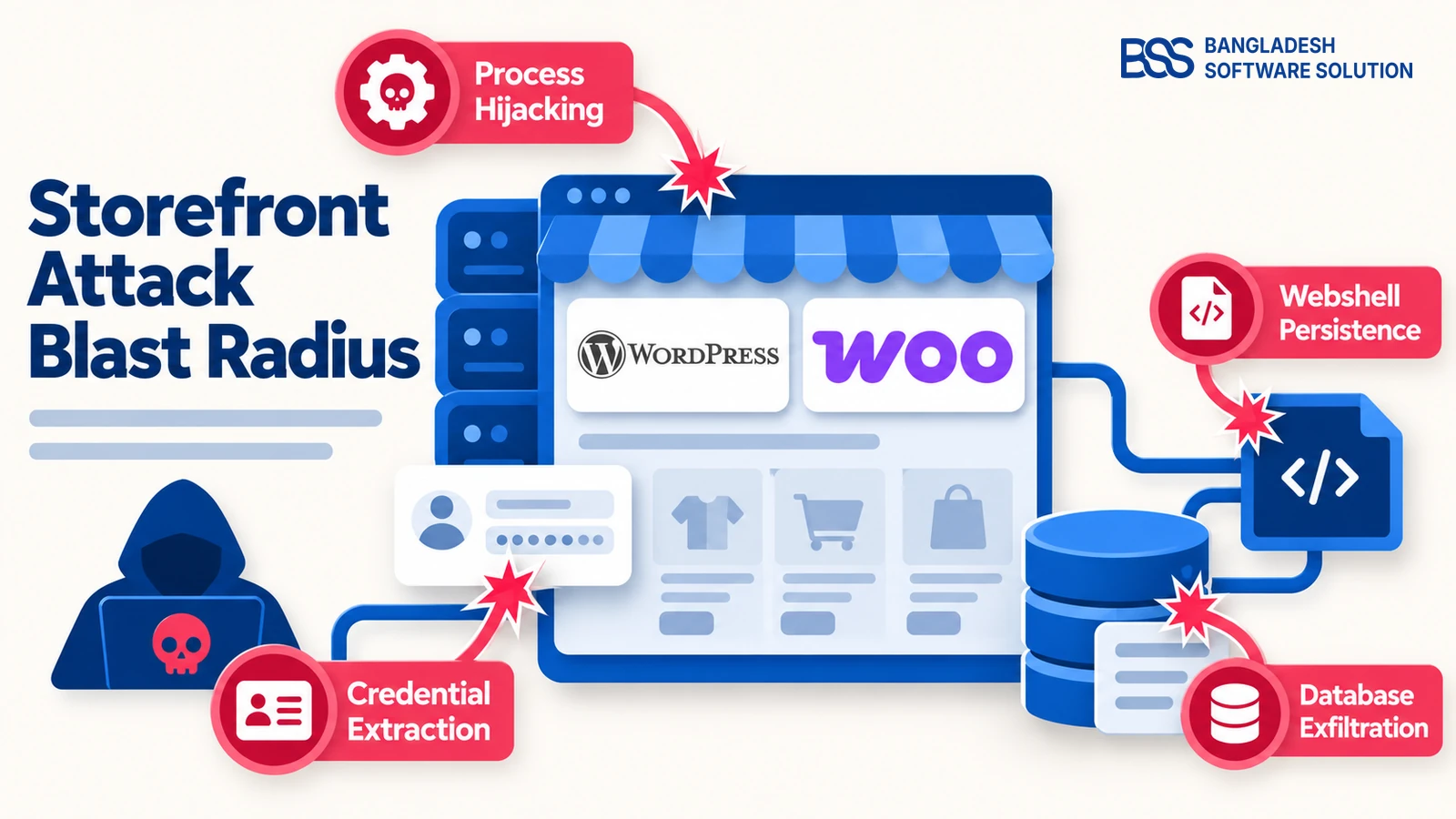
While any PHP website on an unpatched server is at risk, e-commerce stores face devastating commercial consequences. Online retail platforms manage customer identities, billing addresses, saved payment tokens, and inventory transactions that make them primary targets for cybercrime syndicates.
When an attacker executes unauthenticated remote code on a PHP-based store such as WooCommerce or Magento, the blast radius encompasses every layer of the merchant operation. Exploits rarely stop at defacement; automated tools immediately weaponize access to extract commercial value.
When a vulnerability exists in the runtime engine rather than plugin code, traditional web application firewalls cannot guarantee protection.
BSS Engineering
Beyond data theft, attackers frequently plant hidden webshells deep within upload directories or cached asset folders. Even after a server administrator applies binary patches to PHP, previously planted backdoors can remain active for months unless comprehensive forensic scans are performed.
Attackers often leverage automated reconnaissance scripts that scan IPv4 address spaces for vulnerable headers. Once an unpatched worker responds, exploit payloads establish persistent reverse shells in seconds.

Consolidate billing, shipping, and payment into a single, high-converting checkout screen while keeping payment processing strictly isolated and tokenized.
View the pluginFor e-commerce founders, the fallout extends beyond immediate system downtime. Regulatory reporting mandates, PCI-DSS compliance audits, and customer notifications can incur steep financial penalties.

When our team migrates stores from WooCommerce or Magento to nopCommerce, eliminating the ongoing maintenance overhead of PHP patch cycles is often the biggest operational win for founders. If you want to leave interpreter patching behind, BSS handles full-store eCommerce migrations end to end.
Architecture as a Shield: Why nopCommerce Is Not Affected
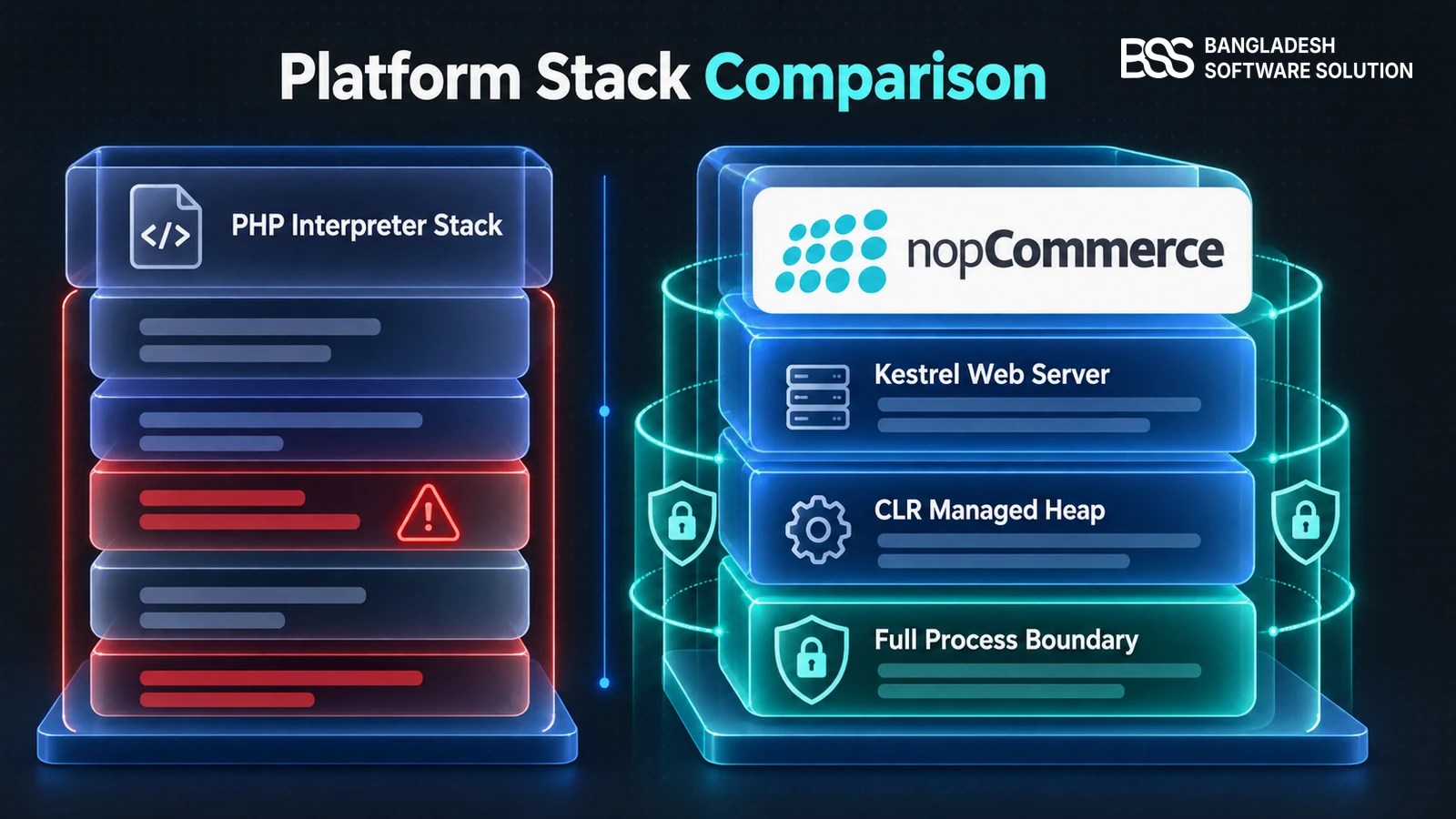
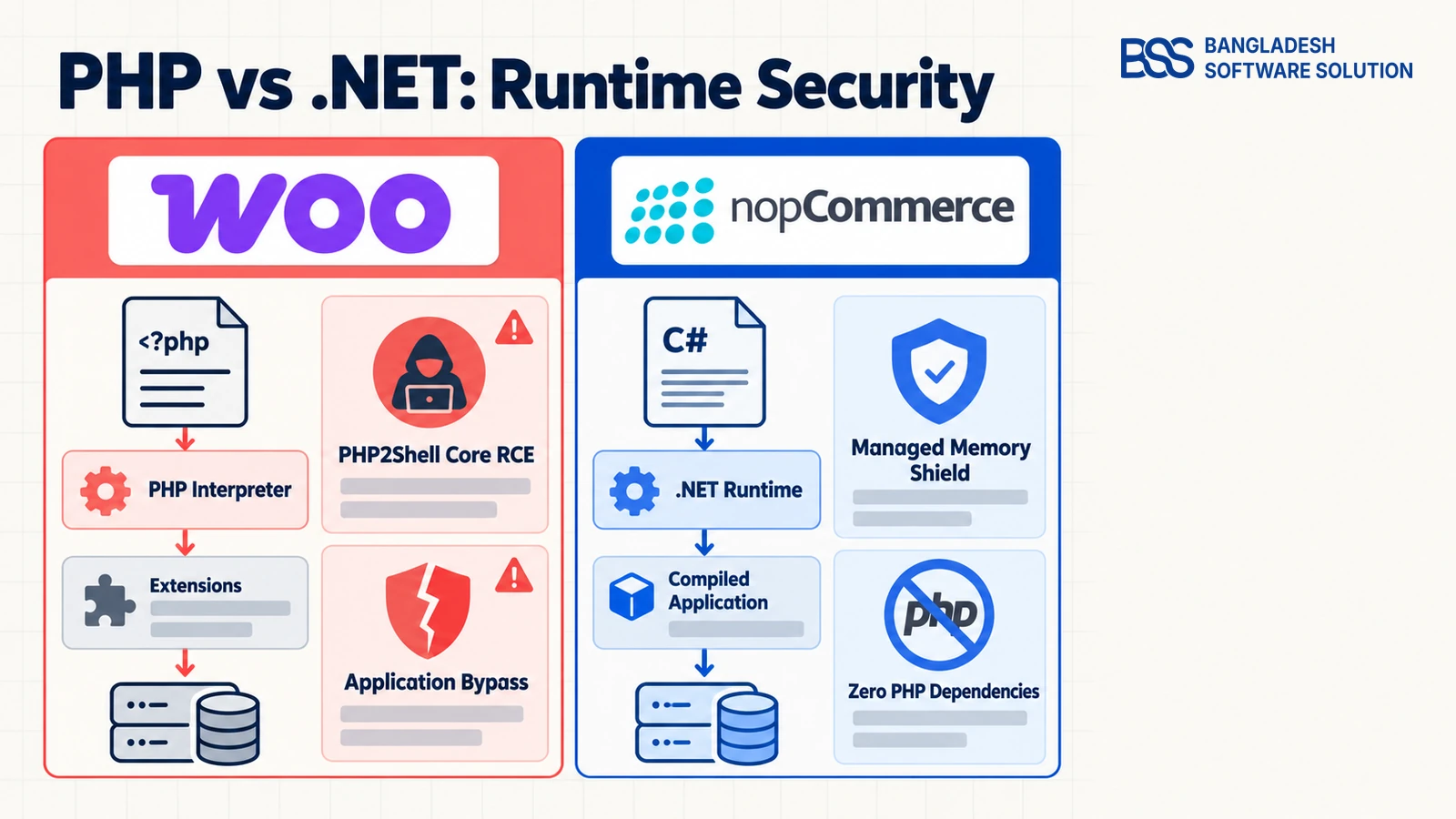
The reason nopCommerce stores remained entirely untouched on October 21 is fundamental architectural divergence. nopCommerce is not written in PHP, does not run through a PHP interpreter, and maintains zero runtime coupling with PHP-FPM, Apache mod_php, or the Zend Engine.
Instead, nopCommerce is built on Microsoft's modern, cross-platform .NET runtime and written in C#. Rather than interpreting raw script text on every HTTP request, .NET compiles source code into strongly-typed bytecode that runs within the hardened Common Language Runtime (CLR).
| Security Dimension | PHP Platforms (WooCommerce / Magento) | nopCommerce on .NET |
|---|---|---|
| Execution Model | Interpreted script runtime via PHP-FPM or Apache mod_php. | Compiled IL bytecode inside managed .NET CLR |
| Memory Safety | Native C engine memory vulnerable to out-of-memory heap corruption. | Garbage-collected, strongly-typed managed memory |
| Web Server Isolation | Vulnerable to worker reuse and shared process state across requests. | Asynchronous Kestrel pipeline with strict boundaries |
| Core Patch Dependency | Emergency binary upgrades required across all host servers. | Zero PHP dependencies; unaffected by interpreter CVEs |
In a compiled .NET application, memory safety is enforced by default. The CLR manages object lifecycles through automated garbage collection and bounds-checking, eliminating entire classes of memory vulnerabilities such as use-after-free and buffer overflows that plague unmanaged runtime engines.
The .NET garbage collector segregates heap memory into generational spaces with automated compaction. This architecture prevents stale object pointers from surviving cleanup cycles or leaking into subsequent requests.
Kestrel handles network I/O through managed thread pools designed for high concurrency. Malformed binary fragments or abnormal buffer allocations are dropped immediately before entering application pipelines.
Architectural Independence
nopCommerce has zero reliance on PHP, PHP-FPM, Apache mod_php, or Zend Engine binaries. Even if an automated scanner targets your nopCommerce store with PHP2Shell payloads, Kestrel and ASP.NET Core treat the requests as inert, non-executable HTTP strings.
Furthermore, nopCommerce leverages ASP.NET Core's built-in enterprise defenses, including cryptographic anti-forgery verification, strongly-typed model binding, and structured dependency injection. The web pipeline actively discards malformed inputs before they reach database queries or business services.
Payment security is equally vital. When handling online transactions, our clients integrate the BSS Stripe Payment Gateway, which processes tokens directly via Stripe Elements so customer payment data never touches server memory.
// ASP.NET Core pipeline in nopCommerce enforces memory safety and request isolation
public void ConfigureServices(IServiceCollection services)
{
    // Type-safe dependency injection and anti-forgery protection
    services.AddAntiforgery(options => options.HeaderName = "X-CSRF-TOKEN");
    services.AddAuthentication(CookieAuthenticationDefaults.AuthenticationScheme);

    // Memory-safe, isolated Kestrel web server configuration
    services.Configure<KestrelServerOptions>(options =>
    {
        options.Limits.MaxRequestBodySize = 52428800; // 50MB ceiling
        options.AddServerHeader = false; // Conceals underlying server identity
    });
}In every enterprise store our engineers build, we take advantage of .NET's built-in dependency injection, strongly-typed data validation, and anti-forgery tokens. You can hire a .NET developer from BSS to review your server setup or implement custom enterprise features without security compromises.
Hardening Your Store: How BSS Delivers Secure nopCommerce Builds
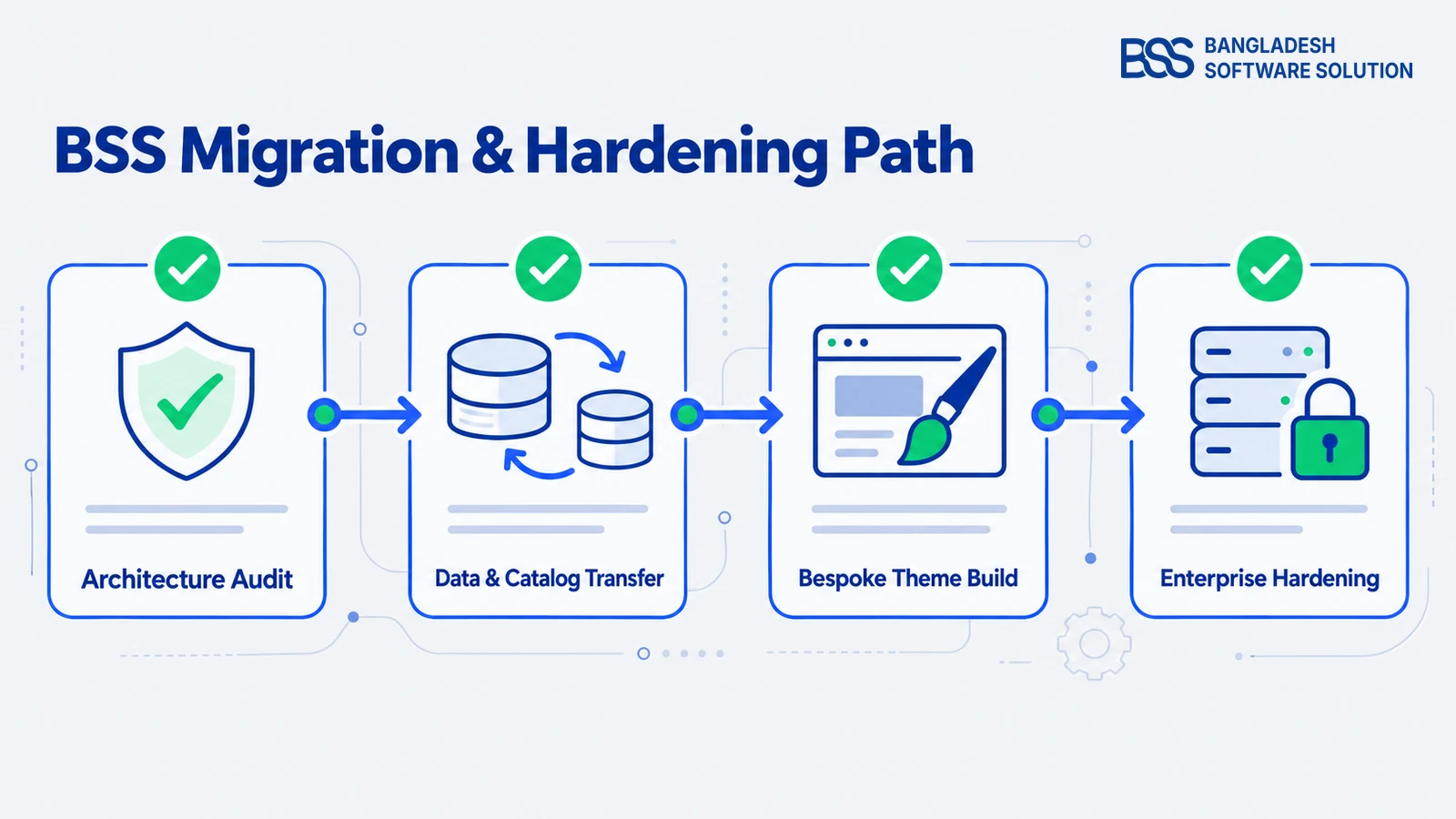
Choosing an inherently secure technology stack is the first step toward safeguarding an e-commerce business. However, translating platform security into flawless customer experiences requires experienced engineering. That is where Bangladesh Software Solution helps ambitious merchants succeed.
As dedicated nopCommerce specialists, our engineering team designs, develops, and deploys high-availability storefronts engineered to withstand sophisticated threats. We build custom responsive themes, architect bespoke integration plugins, and execute zero-downtime migrations from vulnerable legacy platforms.
The BSS Enterprise Hardening Checklist
-
Architecture & Security Audit — Comprehensive evaluation of hosting infrastructure, SSL termination, and data storage policies.
-
Seamless Data & Catalog Transfer — Full migration of product catalogs, customer accounts, and order histories from WooCommerce or Magento without SEO link breakage.
-
Bespoke Theme & Plugin Engineering — Tailored UI design utilizing verified themes and custom plugins adhering to strict .NET coding standards.
-
Enterprise Cloud Hardening — Containerized Docker deployments on AWS or Azure with automated backups, monitoring, and failover redundancy.
During data migration, our specialists map product catalogs, order records, and customer accounts using automated ETL pipelines. To retain organic rankings throughout the platform transition, our team deploys the BSS Advanced SEO Schema plugin, ensuring rich search snippets and structured product metadata remain fully intact.
We configure production hosting environments with hardened Linux containers, automated SSL certificate rotation, and continuous health probes to guarantee maximum uptime during high-volume peak sales periods.
Whether you need a brand-new storefront launch, custom ERP integrations, or ongoing security updates, our engineering team ensures your business remains stable, performant, and protected against evolving online vulnerabilities.
Ready for a Secure, High-Performance Store?
Switch from fragile runtime stacks to an enterprise-grade nopCommerce foundation. Our dedicated team of .NET engineers crafts bespoke themes, custom plugins, and seamless store migrations with ironclad security.
Frequently Asked Questions
Final Thoughts
The October 21 PHP vulnerabilities serve as a stark reminder that software security is fundamentally an architectural choice. When your e-commerce platform relies on an interpreted runtime prone to low-level memory flaws, your business remains permanently tied to urgent patch cycles and potential data breach risks.
By building on nopCommerce and Microsoft .NET, forward-thinking retailers gain an enterprise-grade foundation that combines robust security, exceptional throughput, and complete data ownership. You focus on growing sales and delighting shoppers, while your platform's managed memory architecture keeps malicious actors outside the gate.
Whether you need a new nopCommerce build, custom theme design, or an enterprise migration from a vulnerable PHP platform, our engineering team is here to help.
Book a free consultation