Ask five different "best ecommerce platform" listicles which one to pick, and you'll get five different answers — usually whichever one pays the highest affiliate commission. That noise makes an already hard decision harder, especially since Shopify, WooCommerce, and BigCommerce all genuinely fit different situations rather than one being objectively "best."
In our work migrating stores between platforms and building custom integrations for merchants who outgrow all three, we've watched the same decision play out dozens of times: a business owner picks based on the sticker price alone, then finds the real cost six months later in app fees, a surprise plan upgrade, or a rebuild they didn't plan for.
This guide breaks the decision down the way we'd actually walk a client through it — cost and total ownership, flexibility and customization, how each platform handles growth, and how they compare for SEO — so you can match the platform to your business instead of the other way around. We'll also flag where a fourth option, a custom-built store, becomes the better call.
How Shopify, WooCommerce, and BigCommerce Actually Differ
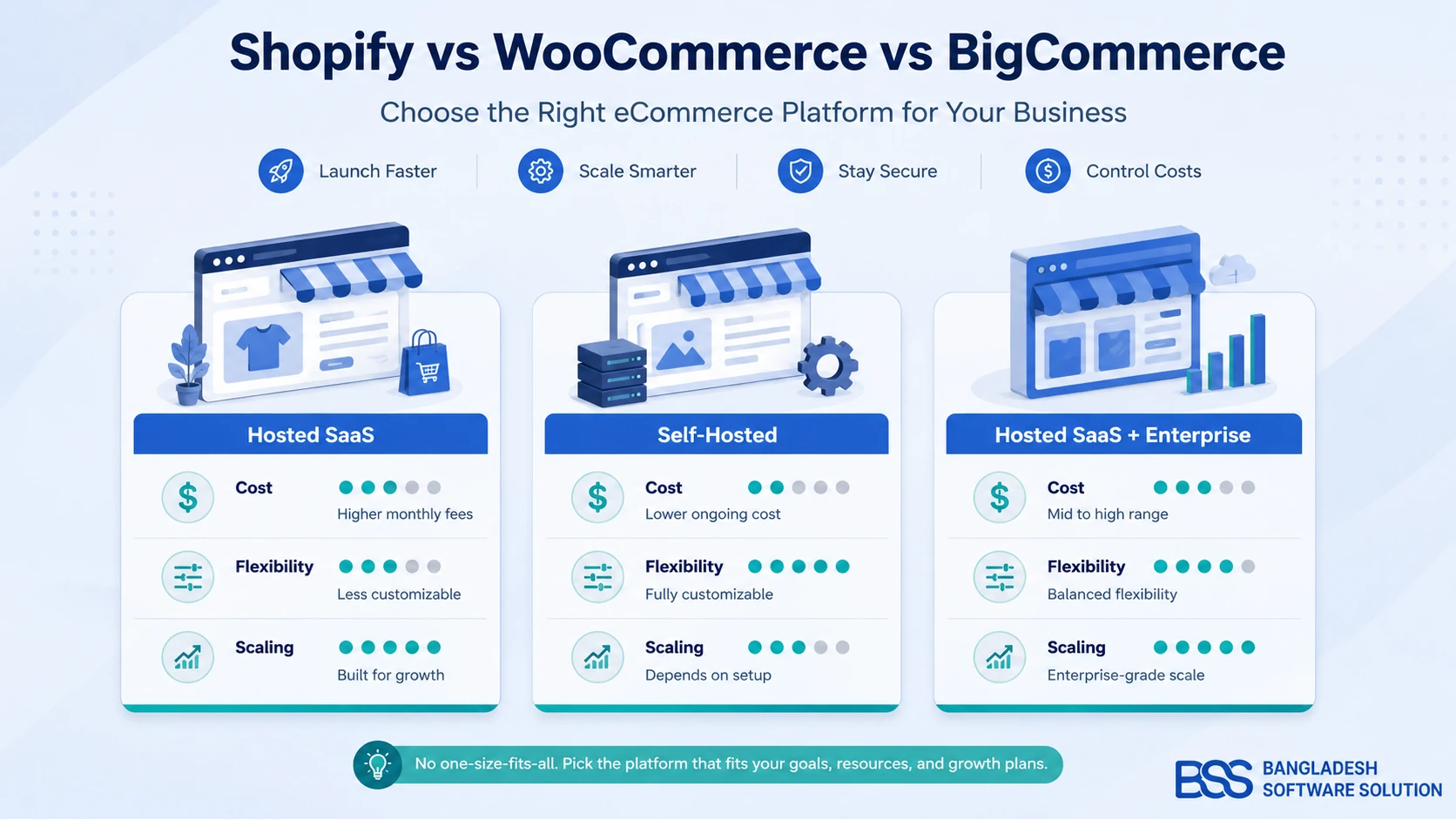
The three platforms solve the same problem — running an online store — with fundamentally different trade-offs. Shopify and BigCommerce are hosted SaaS platforms: the company runs the servers, patches security issues, and charges a monthly fee for the privilege. WooCommerce is the opposite — a free, open-source plugin that turns a self-hosted WordPress site into a store, which means you (or your host) own every part of the stack.
Key Fact: Shopify and BigCommerce are fully-hosted SaaS platforms billed as a monthly subscription; WooCommerce is a free, self-hosted WordPress plugin where you supply and manage your own hosting.
That single difference — hosted vs. self-hosted — drives almost every other trade-off in this comparison: cost predictability, how much you can customize, and how much technical maintenance falls on you.
| Platform | Hosting & starting cost | Payment processing | Best for |
|---|---|---|---|
| Shopify | Hosted SaaS. Basic plan starts at $39/month (roughly $29/month billed annually), per Shopify's own pricing page. | 2.9% + 30¢ on Basic with Shopify Payments, dropping to 2.5% + 30¢ on Advanced — add up to 2% extra if you use a third-party gateway instead. | Fastest path to launch, largest app ecosystem |
| WooCommerce | Self-hosted, free plugin. Hosting alone typically runs $10–$250/month depending on host quality; themes and plugins add more on top. | Depends entirely on your chosen payment gateway — no platform-level transaction fee. | Full control for store owners already on WordPress |
| BigCommerce | Hosted SaaS. Core plan starts at $39/month, with an automatic upgrade once you cross a revenue threshold (e.g., $30K/year on Core, under its 2026 pricing update). | A new 2026 "Open Payment Provider Fee" of 2.0% on Core (1.0% Growth, 0.6% Scale) applies unless you use an embedded payment provider. | Merchants wanting SaaS convenience with more built-in enterprise/B2B features than Shopify's base tiers |
Cost and Total Cost of Ownership
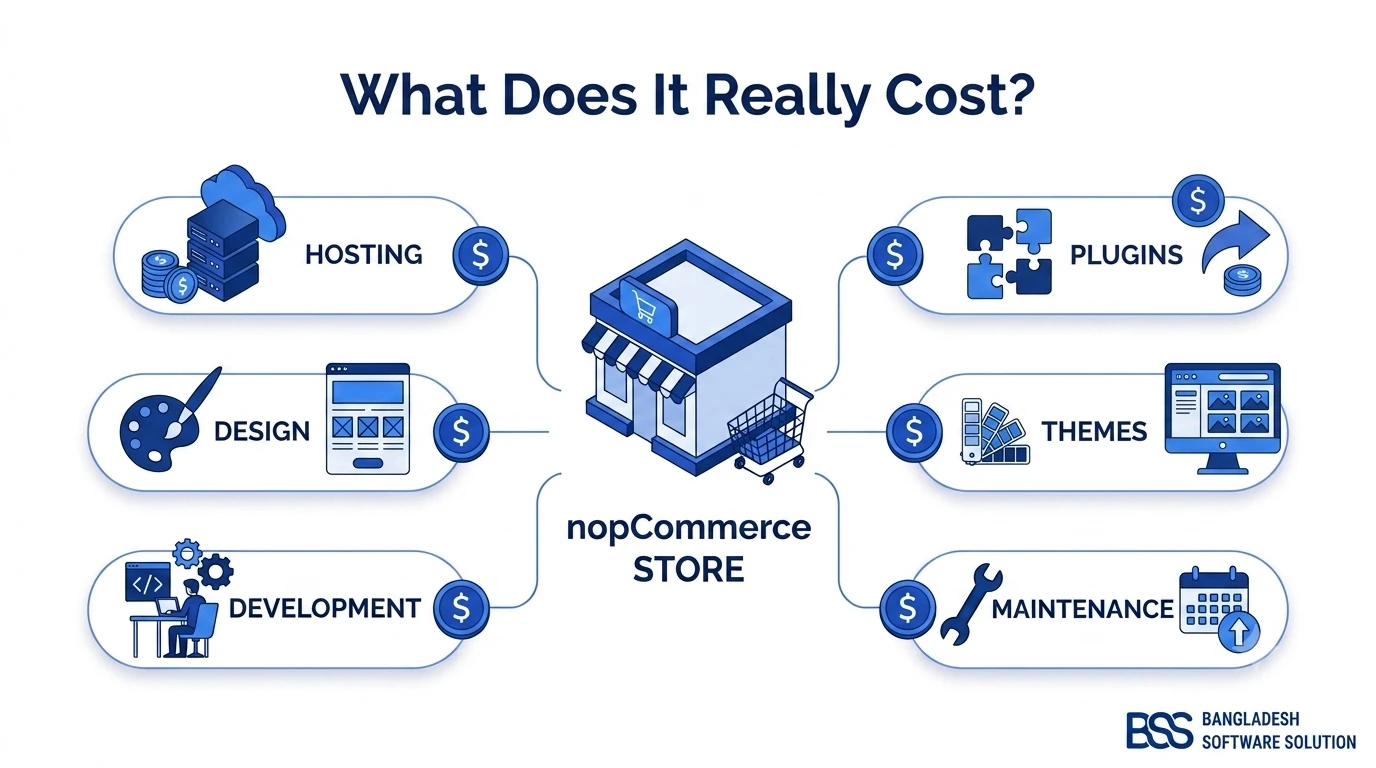
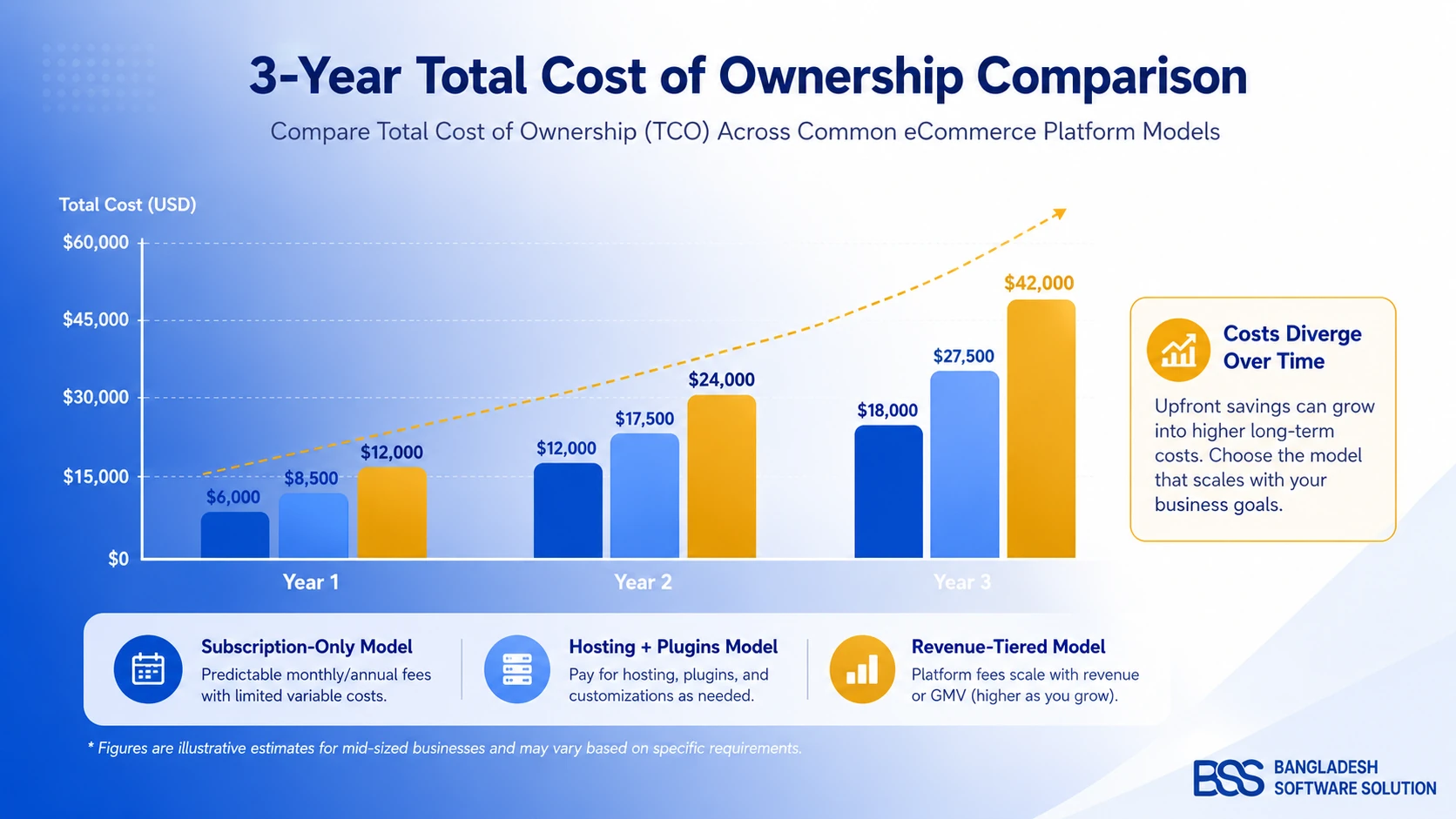
Sticker price is the least useful number in this decision. What actually matters is total cost of ownership — the subscription plus apps, plugins, hosting, and the fees that only show up once you're already committed.
Pro Tip: Read the Fine Print on Revenue Caps
BigCommerce's 2026 update lowered several of its revenue thresholds even while renaming the plans — the old Standard tier's $50K cap becomes Core's $30K cap. A fast-growing store can get bumped to a pricier tier sooner than expected. Check where your current or projected annual sales sit against a plan's cap before you commit, not after the first upgrade notice arrives.
Flexibility and Customization
How much you can change about your store — and who's responsible for keeping it running — depends entirely on the hosted-vs-self-hosted split from earlier.
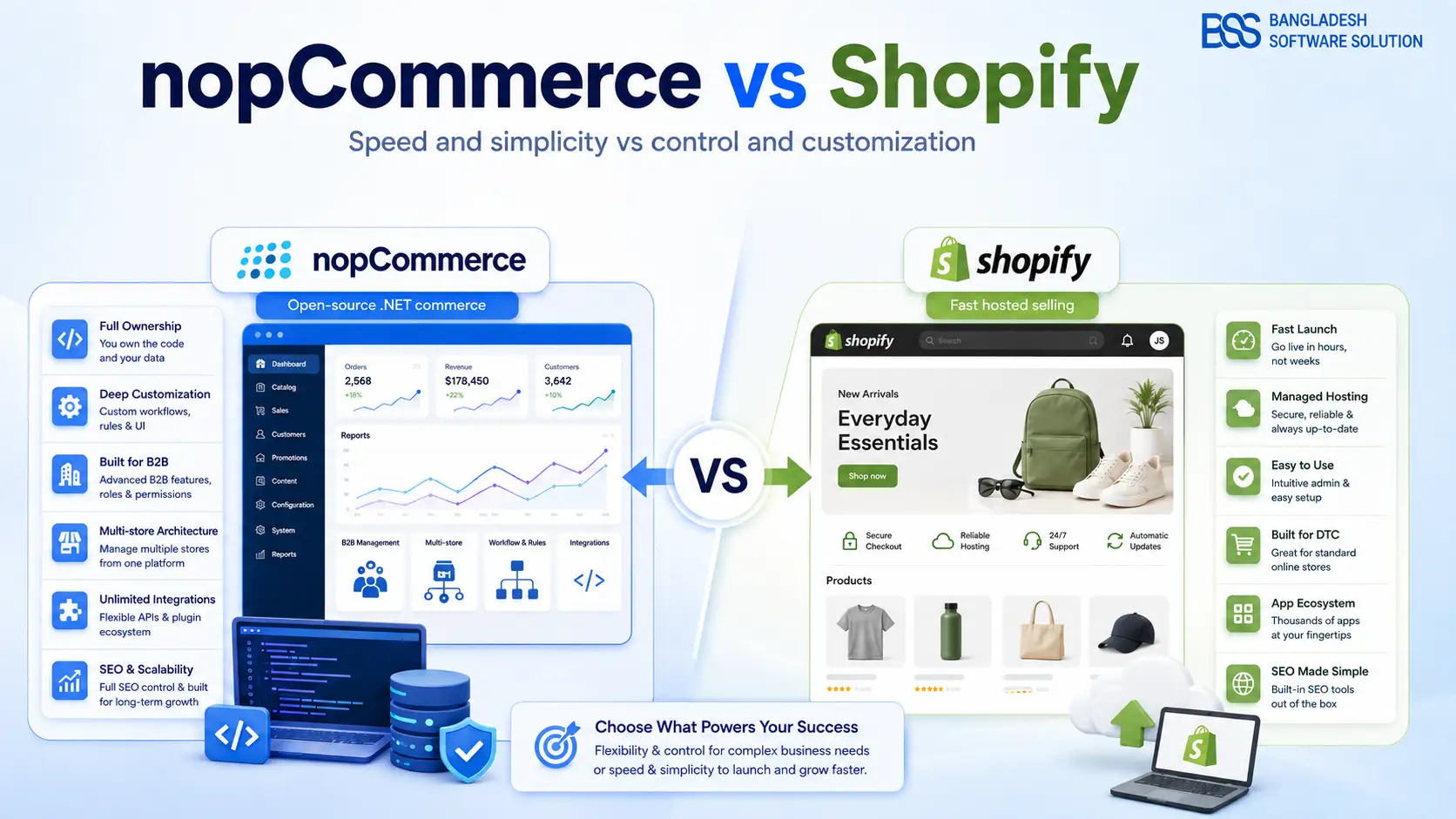
If WooCommerce's self-hosted flexibility appeals to you but you'd rather build on a dedicated, enterprise-grade ecommerce codebase than a general-purpose CMS plugin, that's a different trade-off worth understanding on its own — we've written dedicated comparisons of nopCommerce vs Shopify and nopCommerce vs WooCommerce that go deeper on that specific angle.
Scaling, Performance, and Growth
Every platform here can handle a growing store — the question is what growth actually costs you and who carries the operational risk.
Shopify's enterprise tier, Shopify Plus, is aimed at large-catalog and high-volume merchants; pricing is typically negotiated based on your specific volume rather than a fixed published rate. WooCommerce's scaling story is entirely about your hosting choice — a large catalog runs fine on the right managed WooCommerce host, but a cheap shared host will buckle under real Black-Friday-level traffic, and that risk sits with you, not WordPress. BigCommerce builds in more multi-currency and B2B catalog features at lower tiers than Shopify's equivalents, but its revenue-based auto-upgrade means your costs scale automatically alongside your success, whether or not you planned for it.
Before You Commit or Migrate — Scaling Checklist
-
✓Confirm which plan tier you'll actually need once you cross your first 12 months of realistic sales, not just where you start.
-
✓Ask each platform (or your host, for WooCommerce) what happens to your specific checkout and app stack during a major traffic spike.
-
✓Check whether your planned integrations — ERP, POS, marketplace sync — are natively supported or require a paid app or plugin.
-
✓If you're already running significant multi-currency or B2B order volume, confirm exactly which tier unlocks that — it's rarely the entry tier on any platform.
-
✓Get the current transaction-fee schedule in writing from each vendor before you sign — BigCommerce's 2026 fee changes are a reminder that these terms move.
SEO and Marketing Capabilities
All three platforms can rank well — SEO success here comes down to URL control, content tooling, and how carefully a migration is handled, not which platform has a secret advantage.
Shopify's URL structure has some fixed conventions (like /products/ and /collections/) that you can't fully rewrite, and its built-in blog is functional but basic. WooCommerce, being WordPress underneath, gives you full control over permalinks and a mature content/blogging ecosystem — but your actual SEO performance still depends on how well the site and its plugins are configured. BigCommerce shares Shopify's hosted-platform URL constraints, but its built-in faceted navigation tends to hold up better for larger catalogs.
The biggest SEO risk in this whole decision isn't which platform you pick — it's switching platforms later without a deliberate redirect and structured-data plan, since each one generates product and collection URLs differently by default.
None of These Quite Fit? A Custom-Built Store Might.
If your catalog, B2B pricing rules, or integrations have outgrown what Shopify, WooCommerce, or BigCommerce can do without a stack of paid apps, a purpose-built .NET ecommerce platform like nopCommerce gives you the same full source-code control as WooCommerce with none of the general-purpose-CMS plugin fragility. We build and customize nopCommerce stores for merchants in exactly that spot — see what that typically costs compared to what you're paying now.
Frequently Asked Questions
Final Thoughts
There's no universal winner here — only the platform that matches your specific mix of budget, technical appetite, and growth trajectory. Shopify is the fastest path to a polished, supported store if you're comfortable working inside its app ecosystem. WooCommerce rewards store owners who want full control and already have (or are willing to hire) some technical capability. BigCommerce sits between the two, trading some of Shopify's simplicity for more built-in enterprise features — at the cost of its revenue-triggered upgrades.
If you get partway through this decision and realize what you actually need is full ownership without WordPress's plugin fragility, that's exactly the gap a custom nopCommerce build fills — take a look at our nopCommerce vs Shopify and nopCommerce vs WooCommerce comparisons for the deeper dive, or reach out and we'll walk through your specific catalog and growth plan.