Engineering leaders and growing merchants frequently choose Microsoft .NET when reliability and throughput matter most. Building on ASP.NET Core guarantees compile-time type safety, robust memory management, and native integration with corporate ERP backbones. Yet selecting the right .NET platform is challenging because architectures range from turnkey open-source applications to composable headless suites.
Selecting the wrong framework creates painful technical debt, inflated cloud hosting invoices, and slow feature delivery. Some systems require building your frontend from scratch, while others lock your business into costly recurring software licenses. Understanding how each platform handles catalog queries, checkout concurrency, and theme customization before committing your engineering budget is essential.
This comprehensive 2026 guide breaks down the leading .NET eCommerce platforms across real engineering benchmarks, operational costs, and developer ergonomics. We evaluate why nopCommerce holds the top position in the open-source C# landscape, examine specialized alternatives including Virto Commerce, GrandNode, and Umbraco Commerce, and help you pick the right architecture for your growth roadmap.
The .NET eCommerce Advantage: Why Enterprise Retail Runs on C#
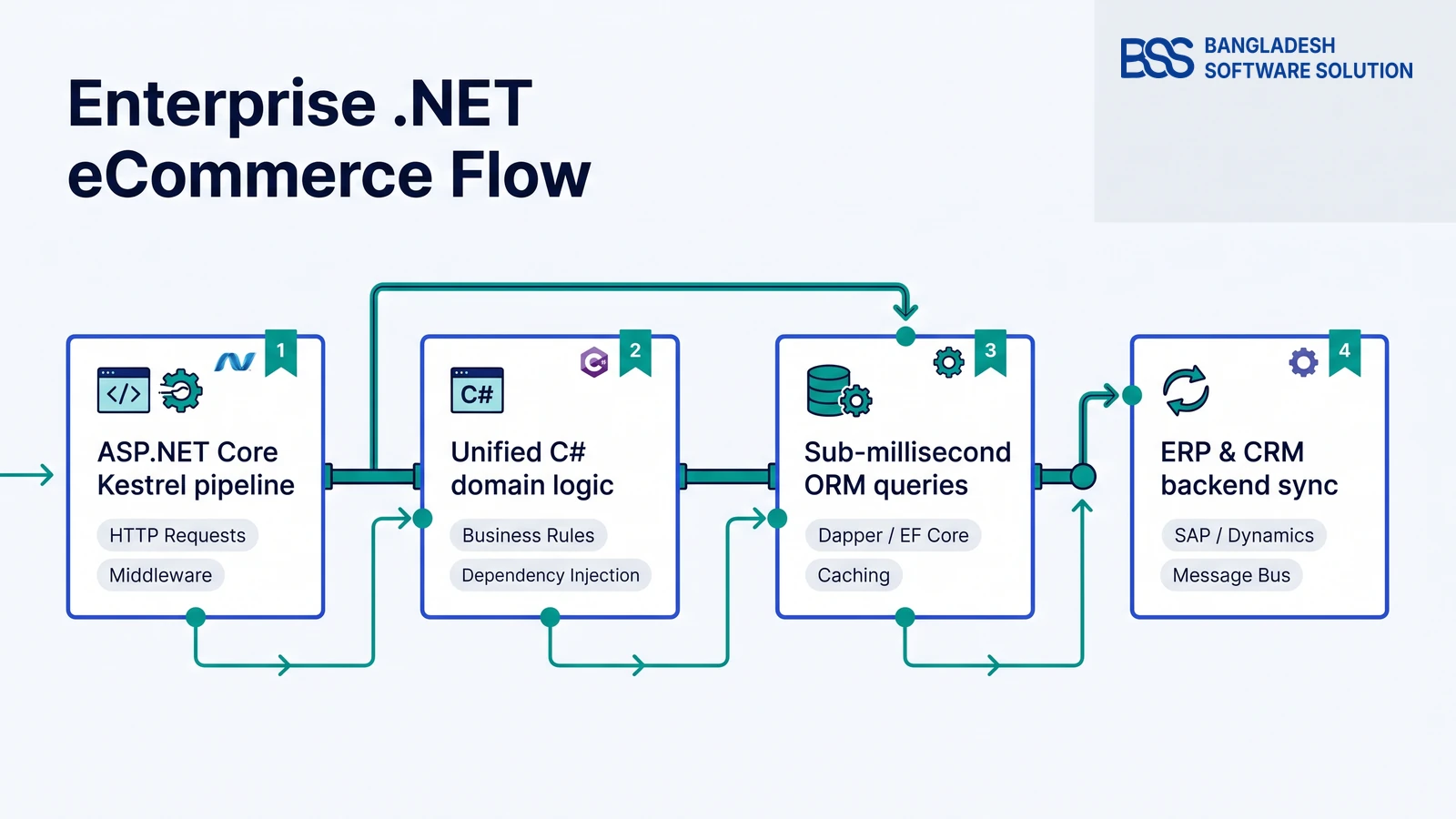
Modern eCommerce backends endure heavy request loads during high-velocity flash sales and marketing pushes. Historically, retail stores relied heavily on interpreted runtime scripting languages, often fighting unpredictable memory consumption, dynamic typing bugs, and sluggish database connection pooling. Transitioning to modern ASP.NET Core fundamentally shifts this performance equation for high-volume merchants.
Core engineering reality: ASP.NET Core's Kestrel web server consistently ranks among the fastest web engines in global TechEmpower benchmarks, serving tens of thousands of requests per second per core with minimal memory overhead.
For mid-market and enterprise retailers, this compute efficiency directly translates to smaller server footprints, reduced cloud infrastructure expenses, and resilient checkouts that stay responsive during peak traffic spikes.
The business case for developing an eCommerce store on .NET rests on three primary architectural pillars that distinguish Microsoft's developer ecosystem from traditional alternatives:
Furthermore, .NET delivers unified cross-platform deployments. Whether your DevOps team prefers hosting on lightweight Linux Docker containers, managed Kubernetes clusters, or traditional Windows Server virtual machines, the underlying ASP.NET Core runtime operates identically with zero vendor lock-in.
Planning a .NET eCommerce rollout? Our certified team helps you evaluate architecture, migrate existing stores, and build custom nopCommerce solutions.
Talk to a nopCommerce expert1. nopCommerce: The Undisputed Open-Source Leader
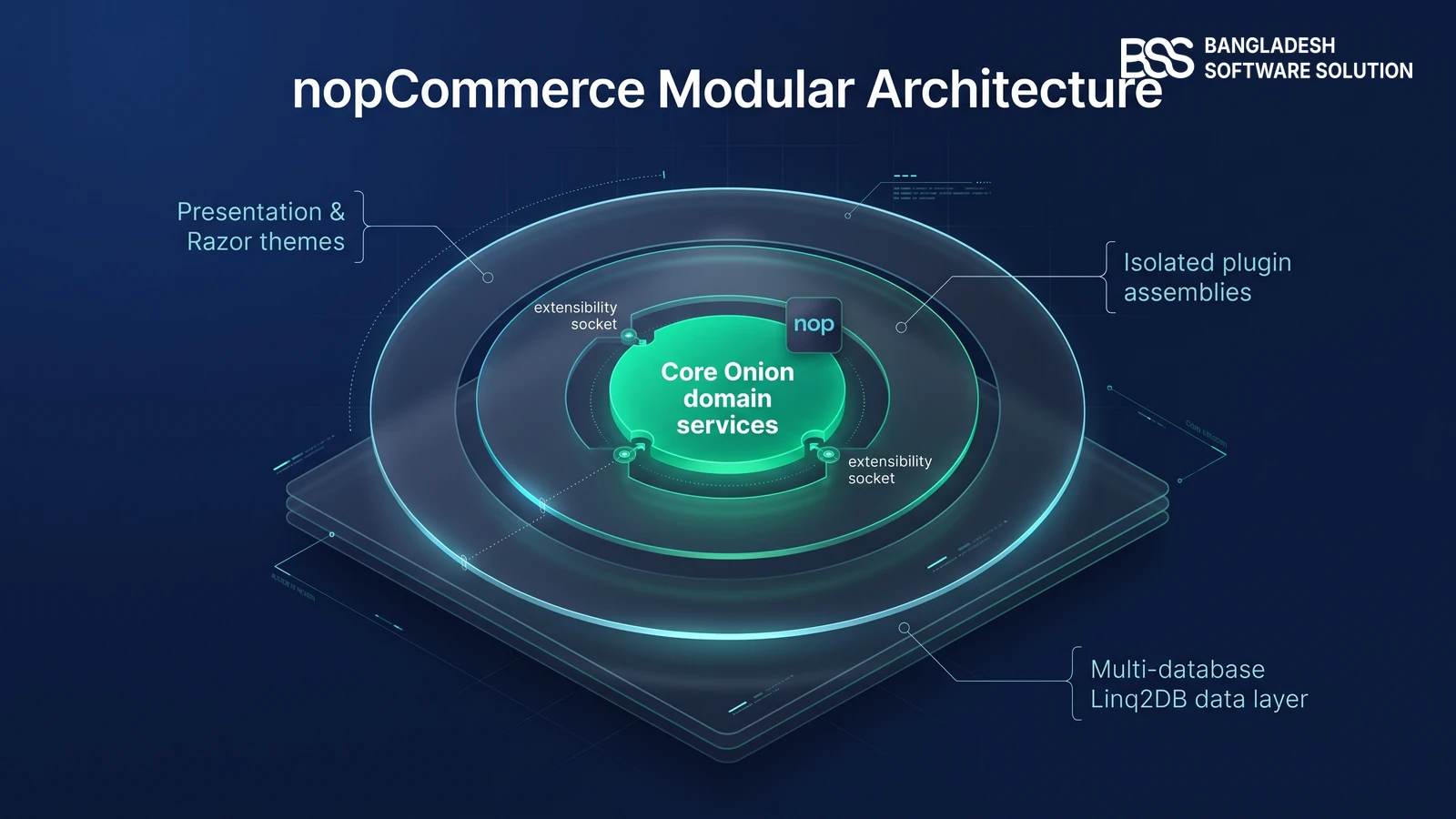
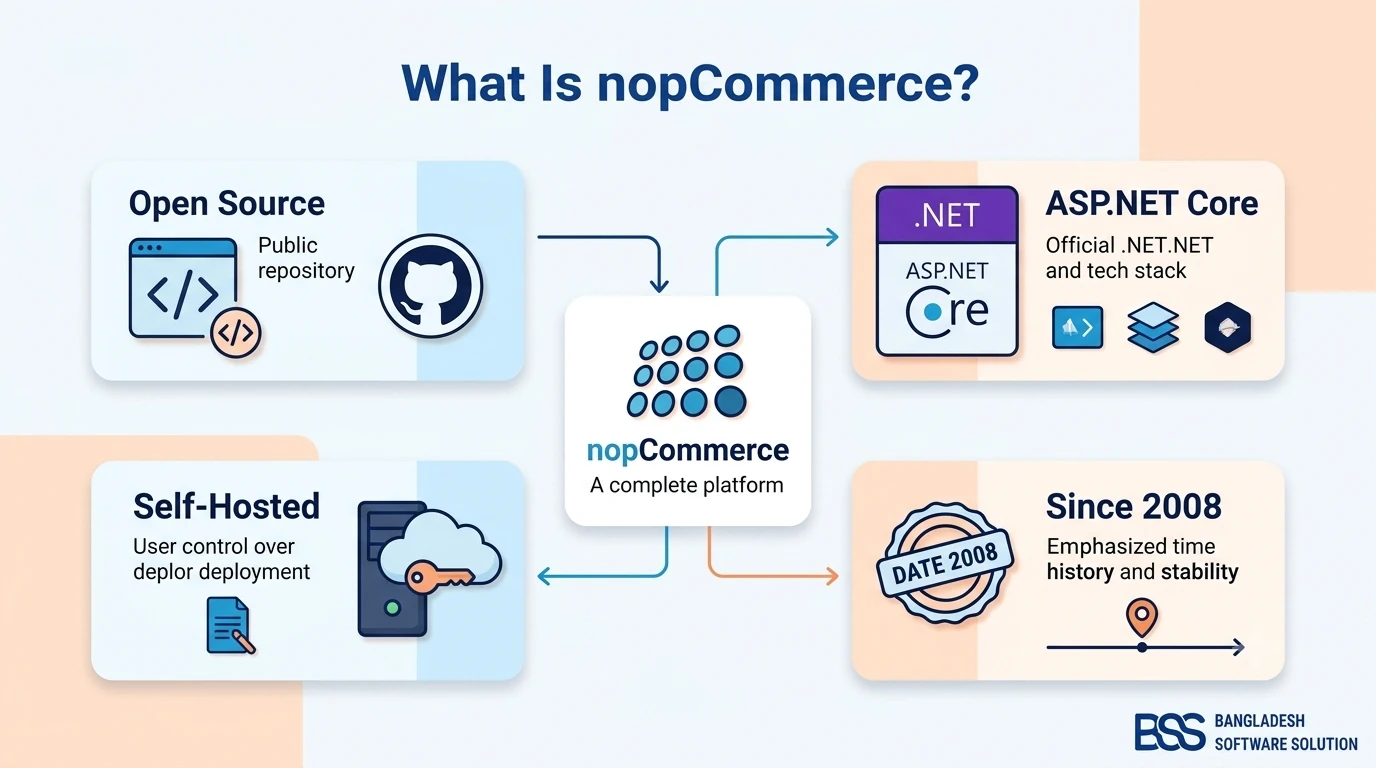
When engineering teams evaluate production-ready, open-source .NET eCommerce solutions, what is nopCommerce quickly becomes the baseline against which all others are measured. With over 60,000 active live stores worldwide, more than 15 years of continuous active engineering, and official support for modern ASP.NET Core, nopCommerce represents the undisputed flagship of open-source Microsoft commerce.
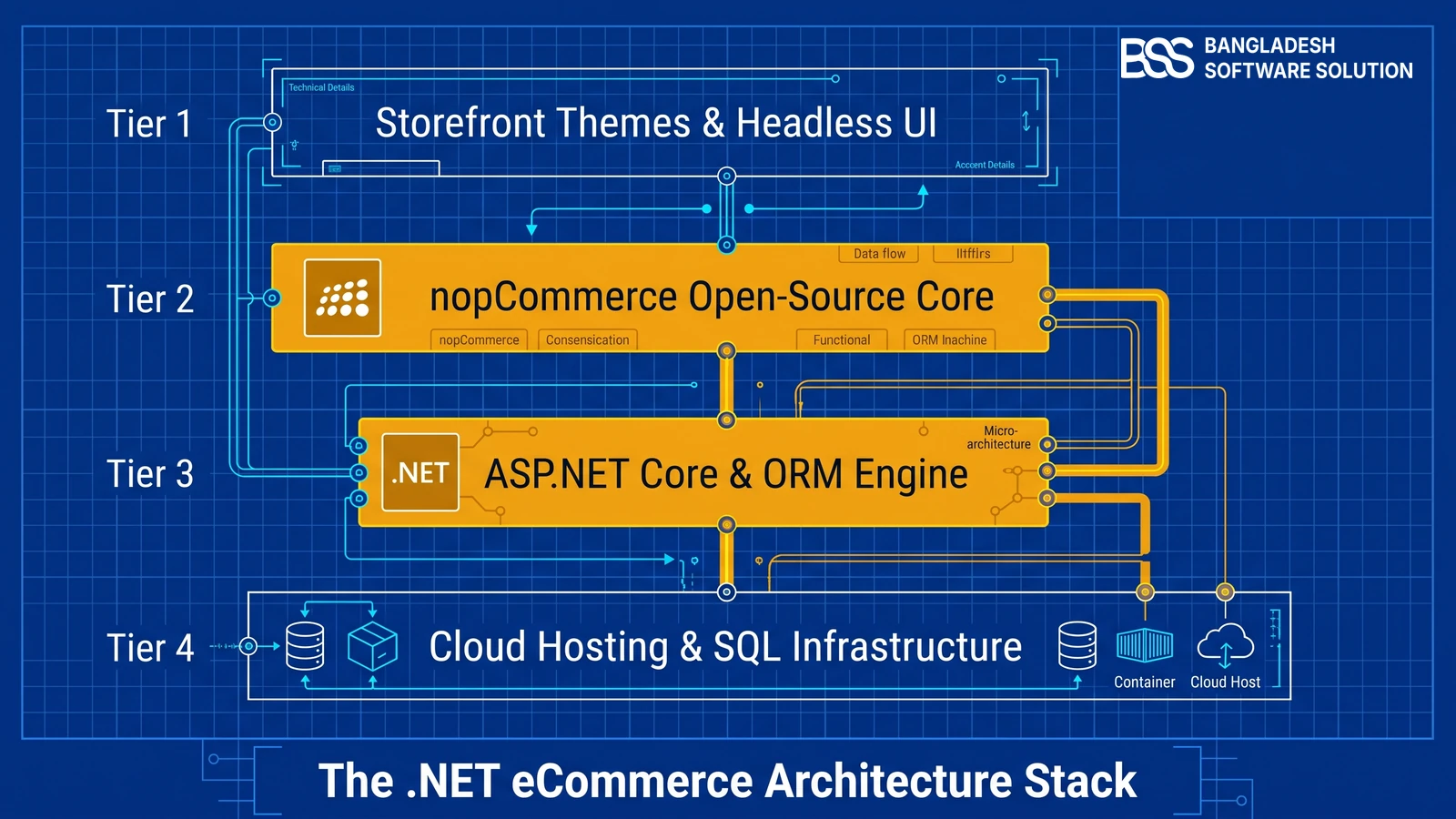
Under the hood, nopCommerce employs a disciplined Onion Architecture that shields core domain entities from external framework dependencies. Database operations run through a fast Linq2DB data-access tier supporting Microsoft SQL Server, MySQL, and PostgreSQL.
Presentation logic renders cleanly via standard ASP.NET Core Razor views. Frontend designers can customize storefront layouts and styling rapidly without needing to master specialized proprietary templating languages.
Extensibility is where nopCommerce truly outpaces competitive platforms. Rather than requiring developers to hack core source code, nopCommerce features an isolated plugin system. Developers build custom payment gateways, shipping integrations, ERP connectors, and widget hooks into standalone assemblies that install without touching base files.
BSS Engineering: Official nopCommerce Silver Partner
Deploying an enterprise-grade nopCommerce storefront requires seasoned engineering experience. As an official nopCommerce Silver Partner, our engineering team at Bangladesh Software Solution designs, deploys, and maintains mission-critical stores for clients globally. Our developers hold official nopCommerce certifications and contribute active plugins and themes to the worldwide ecosystem.
Building a bespoke storefront completely from scratch requires months of UI effort. To accelerate your launch while maintaining exceptional Core Web Vitals, BSS offers an extensive portfolio of production-ready theme bundles on our storefront themes collection. Each theme is tailored to specific industry verticals and packaged with 15 to 19 conversion plugins:
- NopVogue Theme — High-fashion, luxury, and apparel storefront with 17 conversion plugins.
- NopGadget Theme — High-tech electronics and consumer gadget layout with 18 plugins.
- NopFurniture Theme — Furniture, home decor, and interior design storefront with 19 plugins.
- NopPharma Theme — Pharmaceutical, medical supply, and health store bundle with 16 plugins.
- NopEthnic Theme — Cultural apparel, boutique gifts, and artisan craft storefront with 17 plugins.
- NopNoor & NopBeauty — Specialized beauty, cosmetics, and lifestyle storefronts engineered for high conversion rates.

An editorial, conversion-focused nopCommerce storefront bundled with 17 essential plugins including QuickView, Anywhere Sliders, and Mega Menus.
View the theme
When our team tunes high-concurrency nopCommerce stores, coupling distributed Redis caching with precompiled Linq2DB queries routinely cuts database connection contention by over 70%. If your store experiences latency spikes during promotions, explore our nopCommerce caching guide to audit your data caching layer.
2. Virto Commerce: Composable Headless for Complex B2B
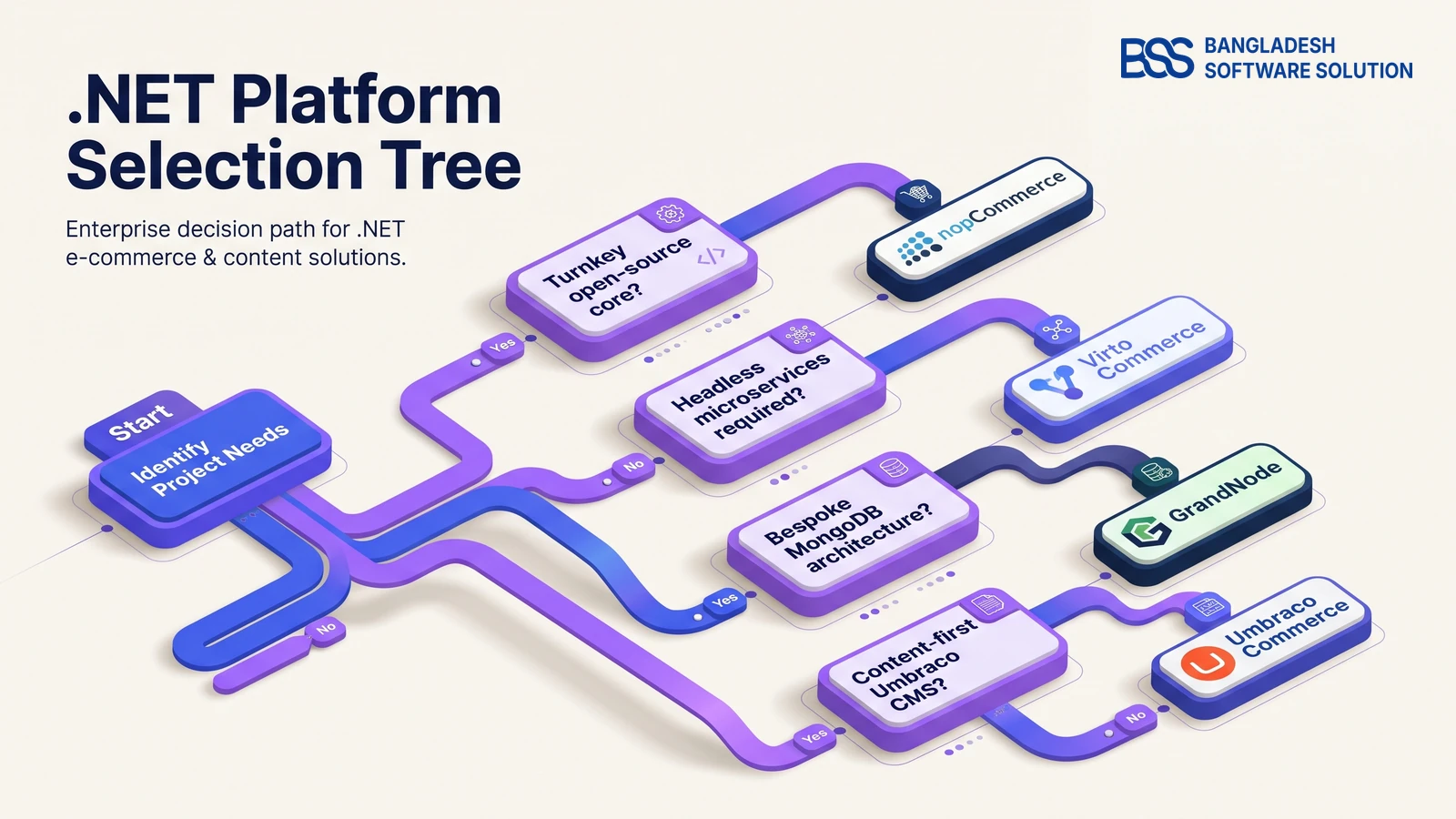
While nopCommerce excels as a comprehensive turnkey application, Virto Commerce approaches digital retail from an API-first, composable microservices philosophy. Written in ASP.NET Core, Virto Commerce targets large enterprises requiring intricate B2B contracting, multi-tiered organization hierarchies, complex CPQ (Configure, Price, Quote) engines, and headless customer experiences.
Virto decouples the commerce engine into modular bounded contexts. Rather than bundling frontend templates within the server application, Virto exposes rich GraphQL and RESTful APIs intended to power separate single-page applications built on Vue.js, React, or mobile native frameworks. This architectural model grants enterprise development teams full freedom to build distinct shopping touchpoints across web, IoT kiosks, and mobile applications.
The primary barrier to adopting Virto Commerce is implementation complexity. Because the platform does not ship an out-of-the-box turnkey storefront comparable to nopCommerce's rich theme ecosystem, your development team must design, develop, and maintain the entire consumer frontend. For businesses lacking dedicated full-time engineering teams, this requirement can inflate rollout timelines and total ownership costs dramatically.
When an enterprise deployment demands bespoke microservice connectors or hybrid architecture, many engineering leads hire a .NET developer from BSS to handle backend implementation while keeping internal teams focused on business logic.
3. GrandNode, Umbraco Commerce, and Enterprise Suites
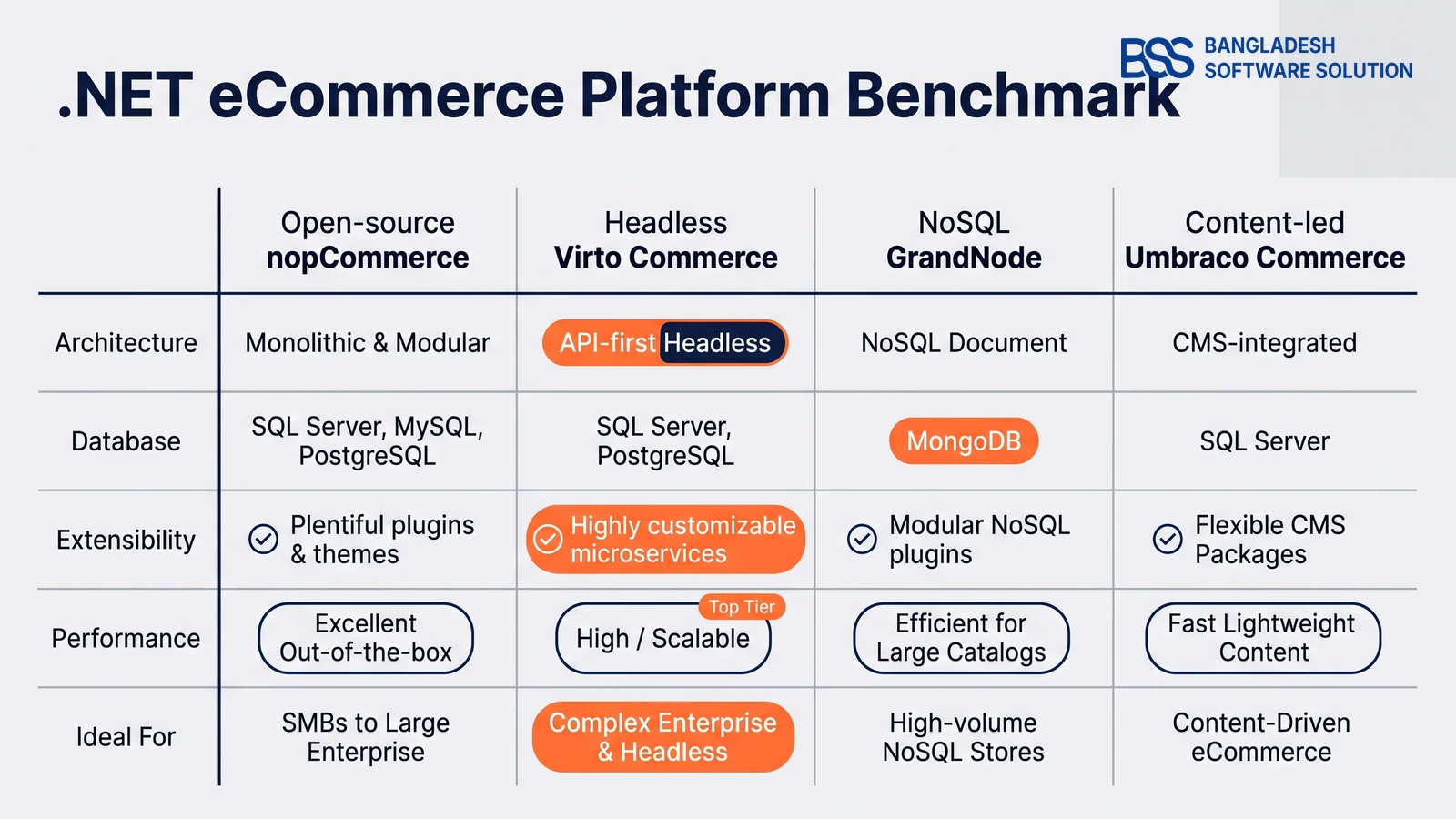
Beyond nopCommerce and Virto Commerce, the .NET ecosystem features specialized platforms designed for distinct architectural philosophies and content-first publishing environments.
GrandNode: The NoSQL Document Alternative
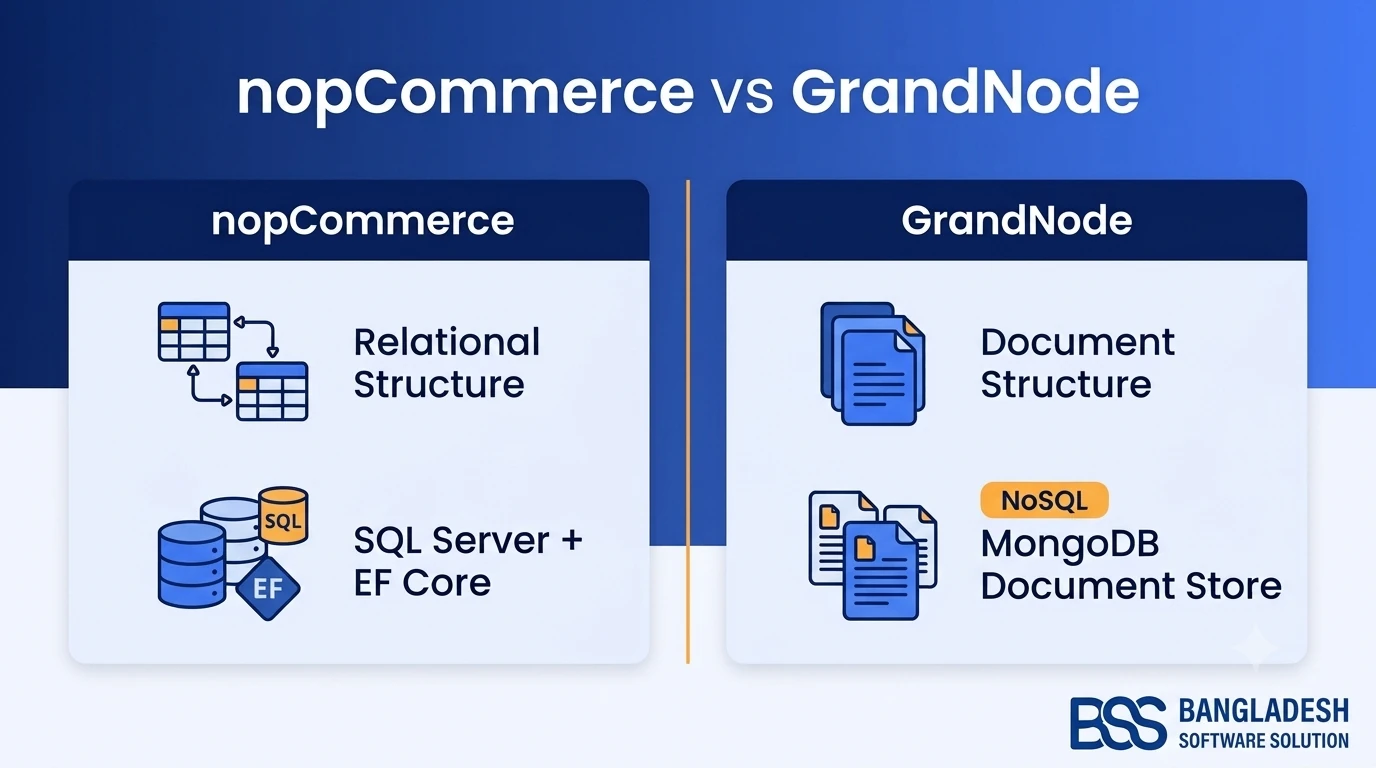
Originally originating as an open-source fork of nopCommerce, GrandNode 2.0 rebuilt its persistence layer around MongoDB rather than relational SQL databases. By utilizing a document database, GrandNode eliminates traditional relational table schemas and foreign key constraints. This model suits catalog structures featuring highly variable, unstructured product attributes that change rapidly without database migrations.
However, running an eCommerce business on MongoDB introduces trade-offs in relational ACID reporting, financial reconciliation, and community plugin availability. As detailed in our deep dive on nopCommerce vs GrandNode, the vast majority of third-party payment gateways, ERP tools, and shipping providers build their premier .NET integrations for nopCommerce's SQL structure first.
Umbraco Commerce: Content-Led Digital Retail
For organizations already operating on Umbraco CMS, Umbraco Commerce (formerly known as Vendr) embeds transactional shopping capabilities directly into the Umbraco content tree. This architecture is ideal for editorial brands, lifestyle publishers, and content-rich organizations where articles and stories drive product discovery.
Because Umbraco Commerce focuses heavily on editorial harmony, it leaves advanced retail operations — like native multi-warehouse routing, complex vendor commissions, and tiered B2B wholesale pricing — to external custom plugins or third-party extensions.
| Platform | License / Pricing | Core Architecture | Primary Database | Storefront Model | Best Suited For |
|---|---|---|---|---|---|
| nopCommerce | 100% Free Open-Source | Modular Onion / ASP.NET Core | SQL Server, MySQL, Postgres | Turnkey Themes + Headless API | Mid-Market & Enterprise |
| Virto Commerce | Open Core + Enterprise SaaS | Composable Microservices | SQL Server / Cloud DBs | Headless API Only | Complex B2B & Headless |
| GrandNode | Open-Source Core | Modular Microservices | MongoDB (Document) | Turnkey + Headless | NoSQL & Unstructured Catalogs |
| Umbraco Commerce | Commercial Add-on License | CMS-Embedded eCommerce | SQL Server | Umbraco CMS Templates | Content-First Publications |
| Sitecore OrderCloud | Enterprise SaaS Subscription | Cloud Headless B2B/B2C | Managed Cloud Datastores | API-First / Composable | Global Conglomerates |
During complex eCommerce platform migrations, we regularly see engineering teams struggle with database deadlocks caused by unindexed search tables. Proper clustered indexing and asynchronous order queues keep checkout pipelines sub-100ms; explore our nopCommerce architecture guide for transaction pipeline patterns.
How to Choose the Right .NET Platform for Your Architecture
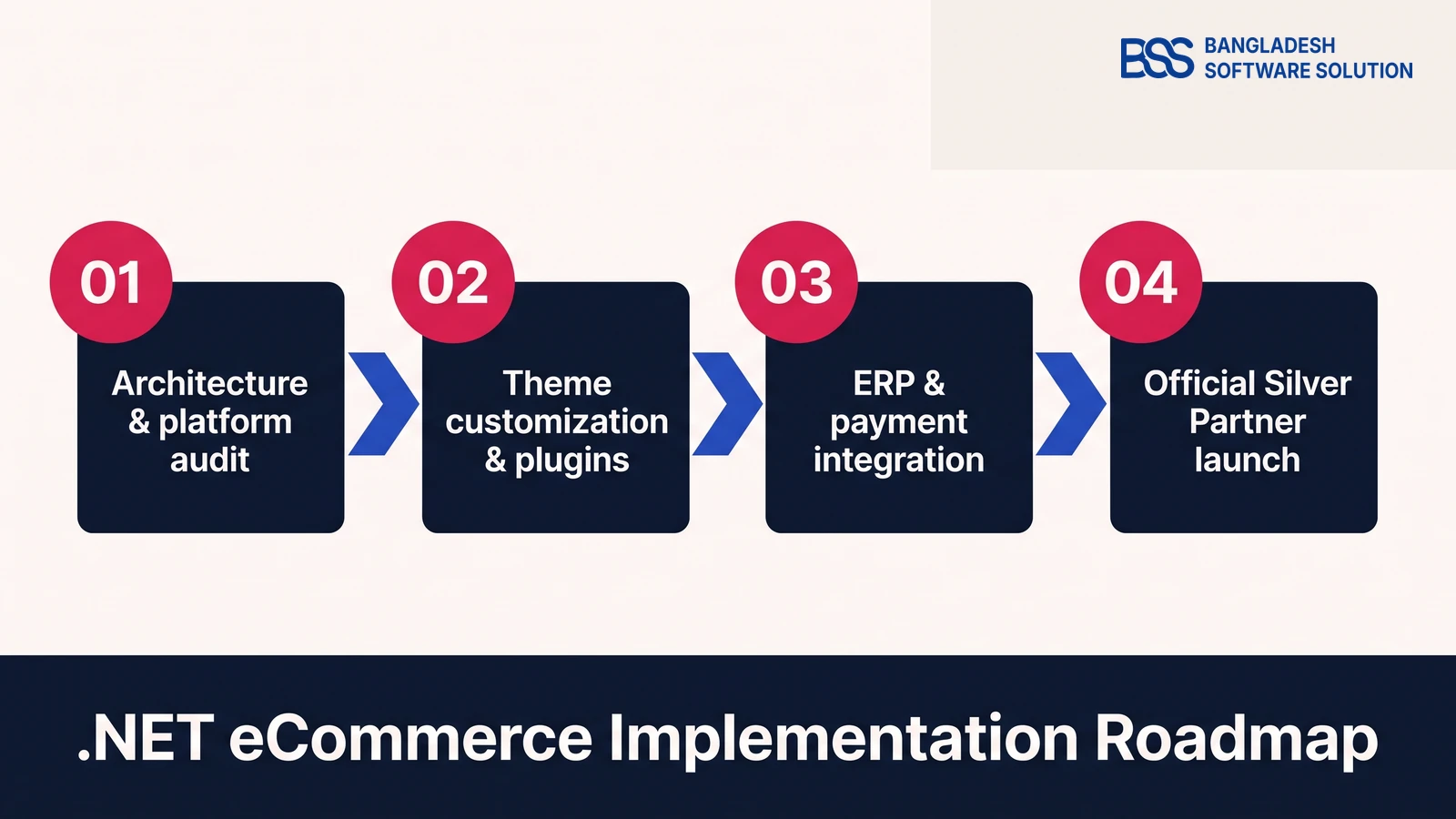
Selecting the optimal .NET eCommerce engine requires balancing technical ambitions with commercial realities. Before locking your organization into a multi-year software commitment, evaluate your operational model against four critical architectural questions:
Platform Evaluation Criteria
-
Turnkey vs. Headless: Do you need a complete storefront operating on day one with battle-tested themes, or does your business require a bespoke headless front end built in React or Flutter?
-
Data Architecture: Does your finance and accounting workflow require strict relational database consistency (SQL Server/PostgreSQL), or does your catalog favor flexible NoSQL documents (MongoDB)?
-
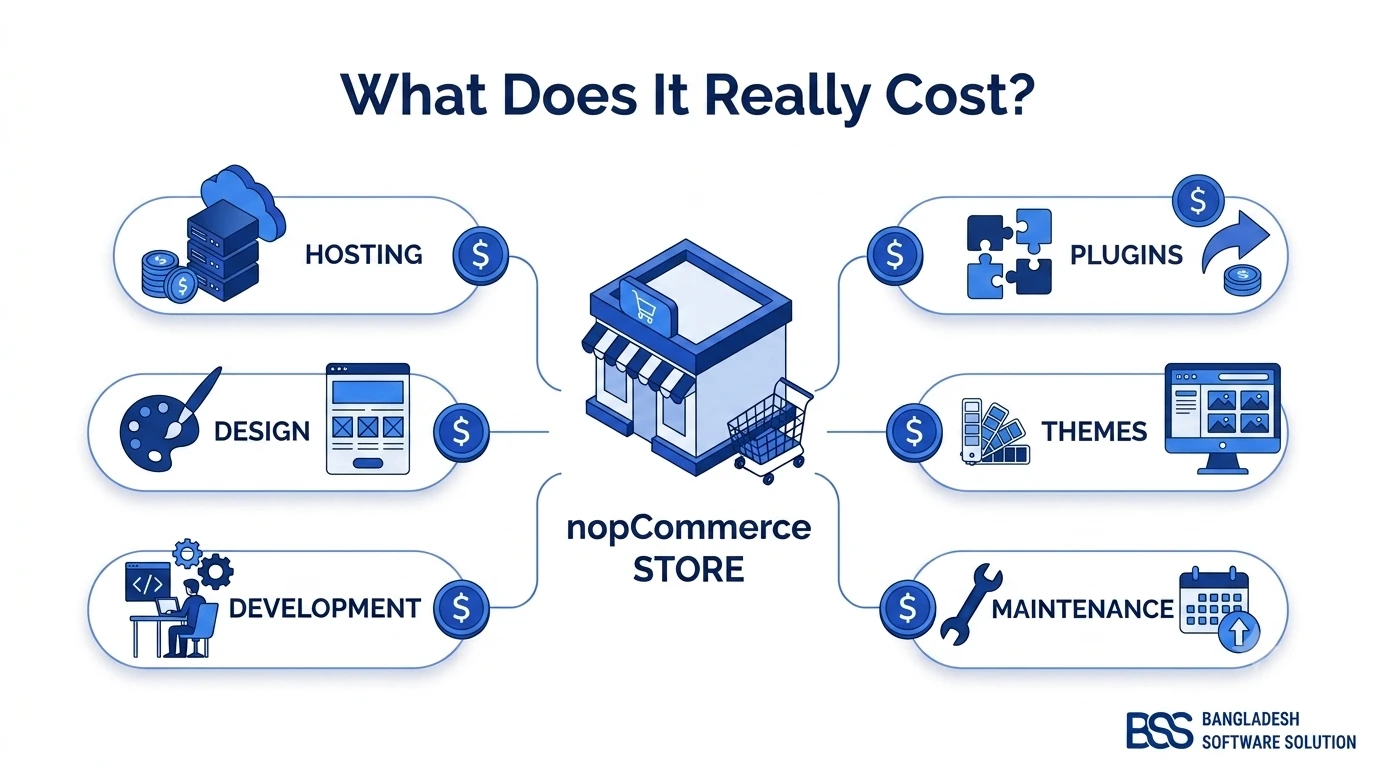
Total Cost of Ownership: Factor in ongoing software licenses, developer hourly rates, third-party plugin purchases, and recurring infrastructure costs rather than evaluating software sticker prices alone.
-
Partner & Community Ecosystem: Can you readily hire skilled engineers and partner with certified solution agencies who can support and maintain the system over a five-to-ten year horizon?
For the overwhelming majority of growing retailers and enterprise manufacturers, nopCommerce delivers the ideal balance: a proven open-source core with zero ongoing licensing fees, full source code ownership, and the ability to customize every pixel through pre-built themes and isolated plugins.
If you are evaluating project costs before migrating off an aging monolith, review our guide on what a nopCommerce store costs to build to budget each implementation phase accurately.
Ready to Build on nopCommerce? Partner With BSS
From custom plugin engineering and turnkey theme deployment to high-concurrency database tuning and ERP integration, our certified .NET developers deliver enterprise results. Let's discuss your project requirements.
Frequently Asked Questions
Final Verdict: Selecting Your .NET Commerce Engine
Choosing a .NET eCommerce platform gives your organization uncompromising speed, enterprise security, and seamless Microsoft integration. While composable frameworks like Virto Commerce and document engines like GrandNode serve specialized architectures, nopCommerce remains the clear choice for retailers who demand full code ownership, zero license penalties, and rapid deployment.
By pairing nopCommerce's core with professionally engineered storefront theme bundles and modular plugins, merchants achieve enterprise-tier performance at a fraction of the total cost of proprietary platforms. Partnering with certified .NET specialists ensures an architecture built for long-term scalability and zero technical debt.
Our certified nopCommerce engineers design custom themes, build high-speed plugins, and manage end-to-end store migrations.
Book a free consultation