Three proposals for the same nopCommerce project are open on your desk. The highest is roughly four times the lowest. All three describe an "experienced nopCommerce team," all three quote a timeline you could live with, and not one of them tells you which company will still be answering your emails eighteen months after launch.
That gap — between what a proposal claims and what a company can prove — is the whole problem with choosing a nopCommerce development company. nopCommerce is a self-hosted .NET platform with a genuinely specialist vendor market, so the usual shortcuts fail you: the firm at the top of the search results is often the one with the largest marketing budget rather than the deepest platform experience.
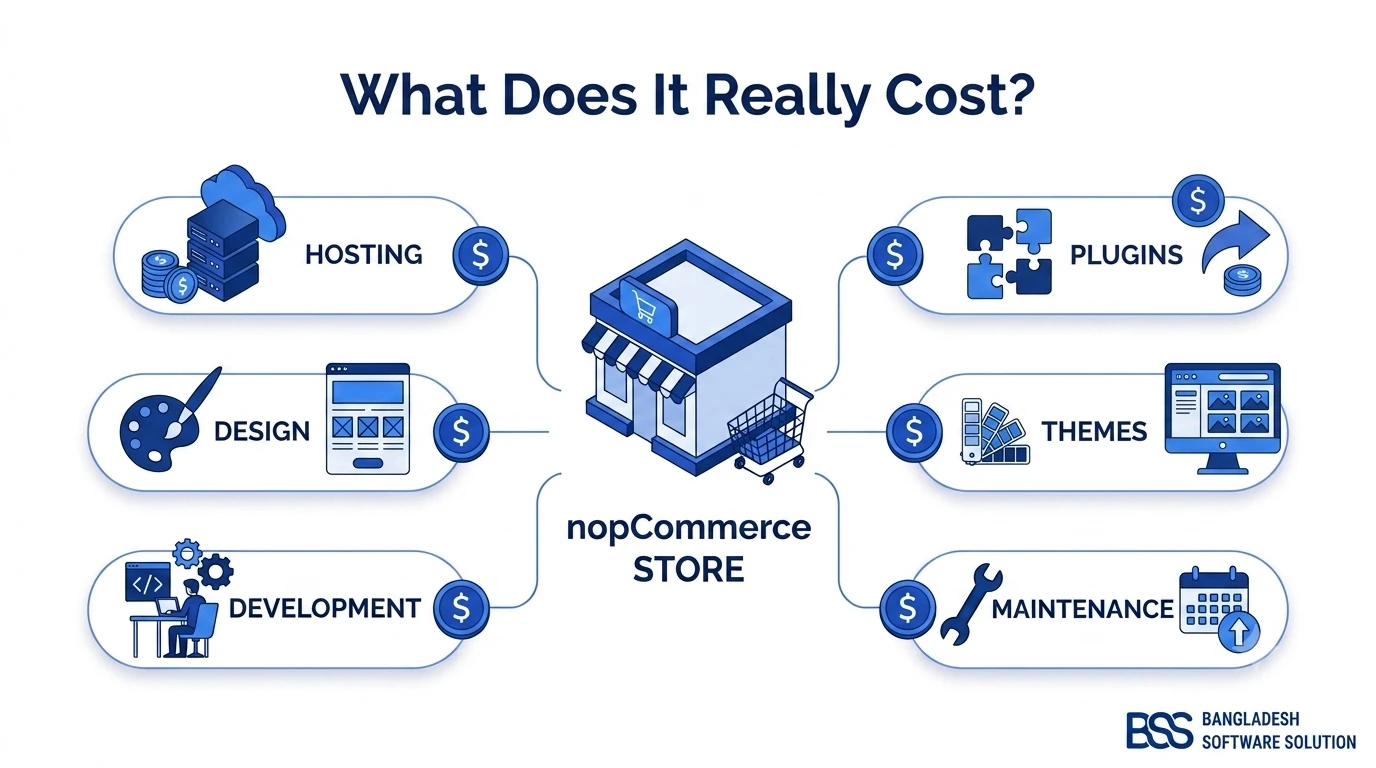
In our own work at BSS, the store rescues that land on our desk almost never failed because somebody wrote bad code. They failed because nobody could answer a much simpler question two years later: who owns this, and who upgrades it? If you are still shaping the budget rather than the shortlist, our breakdown of what a nopCommerce store actually costs to build covers the numbers side of this decision first.
This guide gives you an evaluation method built entirely on evidence you can check yourself, without being a developer: what you are really buying, why your shortlist is already skewed, the five proofs a serious partner can produce on request, which engagement model to commit to, the contract clauses that decide whether you can ever leave — and a checklist you can run through in a single call.
What You're Actually Buying Isn't the Build
Every proposal in front of you describes a project: a scope, a price, a launch date. That framing is comfortable, and it is the single biggest reason these decisions go wrong.
A nopCommerce store is not a deliverable that gets handed over and then stays put. It is a live .NET application that you are now responsible for hosting, patching and upgrading. Each major nopCommerce release can change what your theme and your plugins need in order to keep working — so the custom code written for you this quarter is code somebody has to keep alive for as long as the store trades.
Which means the real question behind all three proposals is not "who builds this best?" It is "who is still able and willing to work on this in two years, and on what terms?"
The reframe: you are not buying a build. You are buying a multi-year dependency on one company's continued existence, attention, and willingness to maintain code it wrote for you.
Judge every proposal against that sentence and a four-times price spread usually starts to explain itself.
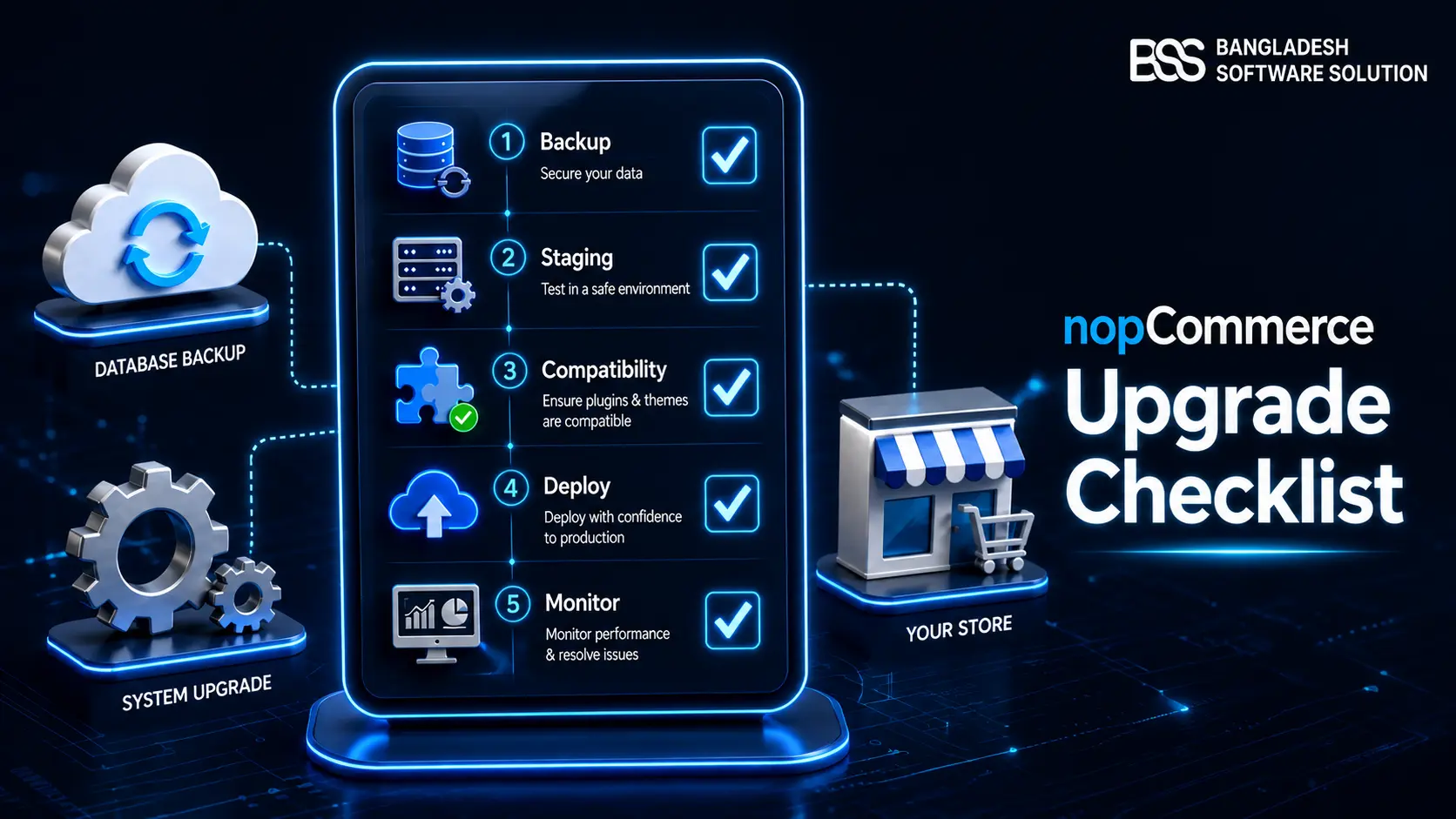
This is also why the upgrade question belongs inside the selection conversation rather than after it. Our nopCommerce upgrade checklist is a fair preview of the work you are asking a partner to sign up for, year after year — read it as a job description for the company you are about to choose.
Where Your Shortlist Came From — and What It's Hiding
Before you evaluate the companies, it is worth evaluating how they reached your list. Almost every nopCommerce shortlist is assembled from three sources, and each one quietly over-represents something that has nothing to do with engineering quality.
A search rewards domain authority and content investment. In a market this small, a large generalist agency with thousands of referring domains can outrank a dedicated nopCommerce shop that has shipped ten times as many stores. The ranking is measuring marketing reach, not maintenance ability.
A partner directory rewards whoever completed the process and paid the fee. That is a genuine signal — we will come back to it — but it is a membership list, not a quality ranking.
A referral rewards a single sample. One happy client tells you a company can succeed once, with that scope, with that team, at that particular moment. Useful, and much less than it feels.
None of this disqualifies anybody. It simply means the shortlist is a starting point — and the companies on it tend to fall into three shapes that behave very differently once the invoice is paid.
Five Proofs a Real nopCommerce Partner Can Produce on Request
Once you know which shape you are dealing with, the evaluation becomes concrete. A company with real nopCommerce depth can answer all five of the following in a single email, without preparing anything special. A company that cannot will negotiate: it offers a case study instead of a URL, or a testimonial instead of a name.
1. Solution Partner status — and what it does and doesn't mean
nopCommerce runs an official Solution Partner program, and membership is publicly listed on the platform's own website. It is a real signal: it shows a company has a formal relationship with the platform vendor rather than having simply added "nopCommerce" to a services page.
Be honest about its limits, though. Partner status reflects a commercial relationship and an application process — it is not a code audit of the work that firm will do for you. Treat it as a floor to clear, not a verdict.
2. Live stores you can open in a browser today
Ask for three URLs, not screenshots. Then check them yourself: a nopCommerce storefront normally exposes its customer login at /login, and a stock installation carries recognisable nopCommerce markup in the page source. You do not need to read any of it — you only need to confirm that the store exists, loads, and is real.
The follow-up matters more than the list. Ask which of those stores the company still maintains. Portfolios are full of sites the vendor lost years ago.
3. Shipped products, not only client work
A company that publishes its own plugins or themes has a public quality record. Strangers install that code, run it on stores nobody warned them about, and complain loudly when it breaks — a far harsher test than a client project delivered quietly behind an NDA.
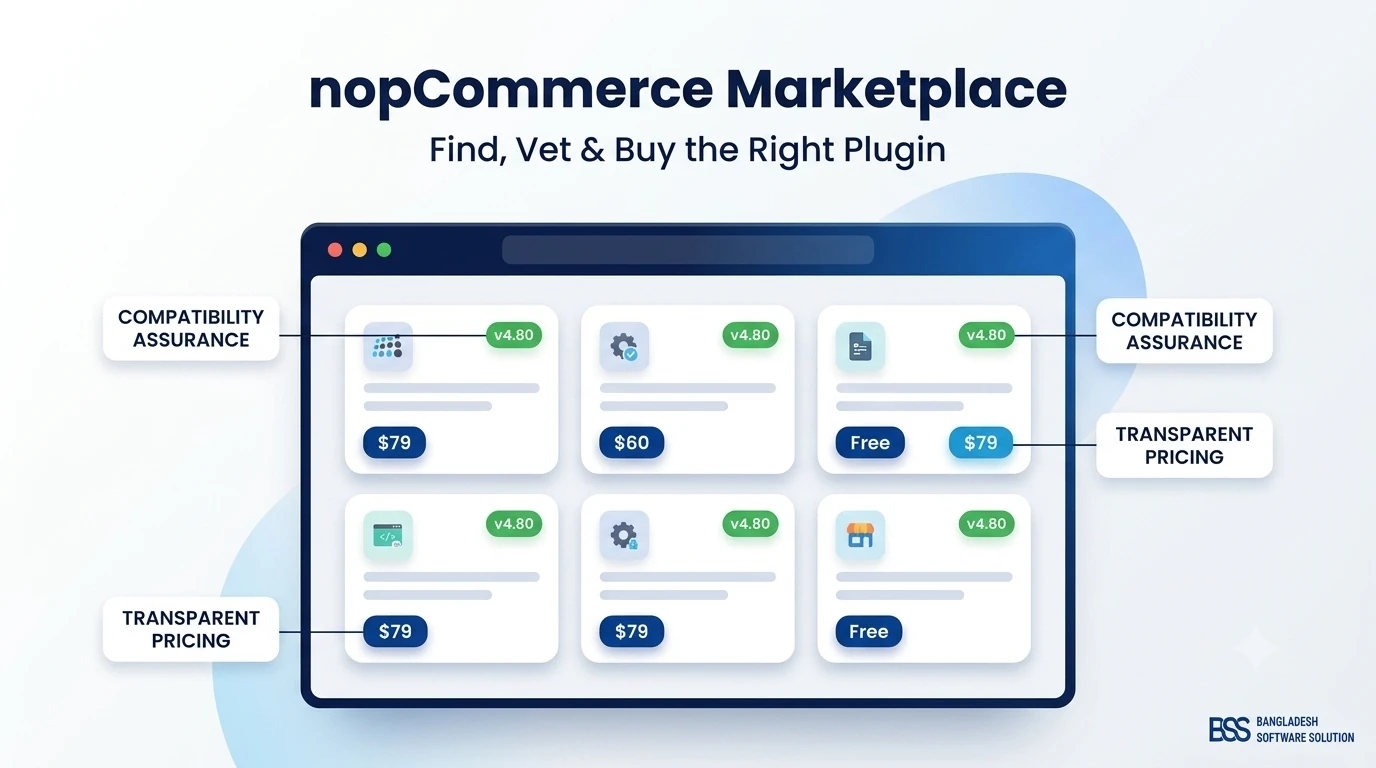
The same vetting instincts apply here as when you evaluate any third-party extension, and our guide to the nopCommerce Marketplace walks through what a credible listing actually looks like. If a company has never shipped anything installable that is not disqualifying — but it does remove the most objective evidence available to you.
4. Named engineers and an honest continuity answer
Ask who specifically will work on your store, then ask the uncomfortable follow-up: what happens if that person leaves? A company that has thought about this describes shared repositories, documented environments and internal handover. A company that has not will simply reassure you.
5. A record of upgrades they have actually performed
Building a new store is the easy half. The revealing question is whether the company has taken a live store across a major nopCommerce version — with real orders, real customer accounts and real search rankings to protect — and can describe what broke and how they handled it.
In our experience this single question separates firms faster than any technical interview. Everyone has a launch story. Far fewer have a migration story.

The one question we would ask first
"Show me the oldest nopCommerce store you built that you still maintain." Every company leads with its newest work; almost none volunteers its longest relationship. That single answer covers client retention, upgrade competence and trust at once.
Fixed-Bid, Retainer, or Dedicated Team — Decide the Shape First
Most buyers pick the company and then negotiate the commercial shape. Doing it the other way round is faster and cheaper, because the shape you need eliminates whole categories of vendor before you have spent a single meeting on them.
There are really only three shapes, and the honest difference between them is not price — it is who absorbs uncertainty.
| Approach | What you're actually buying | Best when | Where it hurts | Cost predictability |
|---|---|---|---|---|
| A. In-house plus freelancers | Hours you direct yourself, on your own repository and your own process. | You already have a technical lead and the work is incremental. | Nobody owns the whole system; upgrades and architecture fall through the gaps. | Low — hours vary |
| B. Fixed-bid project with an agency | A defined scope, delivered to a date, for an agreed number. | Requirements are genuinely stable and you can specify them precisely. | Everything unforeseen becomes a change request; post-launch support is a separate negotiation. | Medium — until scope moves |
| C. Ongoing partnership with a specialist | Continuous capacity: the build, then upgrades, monitoring and improvement. | The store is a core revenue channel and will keep changing. | You pay in quiet months, and you still have to verify the work is happening. | High — flat monthly |

The cheapest proposal and the most expensive proposal are usually pricing two completely different scopes — and only one of them includes the next two years.
BSS Engineering
If the answer turns out to be staffing rather than partnering — you need hands, not a vendor relationship — the questions you should be asking change substantially, and we work through those separately in our guide to hiring a nopCommerce developer.
The Clauses That Decide Whether You Can Ever Leave
You find out whether you chose well at the moment you try to leave. That is when ownership, access and documentation stop being paperwork and start being the difference between a two-week transition and a rebuild.
None of the following requires legal expertise to ask for, and a confident partner will not flinch at any of it.
- Source code ownership on payment — in writing, and explicitly covering custom plugins and theme work, not just "the website."
- Repository access from day one — the code lives in an account your company owns, with the vendor invited in. Not the other way around.
- No vendor-only licensing — no custom plugin built for you may be licensed in a way that stops working when the relationship ends.
- A documented build and deploy process — written so a competent third party could follow it without a phone call.
- Credentials held by you — hosting, domain, database and the nopCommerce admin account are yours, with vendor accounts created underneath them.
- A stated position on major upgrades — included, quoted separately, or not offered at all. Any of the three is workable; silence is not.
The expensive surprise we see most often
When we take over an inherited nopCommerce store, the costly discovery is rarely the theme. It is a custom plugin the previous vendor built as a licensed product — so the store depends on code its owner never had the right to modify. Settle that in the contract, not in the handover meeting.
A vendor change is also the right moment to audit who still has access to what. Our nopCommerce security hardening checklist covers the accounts, keys and settings worth reviewing whenever the people working on your store change.
The Partner Evaluation Checklist
Everything above collapses into one call. Run this list against each company on your shortlist and the gaps show up quickly — usually in the pauses rather than in the answers.
Before you sign with a nopCommerce development company
-
Confirmed nopCommerce Solution Partner listing, or a straight explanation of why not.
-
Three live nopCommerce store URLs you can open and verify yourself.
-
At least one of those stores still under their maintenance today.
-
Publicly available plugins or themes they built and continue to support.
-
Named engineers assigned to your project, with a written continuity plan.
-
A specific major-version upgrade they performed on a live, trading store.
-
Source code and custom plugin ownership transferring to you on payment.
-
Repository hosted in an account your company owns, with access from day one.
-
Hosting, domain, database and nopCommerce admin credentials held by you.
-
A written position on upgrades, security patching and response times after launch.
A company that resists any of items seven through ten is not being difficult about paperwork — it is telling you, early and for free, how the relationship ends. And a quote that comes back dramatically under the others is rarely a discount; it is usually a narrower reading of the same brief, and the difference reappears later as change requests.
Every Proof on That Checklist, in One Place
Bangladesh Software Solution builds nopCommerce stores, publishes and supports its own plugins and themes, and maintains stores it did not originally build. If you are running the evaluation above, we are happy to be measured by it — live store URLs, named engineers, code ownership and upgrade history included.
Frequently Asked Questions
Final Thoughts
Go back to the three proposals on your desk. Nothing about them has changed — but the questions you can now put to each one have.
Which of these companies can send three live store URLs this afternoon? Which still maintains a store it built three years ago? Which has publicly shipped code that strangers depend on? Which will put code ownership and repository access in writing before it invoices you? And which has moved a trading store across a major nopCommerce version and can tell you exactly what broke?
The four-times price spread usually resolves itself once those answers are on the table — not because the expensive proposal turns out to be cheap, but because it becomes obvious the three quotes were never describing the same commitment in the first place.
Choose the nopCommerce development company that can be checked, not the one that describes itself best. The proof is public, and asking for it costs you one email.