WooCommerce can be a sensible way to add commerce to WordPress. The question is not whether it is a good platform. The useful question is whether its operating model still fits your store. If routine plugin updates need a developer, wholesale pricing lives in workarounds, or every traffic spike becomes a hosting exercise, comparing WooCommerce alternatives is reasonable.
This is not another general list of the best eCommerce platforms. BSS already has a small-business platform comparison and a focused Shopify vs WooCommerce vs BigCommerce guide. Here, the shortlist starts with the reason you may leave WordPress and ends with the proof you should demand before migrating.
Fast answer:
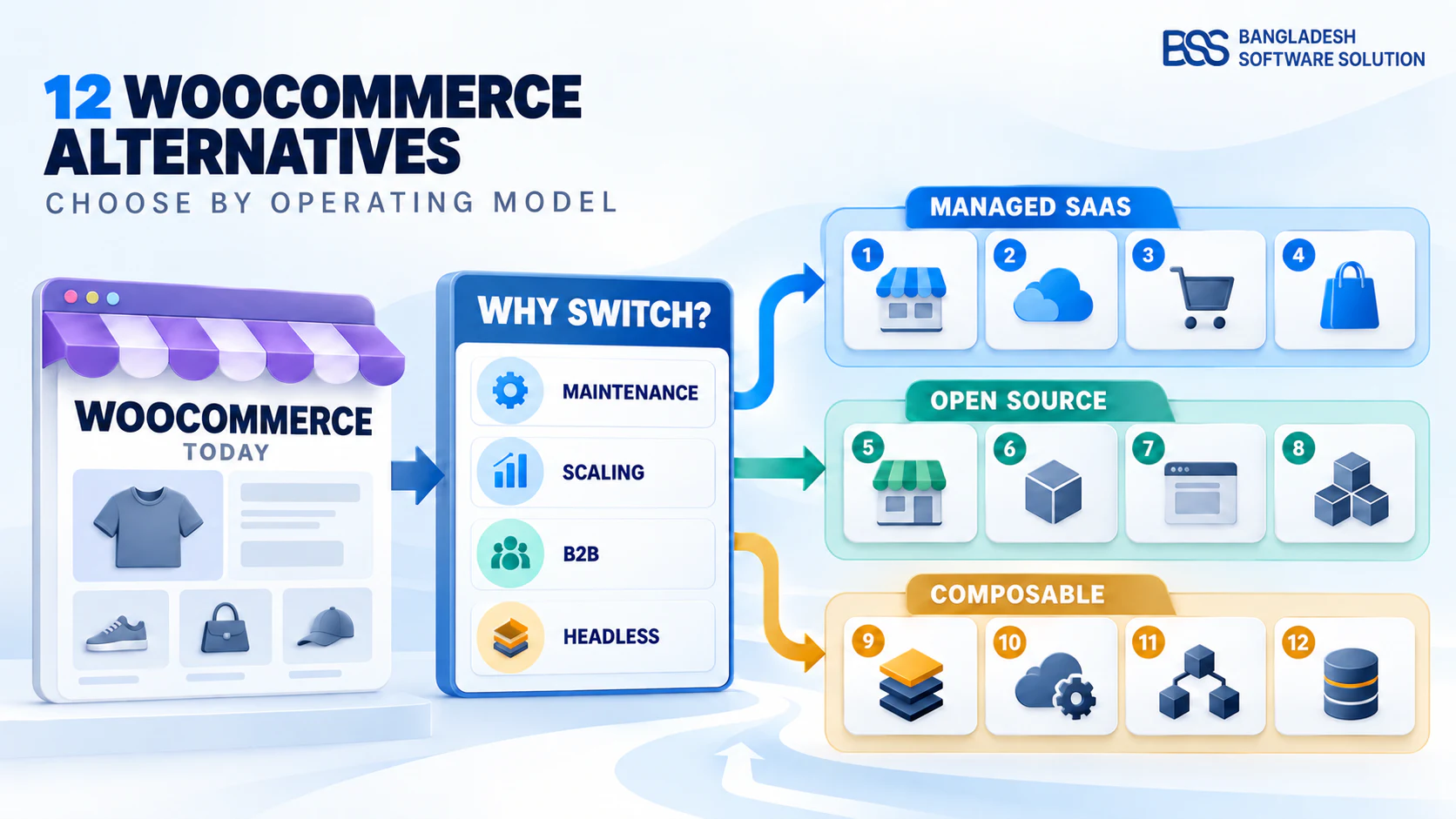
- Choose Shopify, BigCommerce, Wix, Squarespace, Square Online, or Ecwid when reducing hosting and update work is the priority.
- Choose nopCommerce, Adobe Commerce, PrestaShop, or OpenCart when source access and deeper customization matter more than convenience.
- Shortlist Shopware or Saleor when API-led, composable storefront development is part of the plan.
No platform is automatically the winner. Your catalog rules, integrations, team, budget, and tolerance for operational ownership decide the fit.
1. Start With Why You Are Leaving WooCommerce
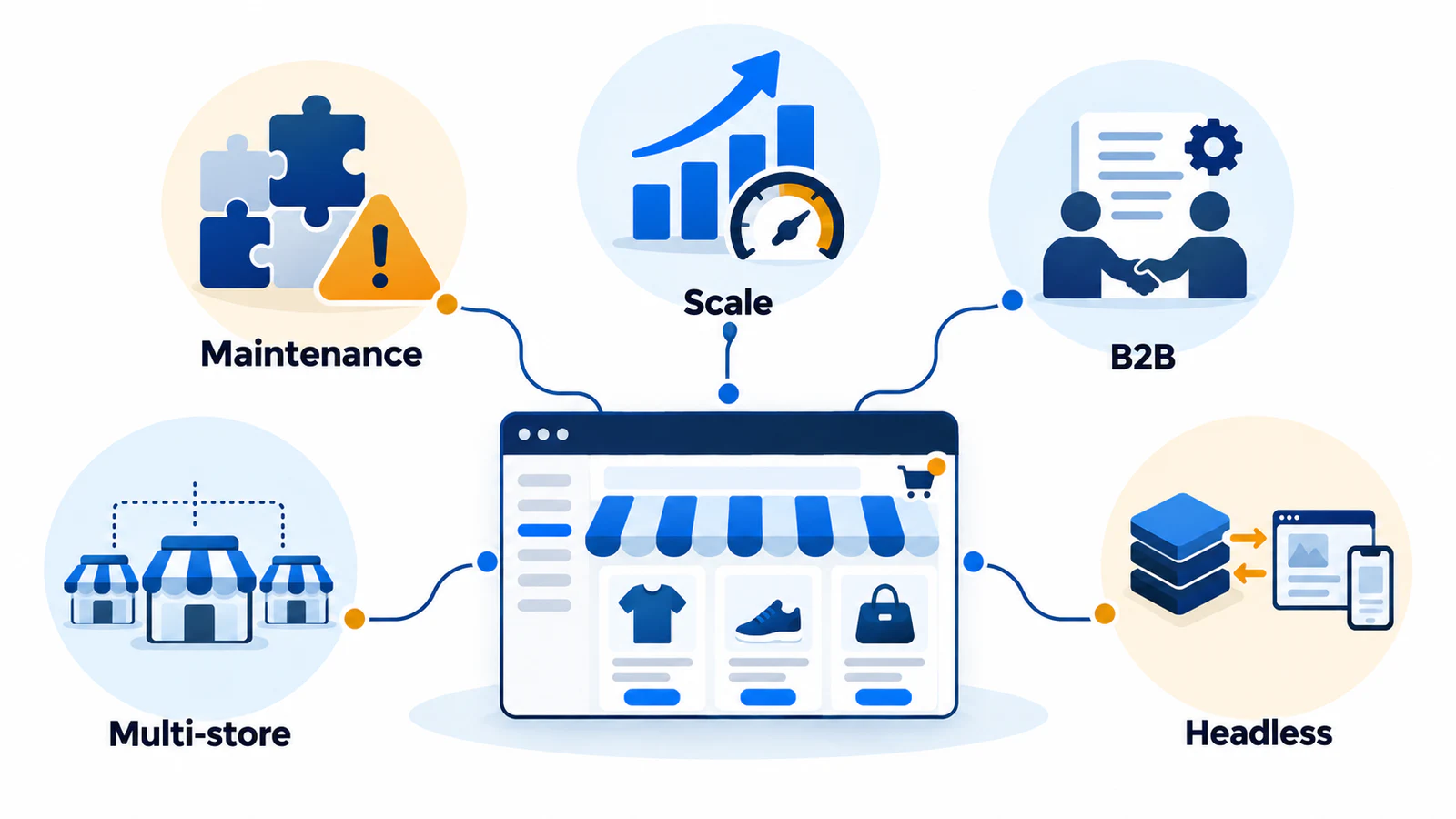
A slow store does not prove WooCommerce is the wrong platform; hosting, database health, theme code, image delivery, and extensions can all be responsible. Likewise, a difficult checkout may need workflow repair rather than a full replatform. Diagnose the constraint before selecting the cure.
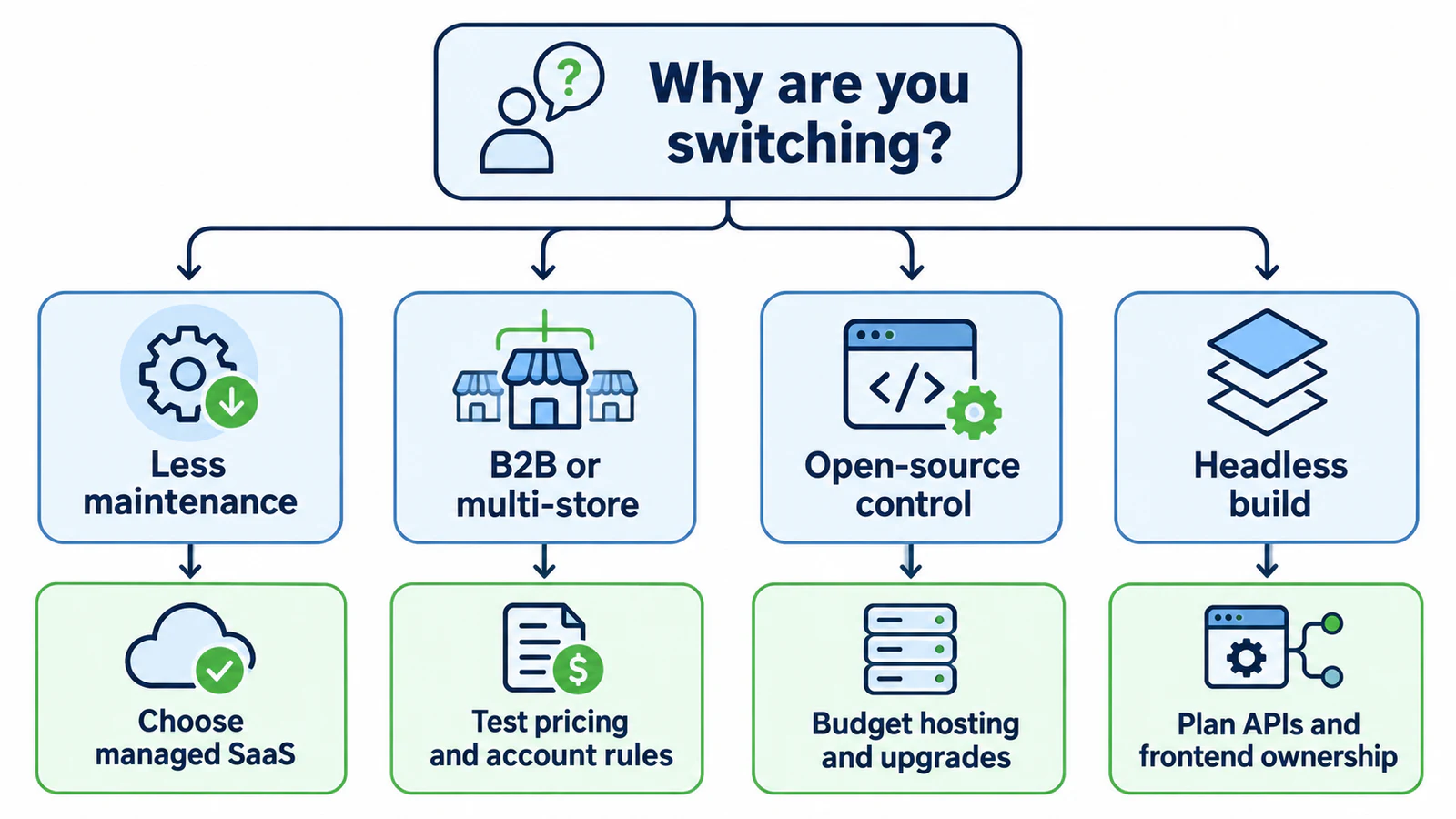
Migration becomes a stronger option when the operating model is the problem: too many interdependent plugins, a growing maintenance burden, company-specific catalogs, several brands, or a frontend that must serve web, mobile, and other channels through APIs.

Write one sentence that begins, “We are switching because…” If the sentence cannot be measured in a test store, the project is not ready for selection. BSS can turn that constraint into a test plan.
Planning a WooCommerce migration? BSS can map your catalog, integrations, URLs, and business rules before a destination platform is chosen.
Review services2. The 12 Best WooCommerce Alternatives, Matched to the Job
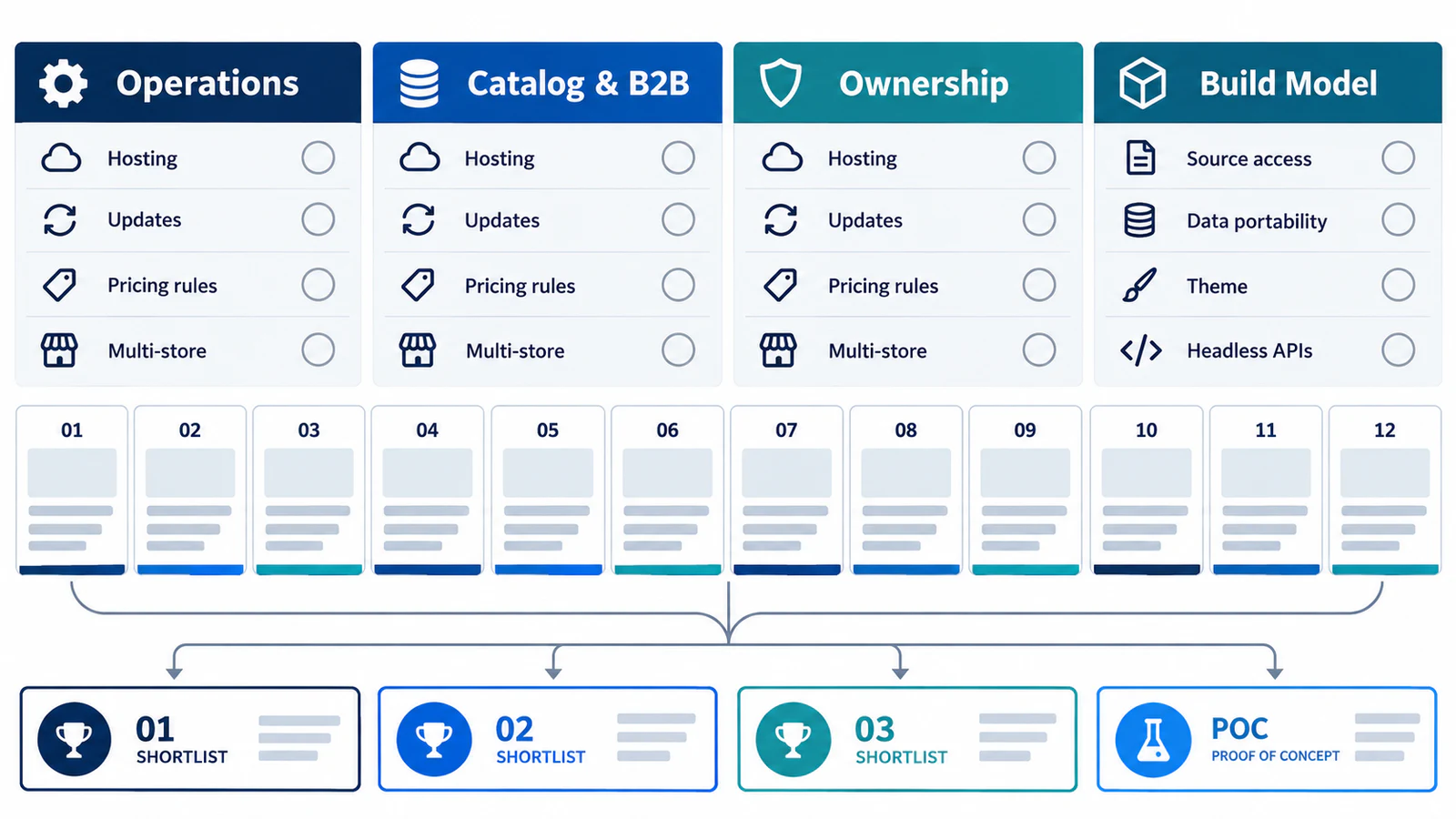
The list below is intentionally not a one-to-twelve ranking. Each option is strongest under a different constraint, and current capabilities were checked against official platform documentation in October 2026.
1. nopCommerce: best for .NET ownership, B2B rules, and multi-store
nopCommerce is open source and built on .NET. Its official documentation describes multiple stores from one installation and customer roles that can support discounted pricing, tax exemption, and other rules.
It fits teams that want source access, Microsoft-stack development, and one administration area for several storefronts. It also shifts hosting, upgrades, and testing to your team or partner. Read the deeper nopCommerce vs WooCommerce comparison.
2. Shopify: best for managed operations and app-led expansion
Shopify packages hosting, updates, checkout, and core operations as SaaS. That reduces infrastructure ownership and can shorten launch time. Its current help documentation also shows that B2B feature availability varies by plan, while some advanced catalog assignments and storefront customization remain plan-dependent. Test every required B2B and subscription flow rather than assuming an app closes the gap.
3. BigCommerce: best for managed multi-storefront commerce
BigCommerce documents multi-storefront support that can serve distinct websites, brands, and sales goals from one catalog. It suits merchants seeking SaaS operations with deeper native catalog capability. Confirm plan thresholds, app compatibility, and the exact storefront count you need during procurement.
4. Adobe Commerce: best for complex enterprise B2B
Adobe Commerce B2B supports company accounts, shared catalogs, custom company pricing, negotiable quotes, and B2B-specific payment and shipping controls. That depth can fit complex procurement, but implementation and ongoing ownership are substantial. Magento Open Source and licensed Adobe Commerce are not identical products, so scope against the edition you will actually run.
5. PrestaShop: best for PHP teams wanting open-source multistore
PrestaShop is self-hosted and PHP-based. Its official documentation describes managing several front offices from one back office, including B2B/B2C stores, different branding, domains, and store-level pricing. It is a natural candidate for teams that want to stay in PHP while moving away from WordPress, provided they can own hosting, modules, security, and upgrades.
6. OpenCart: best for a lighter self-hosted PHP store
OpenCart offers a traditional PHP storefront, extensions, and multi-store settings with separate names, themes, logos, and metadata. It can be attractive when the team wants a simpler open-source base. Extension quality and compatibility still need careful review, especially for tax, payments, shipping, and upgrade paths.
7. Shopware: best for API-led commerce with deployment choice
Shopware exposes an Admin API for operational integrations and a Store API for storefronts, mobile apps, carts, and checkout. Its developer documentation covers SaaS, PaaS, and self-hosted availability for different extension types. It belongs on a shortlist where integration design and custom customer experiences matter.
8. Saleor: best for GraphQL-first headless builds
Saleor is built around a GraphQL API and supports storefronts, apps, channels, checkout, products, and webhooks through that model. It is a developer-led choice for composable commerce, not a drag-and-drop WooCommerce replacement. Budget for frontend development, integration ownership, observability, and content management.
A platform removes one kind of work only by deciding who will own the work that remains.
9. Wix: best for a site-led brand with a moderate catalog
Wix Stores combines a visual site builder with product, order, marketing, and multichannel tools. Wix says stores can offer physical and digital products, subscriptions, multiple payment methods, and third-party apps. It is strongest when the website and content experience lead, while highly specialized catalogs should be proven in a trial.
10. Squarespace: best for design-led content and commerce
Squarespace supports physical products, downloads, services, subscriptions, and gift cards across its commerce-enabled plans. It is a credible fit for smaller, design-focused catalogs. Complex B2B pricing, multi-brand operations, or unusual fulfillment logic should be treated as evaluation gates.
11. Square Online: best when the point of sale leads
Square documents a shared item library and inventory that can synchronize across point of sale and an online store. That makes it compelling for merchants whose physical counter is the operational center. Compare online merchandising, international requirements, and extensibility before using it for a digital-first business.
12. Ecwid: best for adding commerce to an existing site
Ecwid can place a full catalog, category, product card, or Buy Now button into an existing website. It is the closest fit when you want commerce embedded into a site rather than a complete replatform. For complex store logic, verify what remains native and what depends on apps or external systems.
| Migration priority | Start with | Prove before choosing |
|---|---|---|
| Reduce maintenance | Shopify, BigCommerce, Wix, Squarespace, Square Online, Ecwid | App cost, plan gates, data export, checkout rules |
| Own code and hosting | nopCommerce, Adobe Commerce, PrestaShop, OpenCart | Upgrade process, hosting, security, extension support |
| B2B or several stores | nopCommerce, BigCommerce, Adobe Commerce, PrestaShop, Shopware | Company pricing, permissions, catalogs, tax and approval flows |
| Headless or composable | Saleor, Shopware, Shopify, BigCommerce | API coverage, frontend ownership, preview, search and checkout |
How to read this shortlist without creating a new mismatch
A managed platform can reduce server and patch work, but it does not remove operational responsibility. Someone still owns catalog quality, permissions, tax setup, payment disputes, app changes, analytics, and release testing. The difference is which layers the vendor operates and which layers remain yours.
Open-source control is valuable when the business needs rules that cannot be expressed safely through standard configuration. That control also creates a release surface: custom code must be reviewed when the platform, framework, payment provider, or browser changes. Compare the cost of that ownership with the cost of SaaS plans and apps over several years, not one launch month.
For headless commerce, confirm who owns search, content preview, authentication, checkout updates, accessibility, performance monitoring, and frontend deployment. An API-first product can be an excellent foundation, but the storefront experience becomes a software product your team must maintain.
3. Build a Three-Platform Shortlist, Not a Twelve-Platform Debate
Begin with non-negotiable workflows, not feature counts. Give each platform the same script: import representative products, configure tax and shipping, create a customer, apply a discount, place and refund an order, export the data, and connect one critical integration.
- Operations: Who owns hosting, patches, backups, monitoring, and incident response?
- Catalog: Can it model your variants, bundles, price lists, customer groups, and search facets?
- Commerce: Do checkout, payments, tax, shipping, returns, subscriptions, and approvals work in your markets?
- Growth: Can the same design support another brand, store, region, or B2B channel?
- Exit: Can you export products, customers, orders, media, and URL mappings in usable formats?
Ask vendors and developers to demonstrate your hardest workflow with your data. A checkbox is not proof. Ask BSS to scope a proof of concept.
4. The Switching Cost Most Comparison Lists Miss
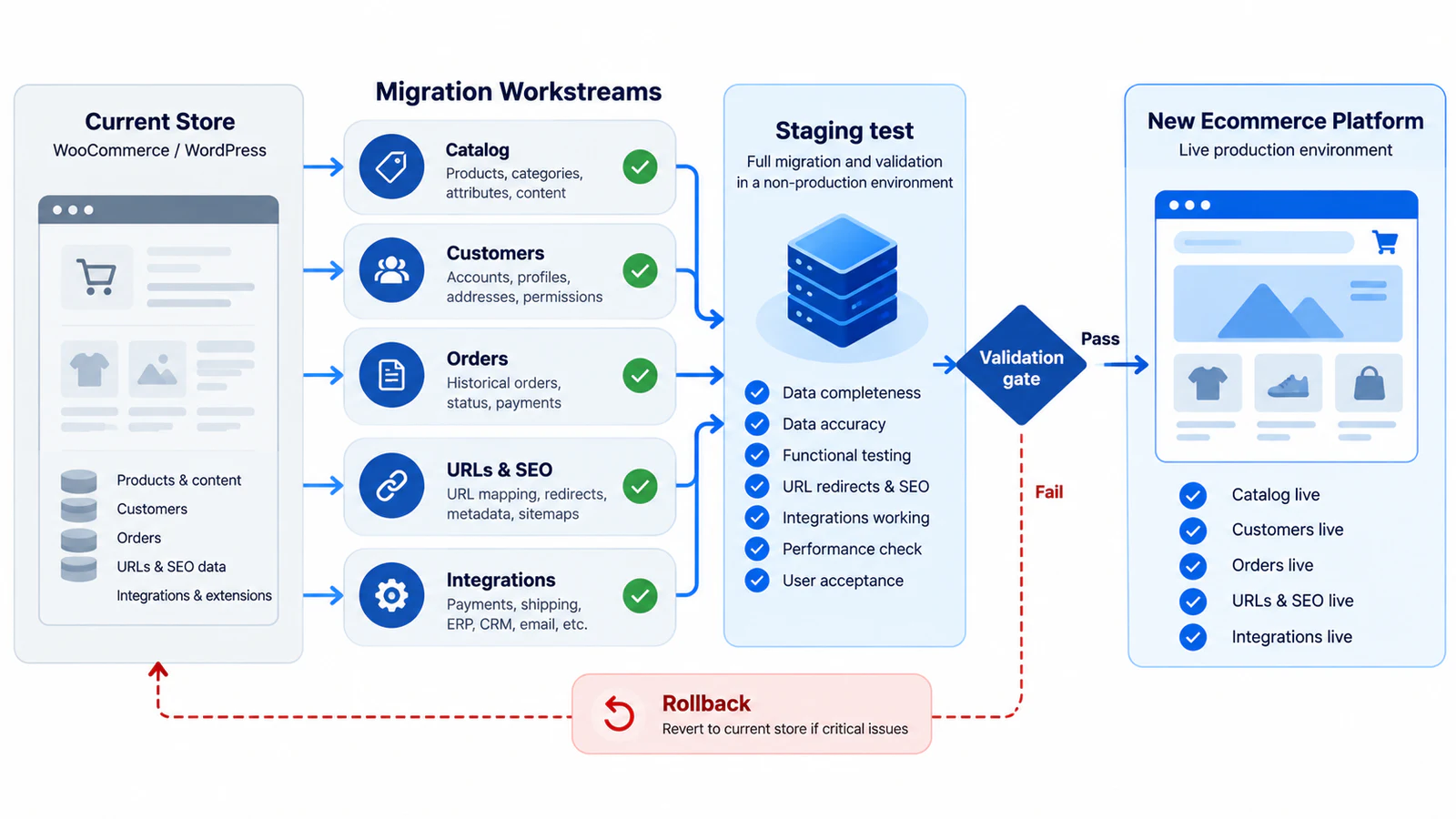
The platform subscription or license is only one line in a replatform budget. The larger work often sits in data cleanup, theme rebuilding, integration replacement, redirect mapping, customer communication, test orders, analytics, and staff training.
Preserve every indexable product and category URL where possible. Where URLs must change, map each old address to the closest new page, carry titles and descriptions forward deliberately, regenerate sitemaps, and test canonical tags and structured data. Our eCommerce migration SEO checklist covers that work in detail.

For a nopCommerce destination, add and validate supported structured data after the migration. This does not replace redirects or technical quality assurance.
View the pluginFinal proof-of-concept checklist
- Representative products, variants, images, categories, and customer groups import correctly.
- Guest and account checkout pass on mobile and desktop.
- Payments, tax, shipping, refunds, emails, and scheduled jobs pass in staging.
- Every critical plugin or integration has a supported replacement.
- Old URLs, metadata, canonicals, structured data, analytics, and sitemaps are validated.
- Performance is tested with realistic catalog size and third-party scripts enabled.
- A content freeze, final delta migration, launch owner, and tested rollback plan exist.
Validate the destination before moving the store
BSS can review WooCommerce data, business rules, integrations, SEO requirements, and nopCommerce fit, then turn the result into a staged implementation plan.
Frequently Asked Questions
Choose the Operating Model Before the Brand
The best WooCommerce alternative is the platform that removes your current constraint without creating a more expensive one. Decide who will own infrastructure, how complex the catalog must become, which integrations are essential, and whether your business needs SaaS convenience, source control, B2B depth, or composable architecture.
Then prove the shortlist in staging. A careful test costs less than discovering after launch that the new platform cannot reproduce the workflow that made your store successful.
BSS can assess WooCommerce data, integrations, SEO requirements, and nopCommerce fit before implementation begins.
Book a consultation