Picture a UK homeware retailer three months from peak season. The nopCommerce store needs a rebuilt checkout, two plugin updates and an upgrade to 4.80, and the in-house team is already stretched. Three proposals land on the operations director's desk: a studio in Warsaw, a studio in Bucharest and a team in Dhaka.
All three promise senior .NET engineers and a nopCommerce portfolio. The Dhaka quote is noticeably lower, the Warsaw one is the most polished, and nobody can say whether the gap is a bargain or a warning. That is the question this guide answers.
Full disclosure: we are BSS Engineering, a nopCommerce team based in Dhaka, so we are the Bangladesh option in this comparison. We have tried to argue Eastern Europe's strengths as fairly as our own, and everything here is something you can verify on a reference call. Where we could not source a number, we left it out.
By the end you will have a side-by-side comparison, a three-question decision path and a checklist that works for a vendor in either region.
Eastern Europe Is Not One Place
Before comparing prices, notice that two of the three proposals sit under a single label that hides more than it shows. Warsaw and Bucharest share a continent and an EU rulebook, but "Eastern Europe" also covers countries with very different legal and risk profiles.
So the honest comparison is rarely "Bangladesh vs Eastern Europe". It is Bangladesh against one specific country and one specific vendor. Unless we say otherwise, the rest of this guide uses EU-member hubs such as Poland and Romania as the Eastern European reference point.
Time Zones and the Working Day
Back at the homeware retailer's desk, the first practical difference shows up in the calendar, not the quote. Where your team sits relative to the vendor decides how much of the day you can actually talk.
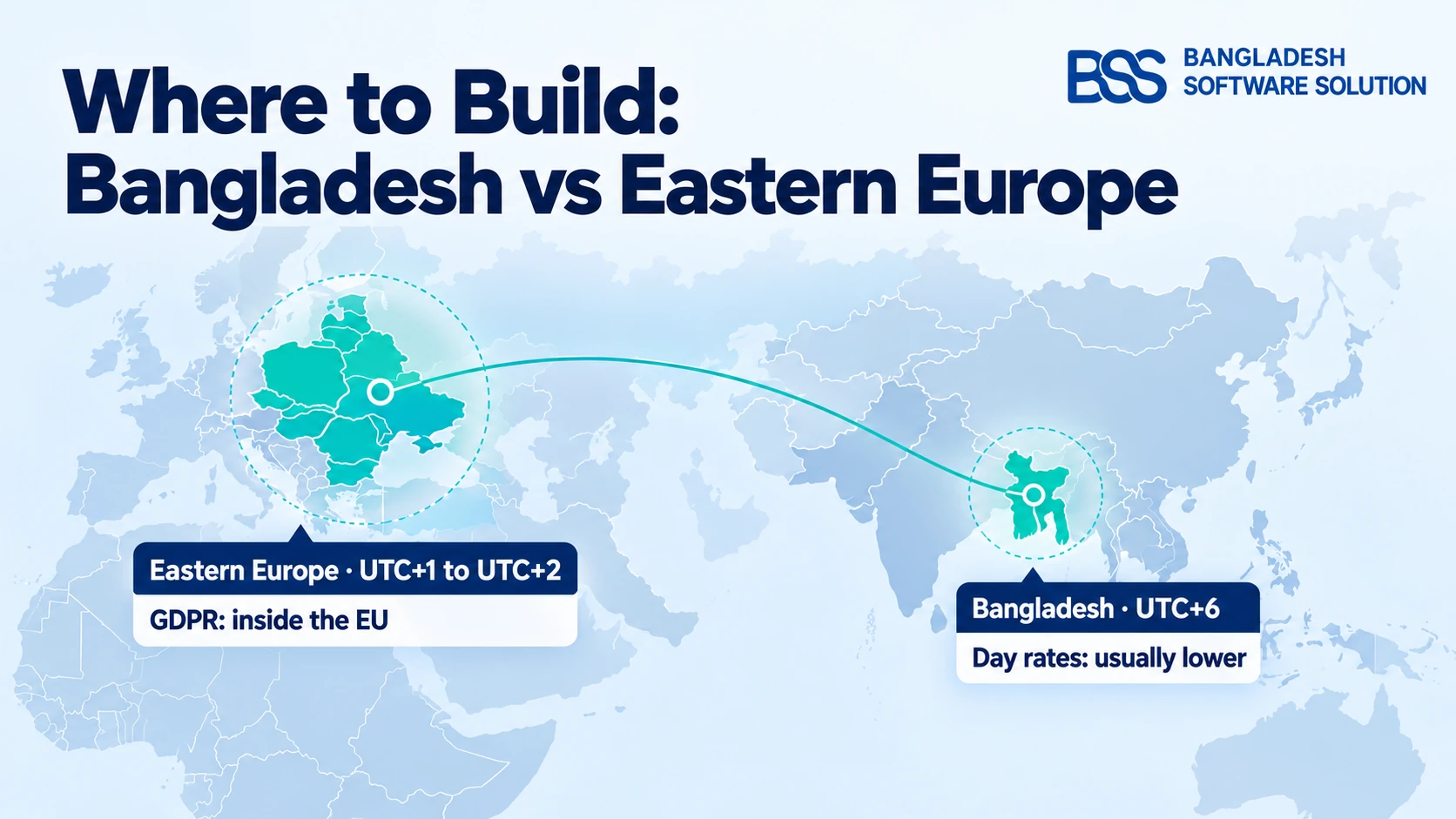
For a UK or Western European buyer, Eastern Europe sits within zero to two hours of your day, so almost everything overlaps. Bangladesh is four to six hours ahead depending on the season, which leaves a few shared hours at the start of your morning: enough for a daily stand-up and a clean handover, not for pair-debugging all afternoon.
For a US East Coast buyer the picture flips. Eastern Europe is six to seven hours ahead, so mornings overlap. Bangladesh is ten to eleven hours ahead, which turns the relationship into follow-the-sun: you hand off at the end of your day and wake up to progress. That is excellent for scoped build work and poor for a live incident.
A time zone is neither good nor bad. It either fits how your team works or it does not.
BSS Engineering
The Calendar Details People Forget
Bangladesh's working week typically runs Sunday to Thursday, with Friday and Saturday off. That makes Friday handovers and Monday-morning deadlines worth planning on purpose. Public holidays differ too: the Eid breaks can stretch across several days, while Eastern European teams pause for Christmas and Easter on dates that vary by country.
Ask every vendor for its holiday calendar before you fix a launch date. On communication, English fluency varies far more between individual vendors than between countries, so judge it the way you would judge anything else: run a technical call with the engineers who will do the work.
Cost: What the Quote Hides
Time-zone friction costs something, and that brings us back to the gap between the three quotes. Day rates in Bangladesh are usually lower than in Eastern Europe, and Eastern European rates have risen as demand and EU wages grew. But the rate is one line in a longer bill.
A common mistake we see when buyers compare quotes is treating the lowest number as the cheapest project. A team that needs three rounds of clarification on a plugin brief usually costs more than one that asks the right questions on day one. For a sense of what a build really involves, see our breakdown of what a nopCommerce store costs to build.
Compare scopes, not rates
Ask every vendor to quote the same written scope with the same acceptance criteria. If one number sits far below the others, ask what it leaves out: testing, documentation, upgrade compatibility or post-launch support. This is general guidance, not tax advice.
Skills: Who Can Ship nopCommerce
Cost and calendar only matter if the team can do the work. nopCommerce runs on ASP.NET Core, C# and SQL Server, so any strong .NET team can learn it. What is genuinely scarce, in every country, is nopCommerce-specific experience: the plugin model, widget zones, event consumers and the upgrade path between versions.
Eastern Europe has an older, deeper outsourcing industry, particularly in enterprise .NET. Bangladesh's is younger and growing quickly, and in our experience its teams tend to value long-term client relationships. Neither fact tells you whether a particular vendor has shipped nopCommerce work, so test for that directly.
If you want a benchmark for what good looks like, our guide to creating a plugin in nopCommerce 4.80 shows the structure a competent team should already know, and our nopCommerce upgrade checklist lists what an upgrade-ready team already does. For a deeper vetting framework, read how to hire a nopCommerce developer and how to choose a nopCommerce development company.
Data, Contracts and Risk
The last gap is the one that decides whether your legal team signs. It splits into three parts: where personal data flows, who owns the code, and what can interrupt delivery.
Data Protection
EU-member hubs sit inside GDPR already, so data shared with a Polish or Romanian vendor stays in the same legal framework. Bangladesh is a third country under GDPR and, at the time of writing, is not on the European Commission's list of adequacy decisions, so please verify the current list. Transfers then need a mechanism such as standard contractual clauses plus a transfer risk assessment.
The cleaner pattern, in either region, is to keep production data in your own infrastructure and give any offshore team least-privilege, logged access. Our nopCommerce security hardening checklist covers the controls. This is general information, not legal advice, so involve your data protection officer.
Contracts and Intellectual Property
Whichever region you pick, insist on a written IP assignment, a governing-law clause you could realistically enforce, and source code in your own repository from day one. EU-member vendors let you contract under familiar EU law. With Bangladesh, agree the jurisdiction and dispute process explicitly rather than assuming.
Infrastructure and Continuity
Bangladesh teams can face power or internet interruptions, and established vendors run backup power and redundant connections. Ask to see how. In Eastern Europe, continuity questions are country-specific: Ukraine-based vendors, understandably, should be asked how they keep delivery running through disruption, and any vendor should be able to explain its staffing redundancy.
The Side-by-Side
With each factor examined, here is the whole comparison in one place. Green means easier for most Western buyers by default, amber means it needs deliberate handling. Neither colour means avoid.
| Factor | Bangladesh | Eastern Europe (EU members) | What to weigh |
|---|---|---|---|
| Overlap with UK / Western Europe | A few shared hours | Near-full overlap | How much live collaboration your work needs |
| Overlap with US East Coast | Follow-the-sun handoffs | Morning overlap only | Batch handoffs versus live debugging |
| Working week | Typically Sunday to Thursday | Monday to Friday | Friday handovers and launch dates |
| Day rates | Usually lower | Mid-range, and rising | Total project cost, not the rate alone |
| Industry depth | Younger, growing quickly | Older, deep in enterprise .NET | Proof of shipped nopCommerce work |
| GDPR for EU data | Third country: safeguards needed | Inside GDPR | Keep production data in your environment |
| Contracts and invoicing | Cross-border, agree jurisdiction explicitly | Familiar EU terms | Your legal and finance teams' comfort |
| Continuity risk | Ask about power and connectivity backup | Varies by country: ask each vendor | Staffing redundancy and a written plan |
How to Decide Without Trusting a Sales Deck
Pulling it together, the decision comes down to three questions, asked in this order. Each one removes an option or confirms one, so you rarely need all three.
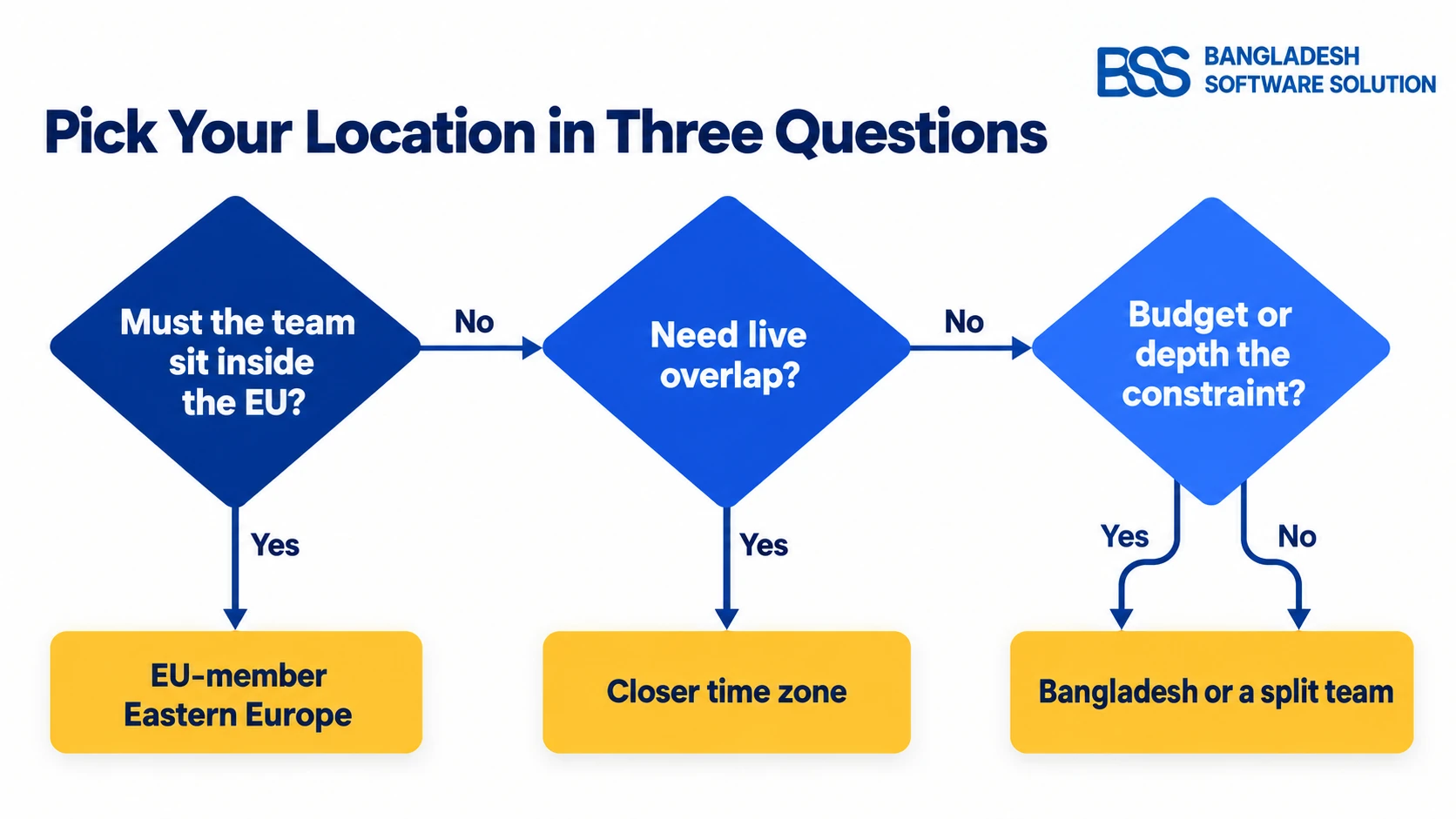
- Must the team sit inside the EU? If your compliance posture requires it, shortlist EU-member Eastern Europe. If it only requires safeguarded access, Bangladesh stays on the list with your data kept in your own environment.
- Do you need live overlap? If most work is interactive, such as incident response or pair debugging, favour the closer time zone. If it is scoped build work with written specifications, a handoff model works.
- Is budget or specialist depth the binding constraint? If budget is tight and the scope is clear, Bangladesh is worth a serious look. If the work is ambiguous and complex, paying for closer collaboration may be cheaper overall.
If none of those settles it, a split can work: an EU-based lead for live and compliance-sensitive work, with a lower-cost team on scoped tasks. It adds coordination overhead, so it needs a clear technical owner. For a neutral shortlist, our explainer on nopCommerce solution partners shows how to vet one in any region.
Eight questions to ask any vendor, in either region
-
Can I speak to the actual engineers, not just the sales lead, on a technical call before signing?
-
Can you show a nopCommerce plugin or theme you shipped that I can install and inspect?
-
Which nopCommerce versions have you upgraded, and can I talk to one of those clients?
-
Where will my production data live, and who will have access to it from your side?
-
Who owns the code, and will it sit in my repository from day one?
-
What is your holiday calendar, and how do you cover a key engineer who is unavailable?
-
What happens during a power or internet outage, or a local disruption, at your office?
-
What does the quote exclude: testing, documentation, upgrade compatibility, post-launch support?
A Dhaka-Based nopCommerce Team, Honest About Fit
BSS Engineering builds nopCommerce plugins, themes, upgrades and integrations for stores abroad. Share your scope and we will tell you plainly whether it suits an offshore team, or whether a closer time zone is the better choice for you.
Frequently Asked Questions
Final Thoughts
Back to the operations director's desk. The question is no longer which country is better. It is which of the three teams can show a nopCommerce plugin that is live, a reference from a store that moved to 4.80, and a plan for who touches customer data.
Asking all three for the same written scope and the same answers to the checklist above turns a gut feeling into a comparison. The Dhaka quote may prove lower and thin on testing, or the Warsaw one may prove complete and worth its premium. Either way, the decision now rests on evidence, not on a country label.
If you already hold a quote and want a second opinion on what it leaves out, send it to our team. We will tell you honestly, even when the answer is to hire someone closer.