Key takeaways
- A B2B platform earns the name on six jobs: company accounts, contract prices, quotes, approvals and terms, quick reorder, and a link to your ERP.
- If you want to own the code, three options are open or source-available: nopCommerce and Virto Commerce on .NET, OroCommerce on PHP.
- Shopify now offers B2B on its Basic, Grow and Advanced plans as well as Plus, but several B2B features stay Plus-only.
- Adobe Commerce has the deepest B2B module, and it is a separately licensed add-on that Magento Open Source does not get.
You sell to other businesses, and your current store treats every buyer like a shopper with a credit card. Buyers want their own prices, a quote for the big order, net terms and somebody on their side approving the spend. This guide ranks eight platforms on those jobs, and says plainly where each one falls short.
One thing up front: we build nopCommerce themes and plugins, and nopCommerce is on this list, so weigh our view accordingly. Everything said about the other seven comes from their own websites and documentation, which we read in November 2026.
| You are… | You want… | Start with |
|---|---|---|
| A .NET team or a Microsoft shop | Code you own, hosted where you like | nopCommerce, then Virto Commerce |
| A B2B-only manufacturer or distributor | Deep B2B rules out of the box | OroCommerce or Adobe Commerce |
| Already selling on Shopify or BigCommerce | Wholesale beside retail, no servers | Shopify B2B or BigCommerce B2B Edition |
| Running SAP or Microsoft Dynamics | The store as a window on the ERP | Sana Commerce or Optimizely Configured Commerce |



What a B2B Platform Has to Handle
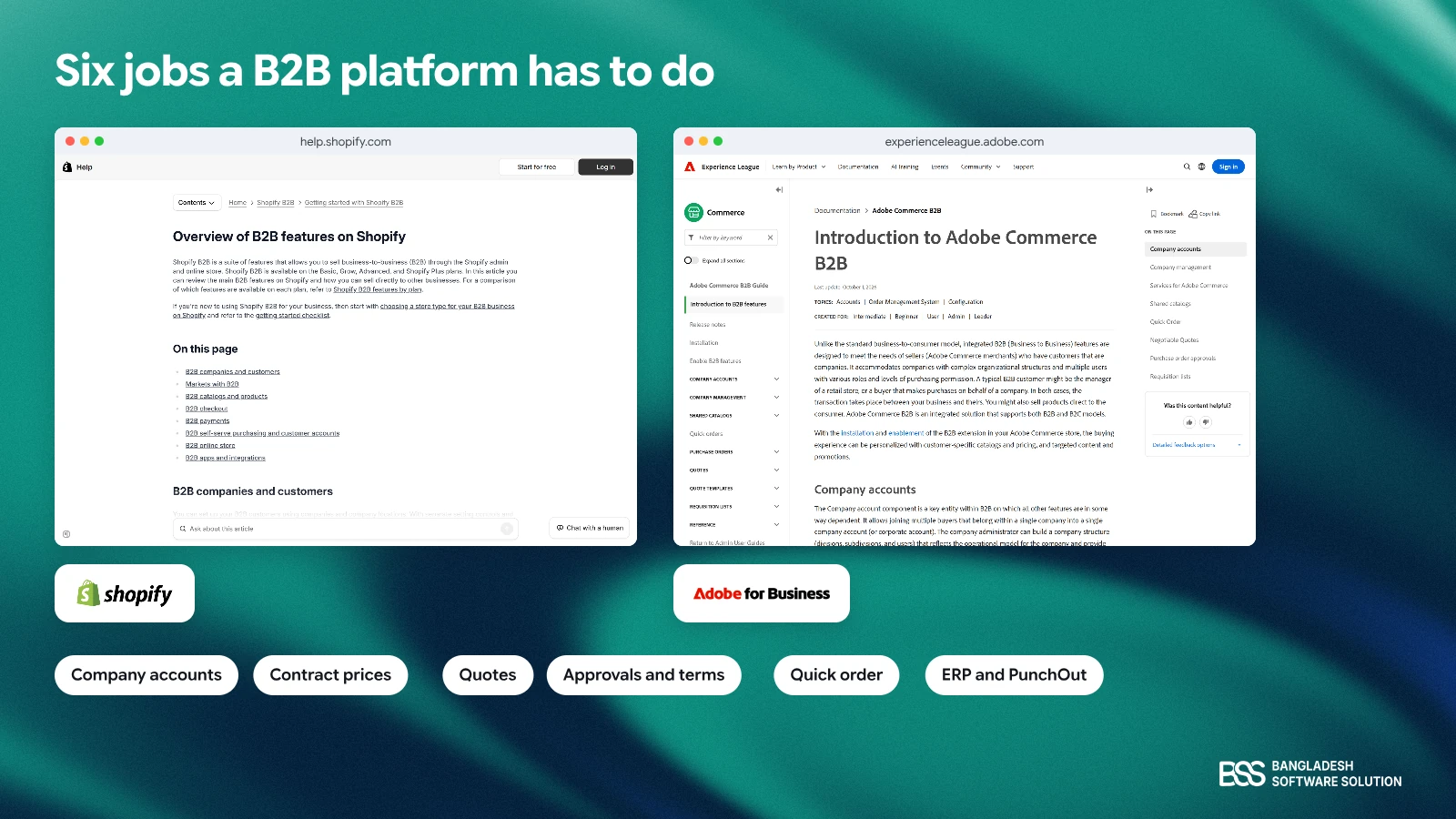
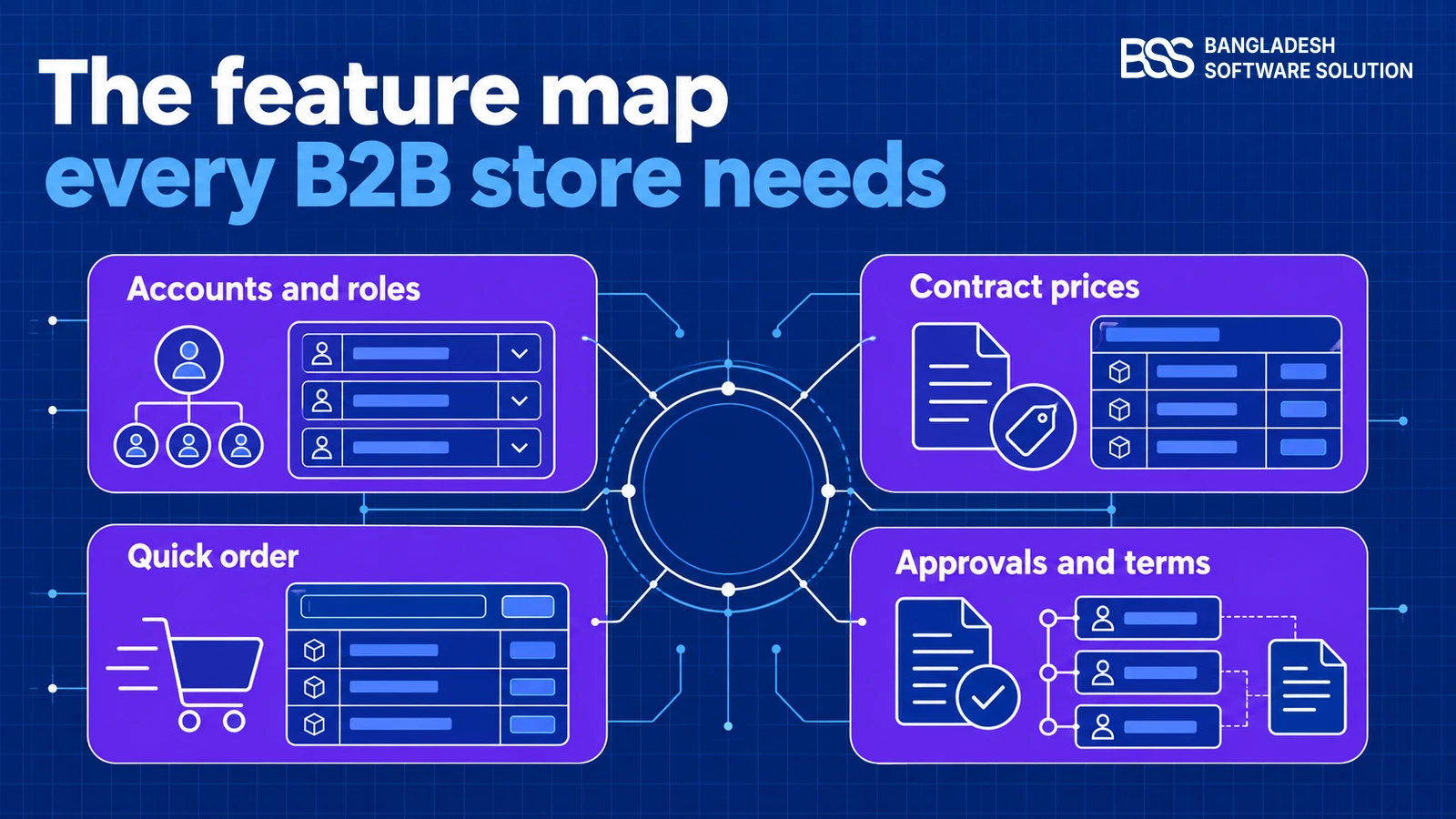
We compared the jobs a business buyer brings to your store, because those are what a platform either does, does with a plugin, or leaves to custom work. Six of them separate a real B2B platform from a retail store with a wholesale price.
The six jobs we ranked on
-
Company accounts with buyer roles: several people under one company, each allowed different things.
-
Contract prices and catalogs: a price list, or a slice of the catalog, per company.
-
Quotes: a buyer asks, your sales team answers with a priced quote that turns into an order.
-
Approvals and payment terms: orders above a limit wait for a manager; trusted buyers pay on account.
-
Quick order and reorder: a buyer types SKUs or repeats last month's order instead of browsing.
-
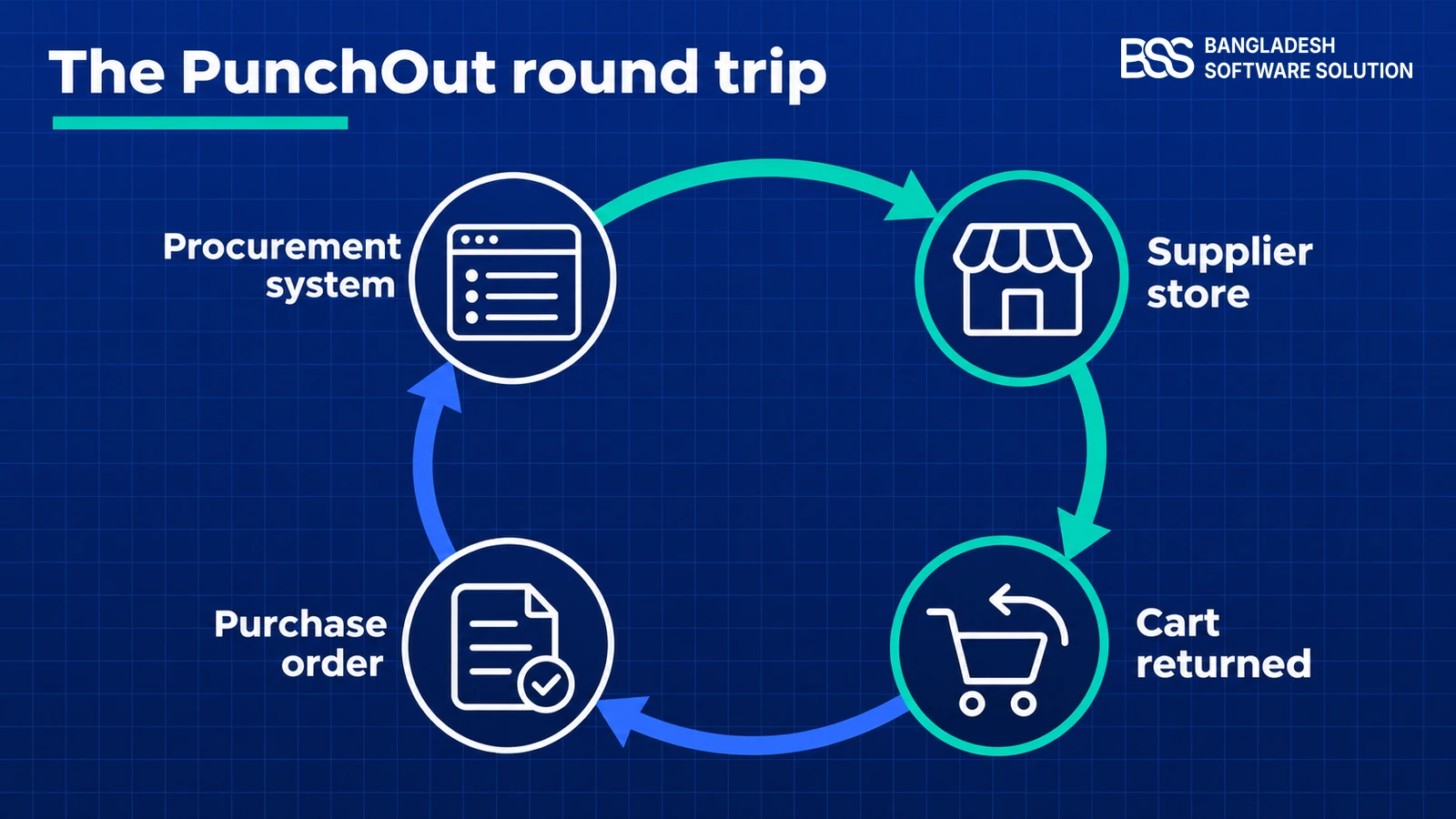
ERP and PunchOut: prices and stock from your ERP, and carts sent back into the buyer's procurement system.
We weighed a seventh point because the title promises it: what you own. An open source or source-available platform lets your developers read, change and host the code; a SaaS platform rents you the result. Neither is better in general, but the choice decides who can fix your store at 2 a.m.
If you want this list as a feature checklist for any platform, our guide to the features a B2B ecommerce website needs goes item by item.
Not sure which of the six your buyers need first? The BSS team can map a buyer contract onto a platform before you build or buy anything.
Talk to an expertThe 8 Best B2B eCommerce Platforms in 2026
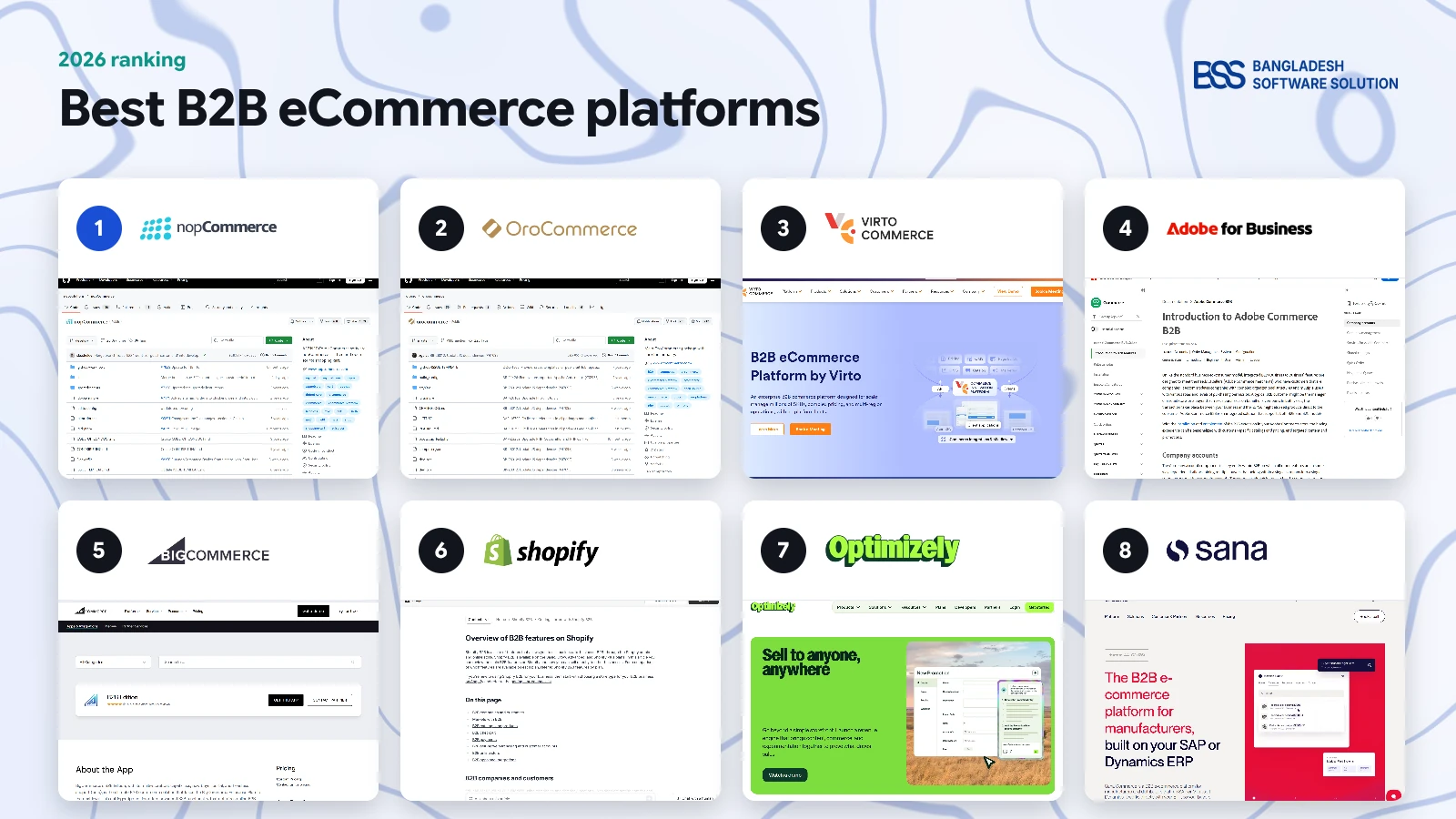
The order below is for a mid-sized B2B seller that wants control over its store: a distributor, a manufacturer selling to dealers, or a retailer adding wholesale. A global enterprise with a large integration budget would order the top differently, and we say where.
| Platform | Model and stack | Best for |
|---|---|---|
| 1. nopCommerce | Open source, ASP.NET Core on .NET 10, self-hosted | .NET teams that want to own the code |
| 2. OroCommerce | Open source Community Edition, PHP on Symfony | B2B-first sellers with complex accounts |
| 3. Virto Commerce | Source-available, .NET 10, cloud or on-premises | Enterprise .NET builds with many integrations |
| 4. Adobe Commerce | Commercial, PHP, B2B module licensed separately | Large catalogs with a big build budget |
| 5. BigCommerce B2B Edition | Hosted SaaS, B2B Edition on the Enterprise plan | Mid-market B2B without servers |
| 6. Shopify B2B | Hosted SaaS, on Basic, Grow, Advanced and Plus | Brands adding wholesale beside retail |
| 7. Optimizely Configured Commerce | Commercial, .NET, hosted | ERP-heavy distributors and manufacturers |
| 8. Sana Commerce | SaaS on Microsoft Azure, built for SAP and Dynamics | Only if your ERP is SAP or Microsoft Dynamics |





1. nopCommerce
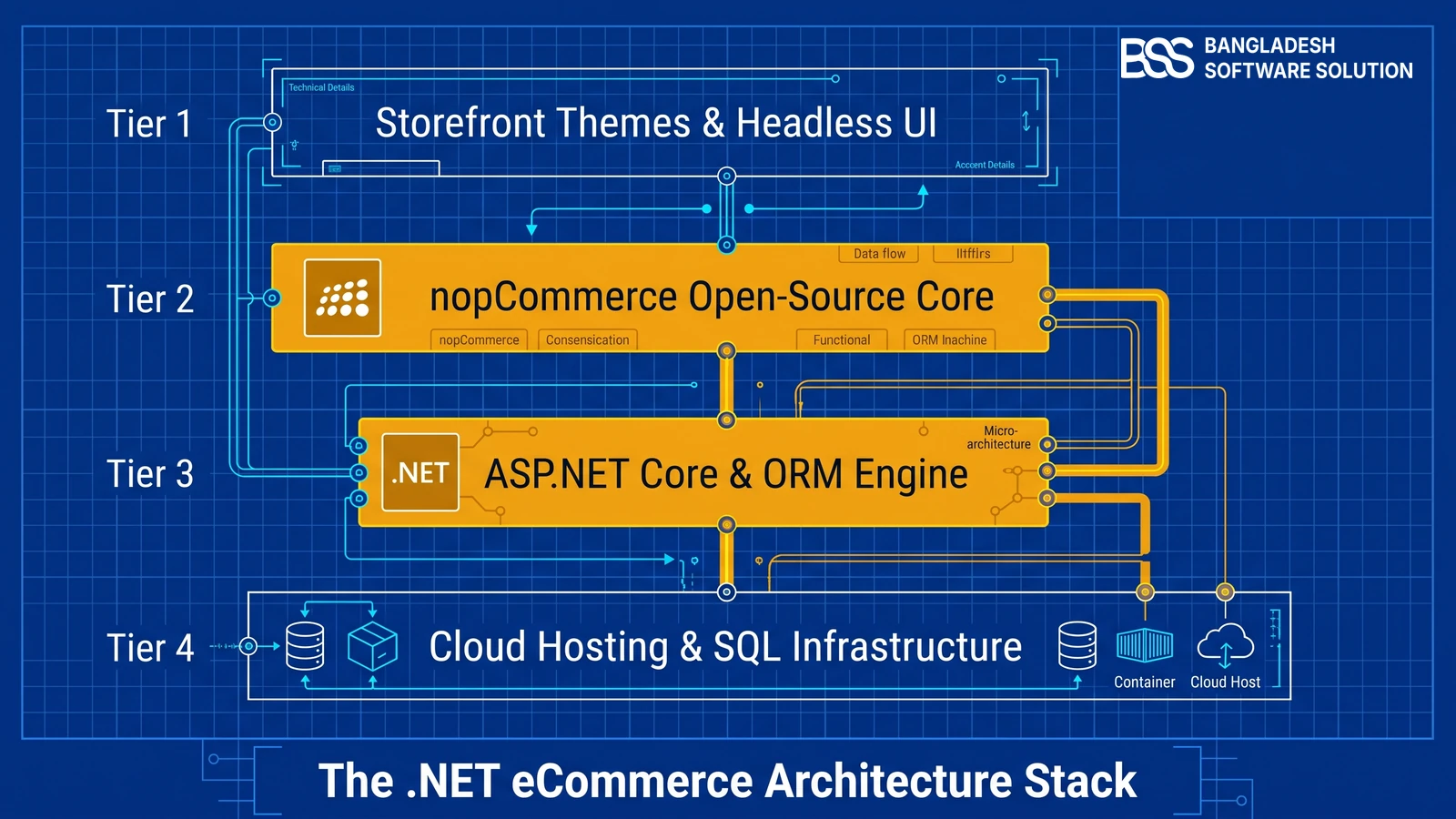
nopCommerce is a free, open source platform on ASP.NET Core; version 5.00 shipped on 27 October 2026 and runs on .NET 10. Its licence is the nopCommerce Public License, which is AGPL v3 plus a required "powered by nopCommerce" footer link that a paid key removes. You host it yourself on Windows or Linux, with SQL Server, PostgreSQL or MySQL.
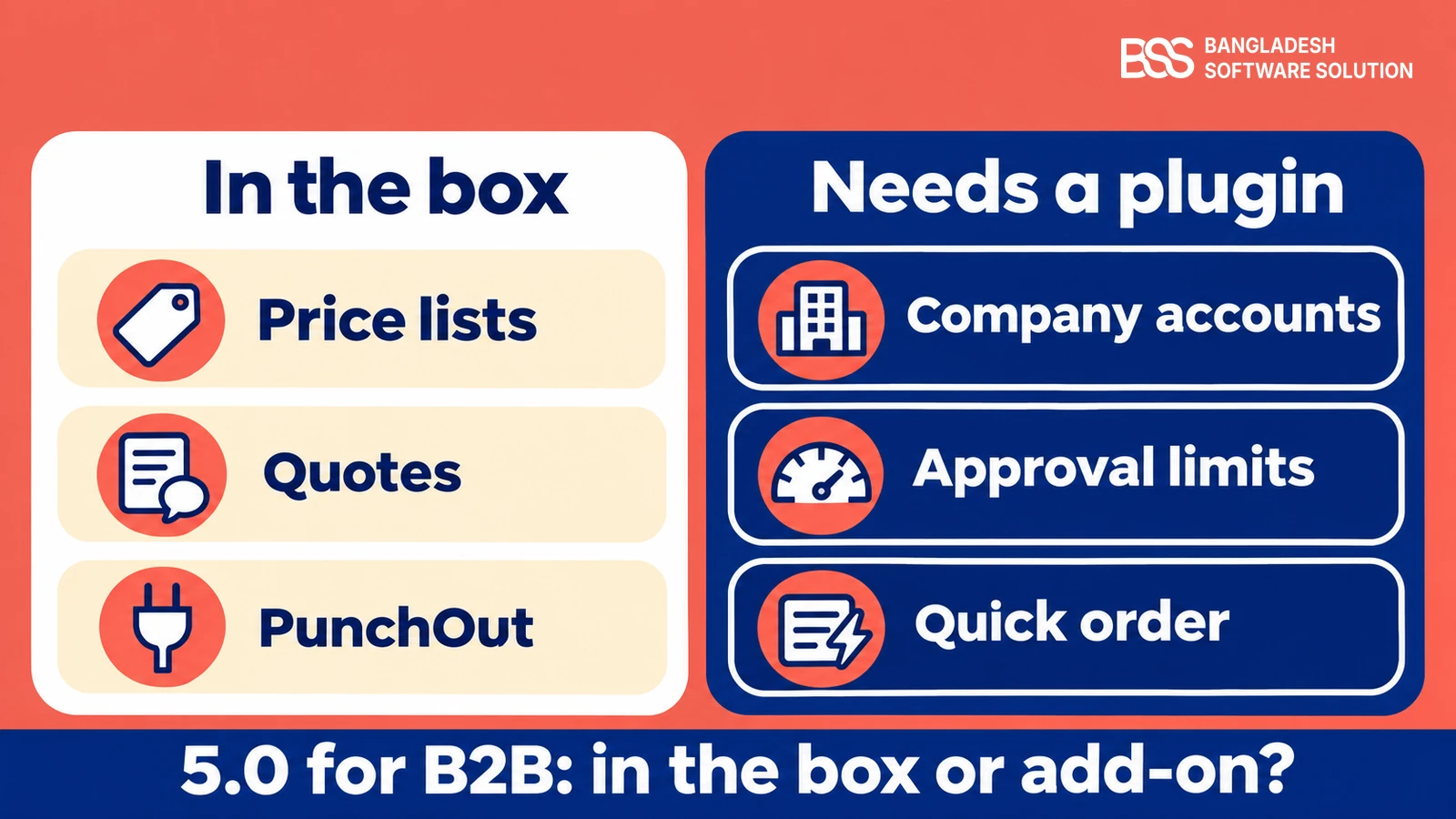
- Where it wins: 5.00 brought native price lists by customer role or single customer, request-for-quote, and cXML PunchOut for procurement systems such as SAP Ariba and Coupa. Roles, tier prices, multi-store and vendors were already there.
- Where it falls short: no company accounts with several buyers, no approval limits and no quick order page in the core. Those come from a plugin or custom work.

Adds company accounts with distributor tiers, a Quick Order page, threshold-based order approval, contract prices per variant and saved order templates to nopCommerce 5.00 and 4.90.
Honest take: the strongest choice here if your team writes C# or your IT runs on Microsoft, and the weakest if nobody on your side will own a server. Our breakdown of what nopCommerce 5.0 does for B2B lists what is in the box and what is not.
2. OroCommerce
Oro built OroCommerce for B2B first, and its Community Edition is free under the OSL-3.0 licence. It runs on Symfony, a PHP framework, either on OroCloud or on your own servers.
- Where it wins: corporate accounts with purchasing roles, price books, RFQ and quotes, order approvals and a quick order form. Oro names Epicor P21, SAP Business One, NetSuite and Microsoft Dynamics among its ERP connections.
- Where it falls short: multi-site and multi-organization setups, Elasticsearch support and OroCloud hosting are Enterprise-only, and Enterprise pricing is not published.
Honest take: the most complete B2B feature set you can start on for free, if your developers work in PHP.
3. Virto Commerce
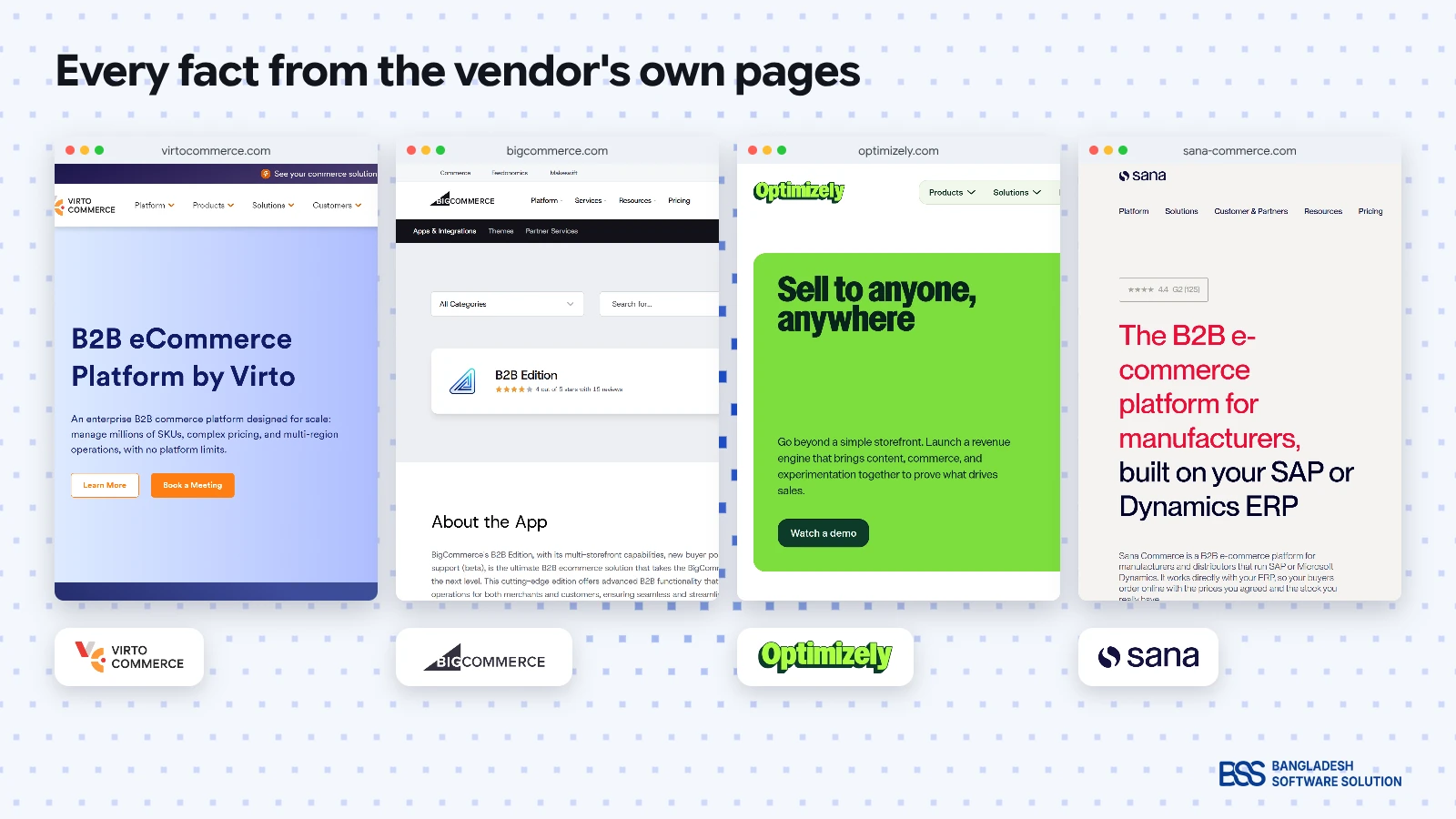
Virto Commerce runs on .NET 10 and ASP.NET Core, in Virto's cloud, your own cloud or on-premises. Its GitHub page calls it source-available, under Virto's own licence rather than an OSI open source licence.
- Where it wins: account and contract pricing, RFQs and quotes, approval workflows, cXML PunchOut with Coupa, Ariba, Jaggaer and SAP, and named ERP links including SAP, Dynamics 365, NetSuite and Epicor P21.
- Where it falls short: no free edition, and its ERP page offers accelerators and partner work rather than saying which connectors are ready-made.
Honest take: a serious .NET option for enterprise builds; budget for integration partners from day one.

When nopCommerce 5.00 came out, we read its source and release milestone to sort the B2B features that shipped from the ones still missing. That is why we can say plainly that company accounts and approval limits are not in the core: we checked the code, not the marketing.
What nopCommerce 5.0 does for B2B4. Adobe Commerce
Adobe Commerce, the commercial edition of Magento, has the deepest B2B module on this list. It runs on PHP, and Adobe's docs list the B2B extension as "Adobe Commerce only, requires a separate license".
- Where it wins: company accounts with divisions, roles and permissions, shared catalogs with per-company prices, negotiable quotes, purchase orders with approval rules, a company credit line, Quick Order by SKU and requisition lists.
- Where it falls short: none of it reaches Magento Open Source, pricing is quoted per customer, and the build and hosting cost is the highest here.
Honest take: for a global enterprise, this moves to the top of the list. For a mid-sized seller, you pay for depth you may never use.
5. BigCommerce B2B Edition
BigCommerce adds B2B through B2B Edition, which its own page says "takes the BigCommerce Enterprise Plan to the next level". The buyer portal is a React app on BigCommerce's B2B GraphQL API.
- Where it wins: company accounts with Admin, Senior Buyer and Junior Buyer roles, sales-rep quoting, shared shopping lists with approval, an invoice portal, buy again and a quick order pad.
- Where it falls short: it sits on top of the Enterprise plan, pricing is "contact us", and BigCommerce lists integration partners rather than named ERP connectors.
Honest take: a good hosted B2B option if your team wants no servers and your volume justifies the Enterprise plan.
On SaaS, the plan decides the B2B features
BigCommerce B2B Edition sits on top of the Enterprise plan, and several Shopify B2B features are Plus-only. Ask for the plan a feature needs before you compare monthly prices.
6. Shopify B2B
Shopify's help centre now says B2B works on the Basic, Grow, Advanced and Shopify Plus plans, so it is no longer Plus-only. It covers companies with locations and roles, catalogs, volume pricing, payment terms from Net 7 to Net 90, quick order lists and reorders.
- Where it wins: the fastest way to put wholesale next to an existing Shopify retail store, with ERP partners Shopify names: Acumatica, NetSuite and Microsoft Dynamics 365.
- Where it falls short: no native quote requests (the help pages point to draft orders), no PunchOut, three catalog assignments below Plus, and direct company catalogs, deposits and partial payments only on Plus.
Honest take: right for a brand whose wholesale side is simple; tight for a distributor whose buyers negotiate.
7. Optimizely Configured Commerce
Optimizely Configured Commerce is a .NET platform for manufacturers and distributors; its docs say it runs on .NET Framework 4.8, with .NET 8 alongside. It is commercial and hosted, with pricing through sales.
- Where it wins: quoting and RFQ, customer and contract pricing, account catalogs, buyer roles with approvals and budgets, a quick order page and cXML PunchOut.
- Where it falls short: its docs say PunchOut "may require customization", ERP integration is generic with no ERP named, and the .NET 8 move drops some older integration endpoints.
Honest take: strong for ERP-heavy distributors with an implementation partner, and more platform than a mid-sized seller needs.
If your ERP is SAP or Microsoft Dynamics, put Sana and Optimizely on the demo list. If it is not, cross Sana off.
BSS Engineering
8. Sana Commerce
Sana Commerce Cloud is SaaS on Microsoft Azure, built to sit on top of an ERP. Its pricing page lists SAP ECC, SAP S/4HANA, Dynamics 365 Finance and Supply Chain, Business Central, NAV and AX.
- Where it wins: customer assortments, volume pricing, sales agreements, quote-to-order on its Pro tier and up, ordering on account, PunchOut and multi-account hierarchies on Advanced.
- Where it falls short: only SAP and Microsoft Dynamics ERPs, the larger ERPs only on the Advanced tier, and pricing on request for every tier.
Honest take: worth a demo if your ERP is on its list; off the list if it is not.
Open Source and .NET: What You Actually Own
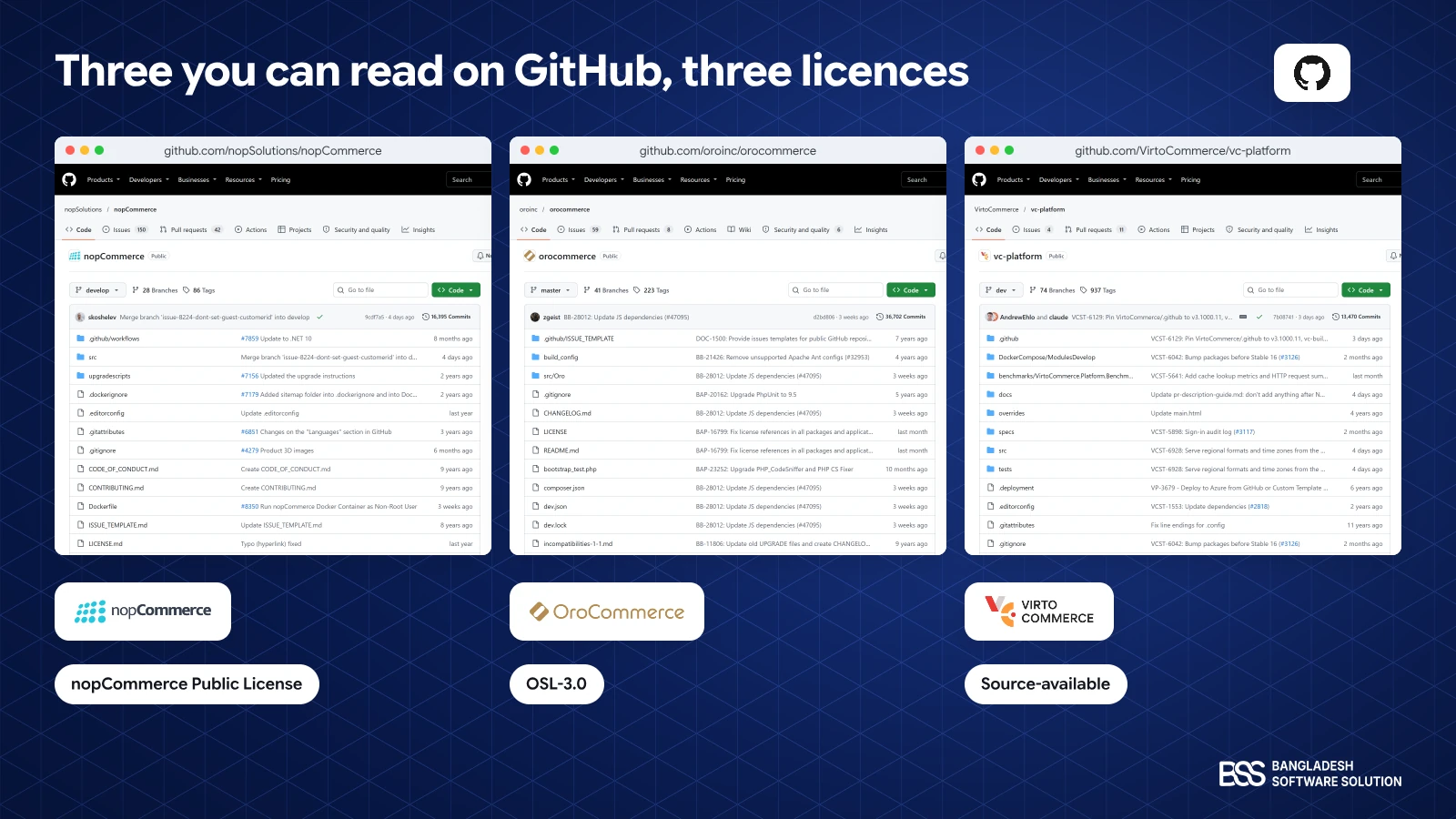
"Open source" means different things on these eight pages, and the difference matters when you sign. Three of them publish their code on GitHub, under three different licences.
| Platform | Licence | Stack | Free to start |
|---|---|---|---|
| nopCommerce | nopCommerce Public License 4.0 (AGPL v3 plus a footer link) | ASP.NET Core, .NET 10 | Yes |
| OroCommerce | OSL-3.0 for the Community Edition | PHP, Symfony | Yes |
| Virto Commerce | Virto Commerce Open Software License (source-available) | .NET 10, ASP.NET Core | No free edition |
| The other five | Commercial or SaaS | PHP, .NET or not stated | No |
Read the licence before you plan the build
The AGPL behind nopCommerce asks you to share changes you make to the platform's own code when you offer it as a service, and to keep the footer link unless you buy the removal key. OSL-3.0 has its own sharing rules. Ask a lawyer about your case; our guide to the "powered by nopCommerce" notice covers the footer part.
For a .NET team the choice narrows to nopCommerce, Virto Commerce and Optimizely, and only nopCommerce is free and open source. That is why it is first for the reader this list is written for: a mid-sized seller whose developers already know C#. Our wider comparison of .NET ecommerce platforms covers the ones that are not B2B-led.
Owning the code also means owning the upgrades. A self-hosted platform needs someone to apply each release, test the plugins and watch the server; budget that as a running cost, not a one-off. If nobody on your side will do it, a dedicated .NET developer from BSS can.
How to Choose: Five Questions Before You Book Demos
Demos are built to impress, so go in with your own questions. These five cut the list to two or three in an afternoon, and each one comes from a buyer rule we have had to build.
Ask every vendor these five
-
Can several buyers share one company's prices and limits? If the answer is "use a customer group per company", picture it at 200 companies.
-
Where does a contract price live, and does it reach a single size or colour?
-
Which ERP connector is ready-made, and which is "an accelerator" or a partner project?
-
Which B2B features need a higher plan or a separate licence?
-
Who can change the code, and what happens to your store if the vendor changes direction?

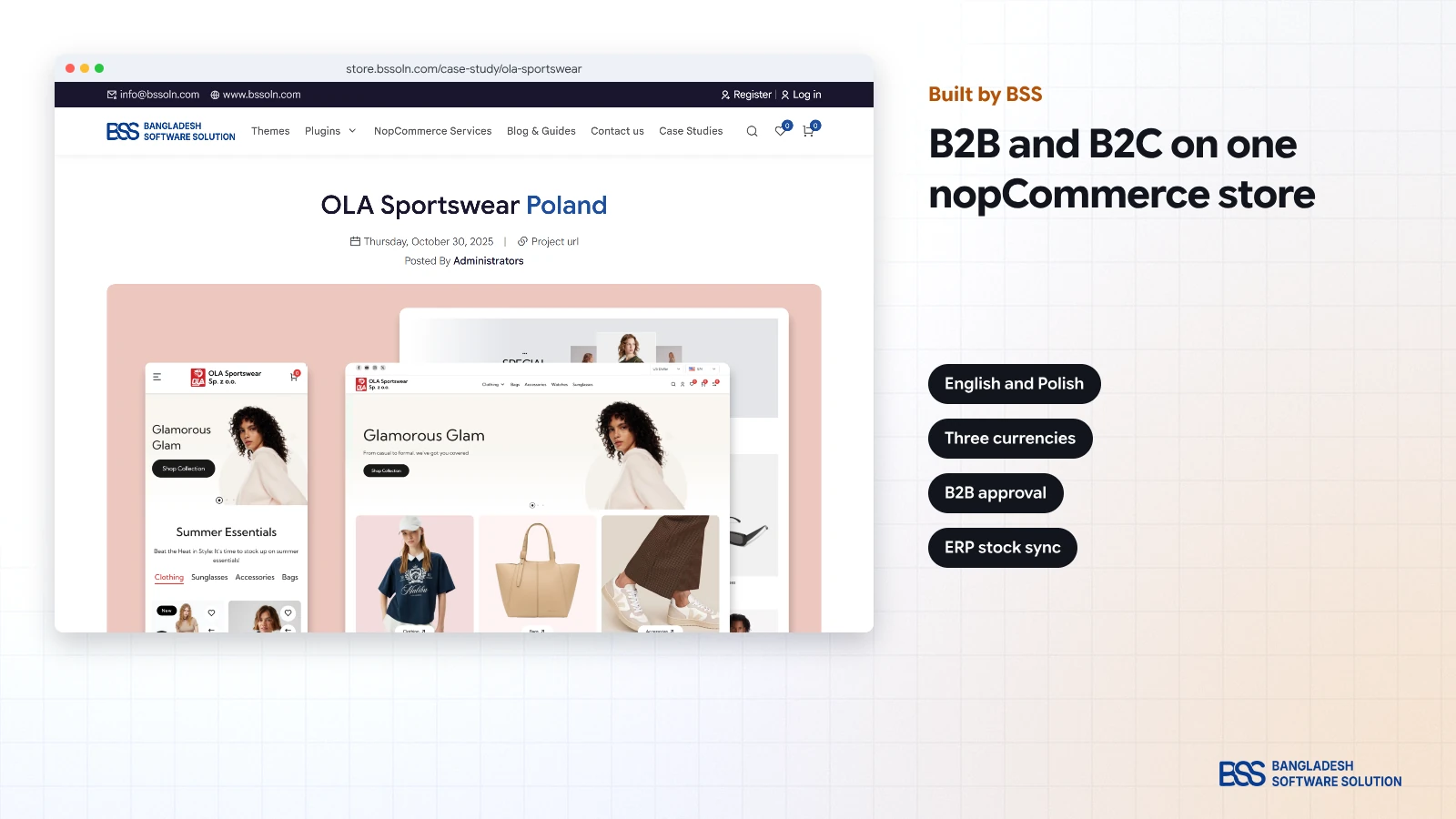
Built by BSS · OLA Sportswear, Poland
B2B and B2C on one nopCommerce store
English and Polish, three currencies, B2B approval, ERP inventory sync and GDPR in place.
Read the case studyWhat switching takes
Moving a B2B store is mostly moving data and rules. Products and customers export cleanly from every platform here; customer-specific prices, company structures and open quotes rarely do, because each platform stores them its own way. Plan to rebuild those from your ERP or a spreadsheet rather than copy them.
Search traffic is the other thing at risk. Every old product and category URL needs a 301 redirect to its new address, set up before the switch; our guide to avoiding SEO traffic loss in a migration covers the redirect map.
Run the old and new stores side by side for a few weeks with two or three trusted buyers ordering on the new one. They will find the price or approval rule you missed faster than any test plan.
When nopCommerce is the wrong fit
Skip nopCommerce if nobody on your side or your partner's will own hosting and upgrades; a SaaS option will cost more each month and less in attention. Skip it if your team is all PHP, where OroCommerce gives you more B2B out of the box.
And if you need every B2B rule on day one with no plugin, Adobe Commerce or OroCommerce Enterprise get you closer.
For OLA Sportswear in Poland we built B2B and B2C on one nopCommerce store: two languages, three currencies, B2B approval and stock synced from their ERP. The approval and the ERP sync were the custom work; the rest was configuration and plugins.
Read the OLA Sportswear case studyWhen the shortlist is two platforms and the deciding question is integration effort, BSS can scope the nopCommerce side for you, including the ERP link and the B2B rules your contracts need.
A B2B store on nopCommerce, built around your buyers' contracts
We map your price lists, approval rules and ERP link onto nopCommerce 5.0, add the plugins that close the gaps, and build what is left.
Frequently Asked Questions
Final Thoughts
Start from your buyers' contracts. List the six jobs, mark which ones your contracts need on day one, and the eight platforms sort themselves. If you want to own the code and your team knows .NET, nopCommerce with a B2B plugin covers most of the list; if you need everything native, Adobe Commerce and OroCommerce go further, at a cost.
Whatever you choose, test the hardest buyer rule first, with real data, before anything else gets built.
Bring us your hardest buyer rule. The BSS team will show you how it works on nopCommerce, and tell you honestly if another platform fits better.
Talk to an expert