Your first collection is photographed, the packaging samples are on your desk, and launch day is circled on the calendar. Yet the online store still feels like a pile of disconnected decisions: which platform to choose, how to organize sizes and colors, what the product page must show, and whether checkout, shipping, and returns will survive the first real orders.
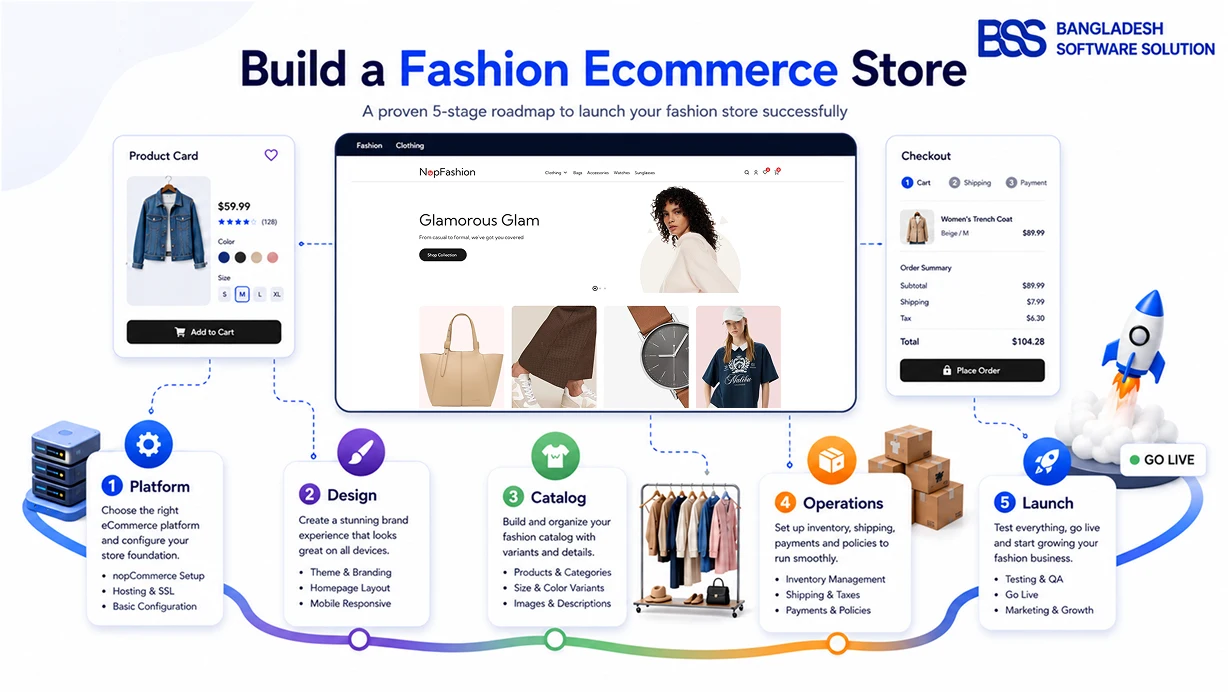
That is the moment when a fashion ecommerce store either becomes a coherent retail operation or an attractive website with fragile foundations. In our store builds, the strongest launches work backward from the customer journey and the fulfillment workflow. This guide follows that same sequence: define the commercial model, select the platform, design for fashion discovery, prepare the catalog and operations, test the full order path, and launch with a measurable first-month plan.
Start With the Store Model, Not the Theme
Before the homepage has a font or color palette, the business needs rules. Fashion catalogs create operational complexity quickly: one style can become dozens of sellable variants once size, color, fit, and season are involved.
Decision first: write down who you sell to, where you ship, how many styles and variants launch, who owns inventory updates, and what happens when an item is returned. Those answers shape platform, information architecture, integrations, and budget more than visual taste does.
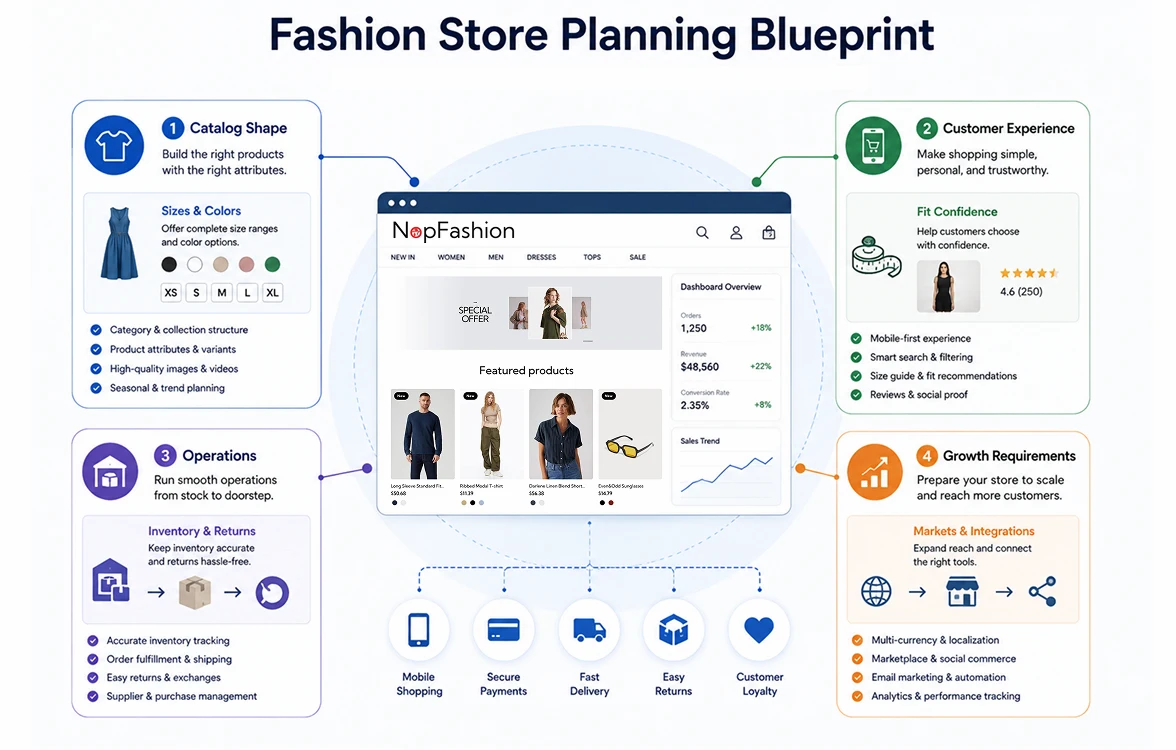
Choose a Platform Around Control, Speed, and Complexity
Once the operating model is clear, platform selection stops being a popularity contest. The right option is the one that supports your catalog and order workflows with an acceptable balance of launch speed, ownership, and ongoing engineering effort.
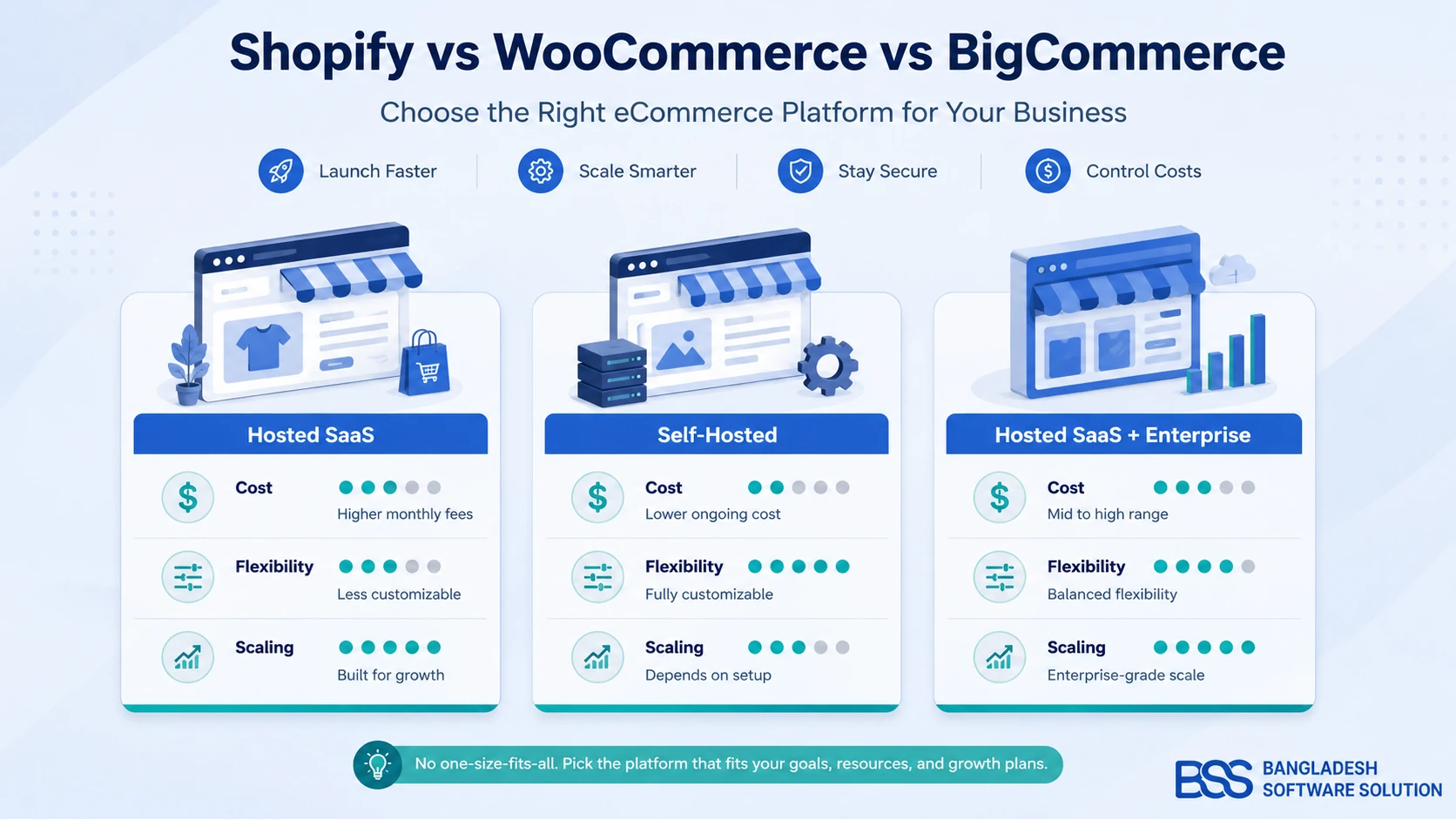
| Approach | Strength | Trade-off | Best fit |
|---|---|---|---|
| Hosted SaaS | Fast launch, managed hosting and a guided admin experience | Recurring platform and app costs; deeper workflows may be limited by plan or ecosystem | New brands with a conventional catalog and a small operating team |
| Content-led self-hosted | Flexible publishing and broad extension choice | Hosting, updates, plugin quality, and performance need active ownership | Editorial brands already invested in a content-management ecosystem |
| Open-source commerce | Source-code ownership, custom workflows and integration freedom | Requires capable hosting, implementation, testing, security, and maintenance | Complex catalogs, regional integrations, B2B/B2C requirements, or long-term control |
| Headless/custom stack | Maximum front-end freedom and channel flexibility | Highest delivery complexity; every integration and preview workflow needs deliberate architecture | Mature teams with distinctive experiences across web, app, retail, and marketplaces |
For a straightforward launch, hosted software often wins on speed. When the store needs custom size logic, local payment and delivery integrations, multiple storefronts, unusual promotions, or direct ownership of the codebase, an open platform such as nopCommerce becomes more compelling. If you are still weighing the broader market, use our small-business ecommerce platform comparison as the next decision step.
Design for Discovery, Confidence, and Fit
With the platform chosen, design should now reduce the uncertainty that stops fashion shoppers from buying. A polished hero image cannot compensate for unclear sizing, weak product imagery, confusing color selection, or a mobile menu that hides the collection structure.
Pro Tip: Build the Size Guide From Returns Data
Do not treat a generic size chart as finished content. Start with garment measurements and fit notes, then record why returns happen. The useful guide evolves around real confusion: waist placement, stretch, rise, sleeve length, model measurements, and whether a style runs small or oversized.
Mobile is the primary design constraint, not a smaller desktop canvas. Keep tap targets comfortable, avoid forcing shoppers through oversized campaign media, and verify that variant selection, image zoom, sticky purchase controls, and validation all work with one hand. Our guide to customizing a nopCommerce theme without coding shows which presentation changes can stay in the admin workflow and when development becomes the safer route.
Build the Catalog and Operations as One System
The storefront now has a customer-facing shape, but the launch will still fail if product data, inventory, payments, shipping, and returns are managed as separate projects. A fashion product record should support merchandising and fulfillment from the same source of truth.
Create a naming convention for SKUs, attribute values, image files, collection labels, and SEO fields before bulk entry. A common mistake we see during audits is using visually similar but technically different values—such as “Navy,” “navy blue,” and “Dark Navy”—which fragments filters, reports, and inventory sync.
Inventory should be tracked at the sellable variant level. Connect each size-color combination to the correct stock record, define what happens at zero inventory, and rehearse cancellations, exchanges, partial refunds, damaged returns, and restocks. For a deeper operational model, continue with our ecommerce inventory management guide.
Test the Entire Order Journey Before Launch
By this stage the site can look finished while the riskiest work remains invisible. Testing should follow complete customer journeys across devices, payment outcomes, fulfillment states, emails, and analytics—not isolated page checks.
Fashion Store Pre-Launch Checklist
-
✓Place test orders for every payment method, including approved, declined, cancelled, refunded, and duplicate-submit scenarios.
-
✓Verify variant inventory, low-stock behavior, size and color switching, sold-out messaging, and back-in-stock capture.
-
✓Check mobile navigation, filters, product media, cart, checkout, account creation, guest purchase, and form error messages.
-
✓Confirm shipping rules, tax behavior, delivery estimates, order emails, packing workflow, exchange handling, and return instructions.
-
✓Validate analytics and conversion events, product URLs, metadata, structured data, image performance, redirects, backups, security, and monitoring.
Checkout deserves its own usability pass because it is where marketing, design, payments, address rules, and shipping collide. Use our checkout page design best-practices guide to review friction before paid traffic arrives.
Frequently Asked Questions
Launch a Retail System, Not Just a Website
Return to the collection samples and the circled launch date. The path is clearer now: the catalog model determines the platform requirements; those requirements shape the design; the design depends on complete product data; and the launch depends on tested payments, inventory, fulfillment, returns, analytics, and support.
A fashion ecommerce store is ready when a customer can discover the right item, understand fit and delivery, pay confidently, receive accurate communication, and return or exchange without confusion—and when your team can operate that journey repeatedly. Build that complete loop first, then use the first month of search, conversion, support, and return data to decide what to improve. If nopCommerce is the platform you choose, bring BSS your catalog and launch requirements and we can turn the plan into a production store.