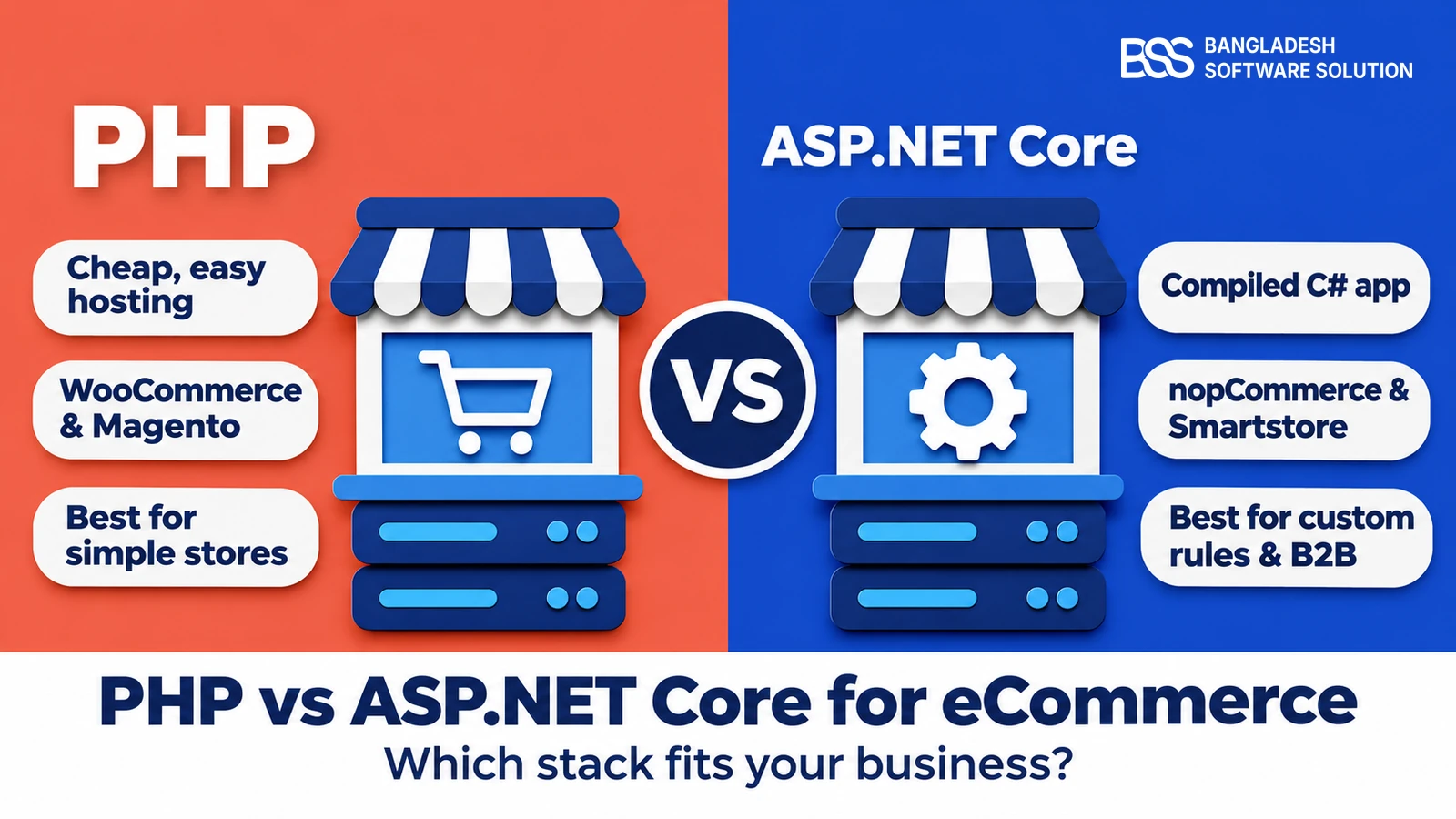
You have two quotes on your desk. One agency wants to build your new store on WooCommerce, which runs on PHP.
The other wants to use nopCommerce, which runs on ASP.NET Core. Both sound very sure of themselves, and both say their way is "more scalable".
The honest answer is that either stack can run a good online store. The real question for PHP vs ASP.NET Core for eCommerce is which one your business can afford to look after for the next five years.
We build nopCommerce themes and plugins at BSS, and our wider team also builds on WooCommerce and Shopify. So we've seen both sides go well and go badly. This guide compares the two on what matters to a store owner: how they work, the platforms and people around them, upkeep, cost and how to choose.
How PHP and ASP.NET Core Actually Differ
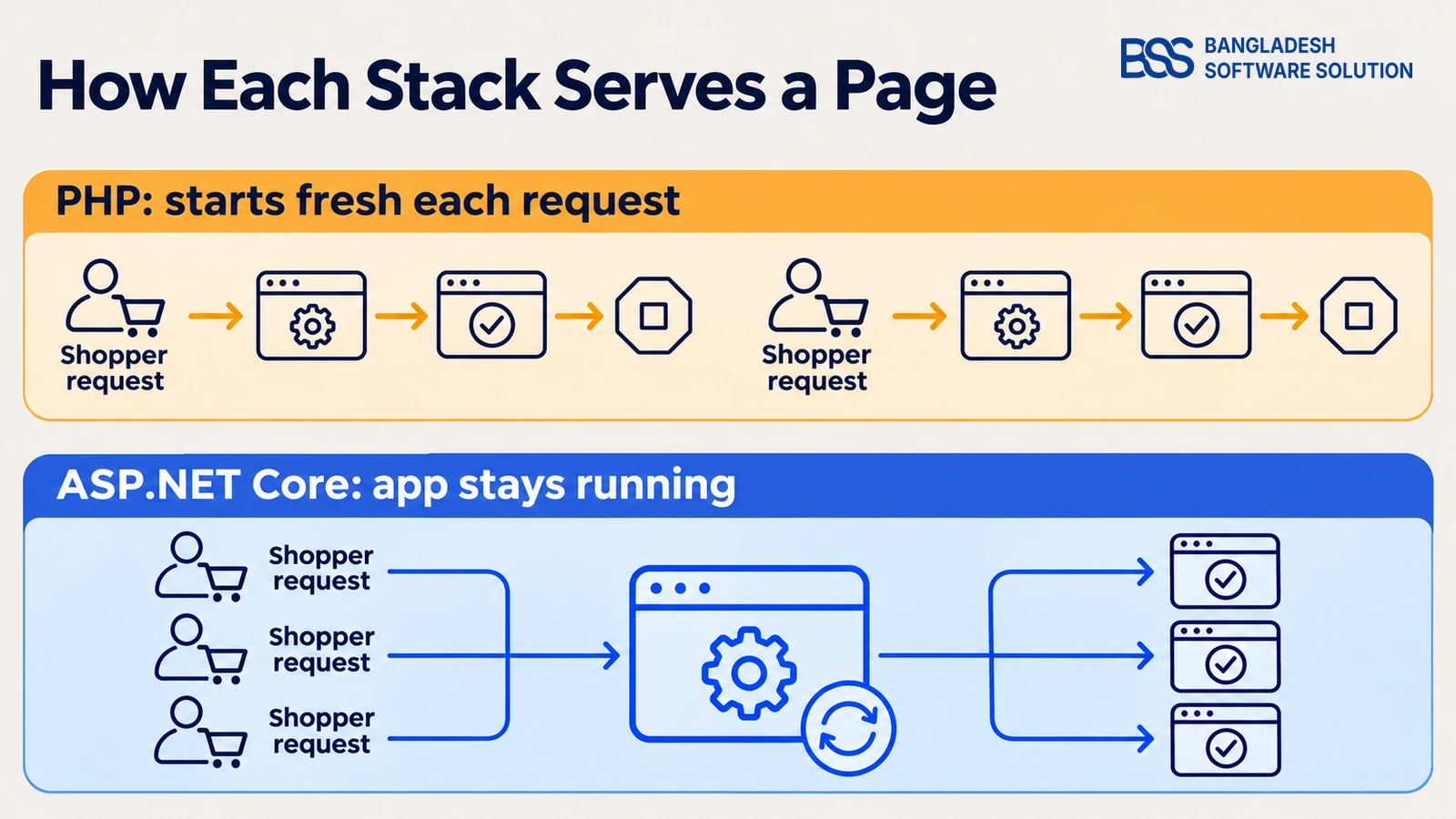
PHP is a scripting language made for the web. In a typical setup, each page request starts fresh, runs the code and then lets go of everything. That's simple and forgiving, and it's one reason PHP spread so widely.
ASP.NET Core is Microsoft's framework for web apps written in C#. Microsoft describes it as "cross-platform, high-performance, open-source". Your store runs as one app that stays running between requests, so it can keep useful data in memory.
What does that mean in practice? C# is compiled, so many mistakes get caught before the code ever reaches your customers. PHP lets you change a file and see the result straight away, which makes small fixes quick but also makes careless changes easy.
An old myth
Many people still think .NET means Windows servers. That stopped being true years ago. nopCommerce, for example, runs on Windows, Linux or Mac and supports Docker.
A real example: for NirmHaven, a retail brand in Bangladesh, we built a localized nopCommerce store and ran it with Docker on a VPS. No Windows server was involved.
What about speed?
You'll find benchmark charts where ASP.NET Core beats PHP frameworks by a wide margin. Those tests measure tiny, ideal pages, not a real store with dozens of plugins and large product photos.
In the stores we've worked on, slow pages almost always come from hosting, missing caching, heavy images or too many plugins. Fix those first, on either stack. Our nopCommerce caching guide shows what that looks like on the .NET side.
Weighing two quotes right now? BSS builds on both WooCommerce and nopCommerce, so we can give you a straight second opinion.
Talk to the BSS teamThe Store Platforms and People Behind Each Stack
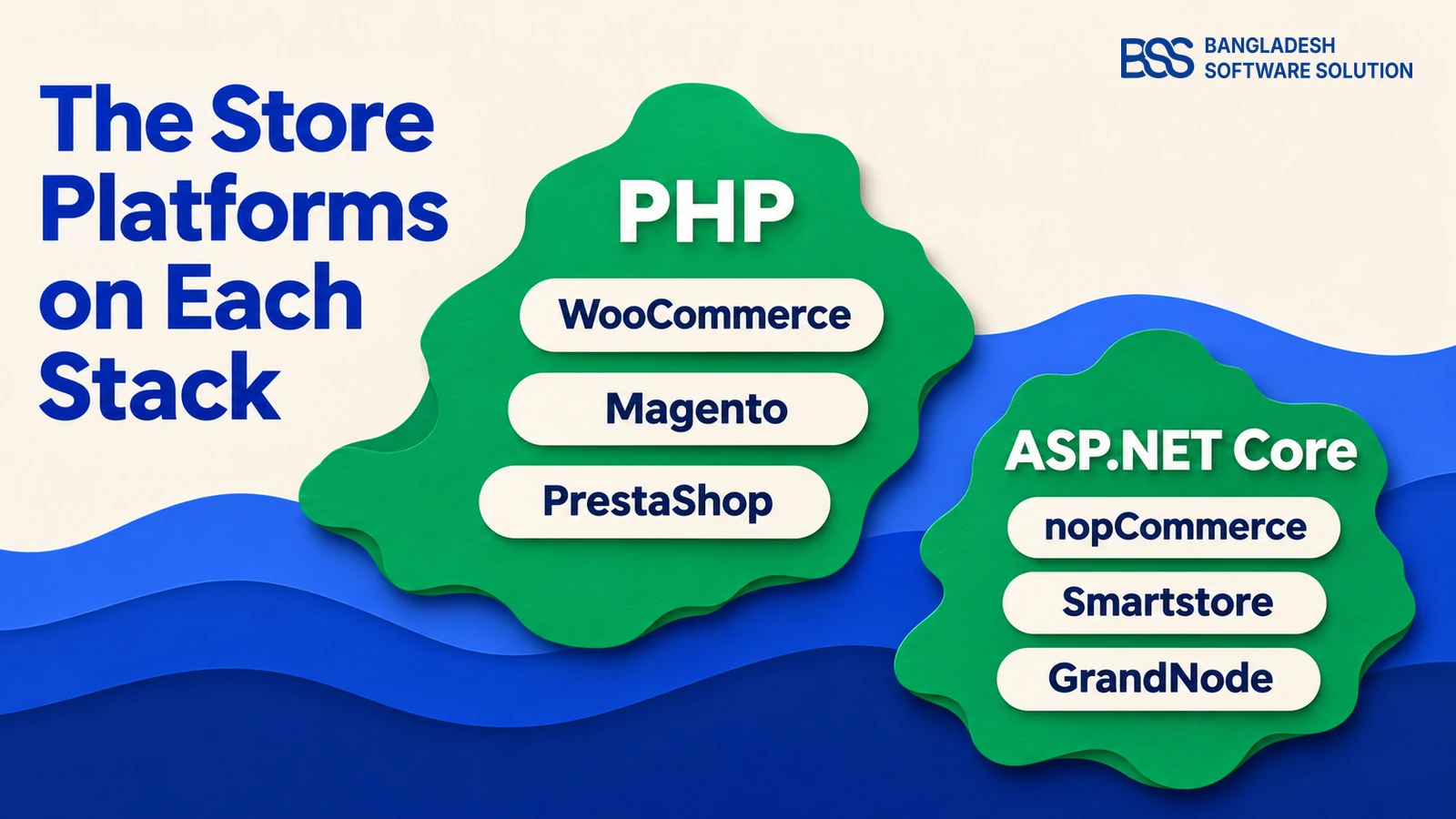
Knowing how the code runs is only half of it. You'll never pick a language on its own. You pick a store platform, and the platform brings its stack along with it.
On the web, PHP is everywhere. W3Techs reports that PHP is used by 69.0% of websites whose server-side language it can detect, against 4.2% for ASP.NET, as of November 2026. On the store side, Store Leads counts 4,334,124 live WooCommerce stores and 101,733 on Magento, both PHP platforms.
The .NET side is smaller but well established. nopCommerce, Smartstore and GrandNode all run on ASP.NET Core, and nopCommerce says 60,000 stores use it, by its own count. Our guide to choosing a .NET eCommerce platform covers that side in more detail.
The developer picture is the other way round
Here's the part that surprises people. In the 2025 Stack Overflow Developer Survey, 27.8% of respondents use C# and only 18.9% use PHP. For frameworks, 19.7% use ASP.NET Core, 8.9% use Laravel and 4% use Symfony.
Why the gap? PHP's web share comes largely from content sites built on WordPress, while C# developers work across business software of every kind. Keep in mind the survey only counts people who answered it, so treat it as a signal, not a census.
For you, the takeaway is simple: PHP talent is easy to find for theme and plugin work. C# talent is easy to find for business logic and integration work. Think about which kind of work your store will need most.
If you sell to other businesses
B2B stores deserve a closer look at the .NET side. Customer-specific prices, approval steps and ERP sync are all custom logic, and that's where strict, compiled code earns its keep.
On a PHP store, B2B usually means adding extra plugins on top and making sure they work well together. Our guide on whether nopCommerce is right for B2B stores goes through the features one by one.
Security and Upkeep: Both Stacks Run on a Clock
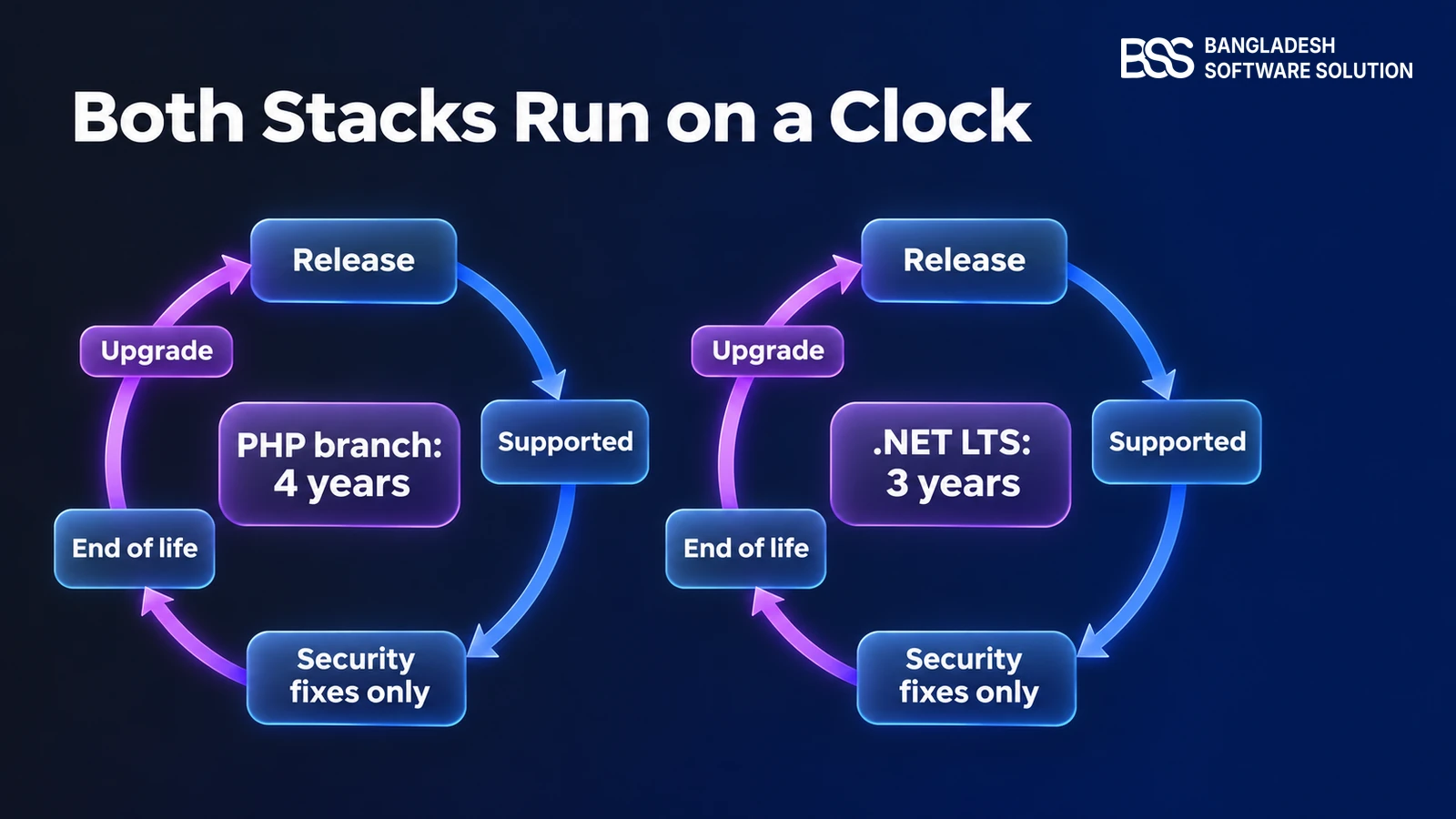
This is where store owners get hurt most, on both stacks. Every version of PHP and .NET has an end date, and after it there are no more security fixes.
PHP gives each branch 4 years of support. Right now, PHP 8.2 to 8.5 are supported, and PHP 8.2 gets its last security fixes on December 31, 2026.
.NET long-term releases get 3 years. .NET 8 and 9 reach end of support on November 10, 2026, and .NET 10 is supported until November 10, 2028.
Here's a number worth stopping on. W3Techs shows 66.5% of PHP websites on version 8, but 25.9% still on version 7 and 7.5% on version 5. That's roughly one PHP site in three on a version php.net no longer lists as supported.
| Upkeep | PHP store (such as WooCommerce) | ASP.NET Core store (such as nopCommerce) |
|---|---|---|
| Language support | 4 years per PHP branch | 3 years per .NET long-term release |
| Supported now | PHP 8.2, 8.3, 8.4 and 8.5 | .NET 10 (long-term release) |
| What you update | WordPress, WooCommerce, the theme and each plugin | nopCommerce, the theme and each plugin |
| Who usually does it | Often the owner, from the dashboard | Usually a developer |
That last row matters more than any benchmark. WordPress makes routine updates a button press, which is a real plus for a small team. A nopCommerce version upgrade normally needs a developer, so you should budget for it from day one.
Neither stack is safe if nobody updates it. Most store breaches we hear about start with something old and forgotten, not with the language itself.
BSS Engineering
If you run a PHP store today, our guide to checking your PHP site's security risk explains how to tell if you're exposed and what to patch first.

On the nopCommerce upgrades we run, the core is rarely the problem. It's usually a custom plugin that compiled last year and no longer loads. Our nopCommerce upgrade checklist is the list we work from.
Hosting, Hiring and Running Cost
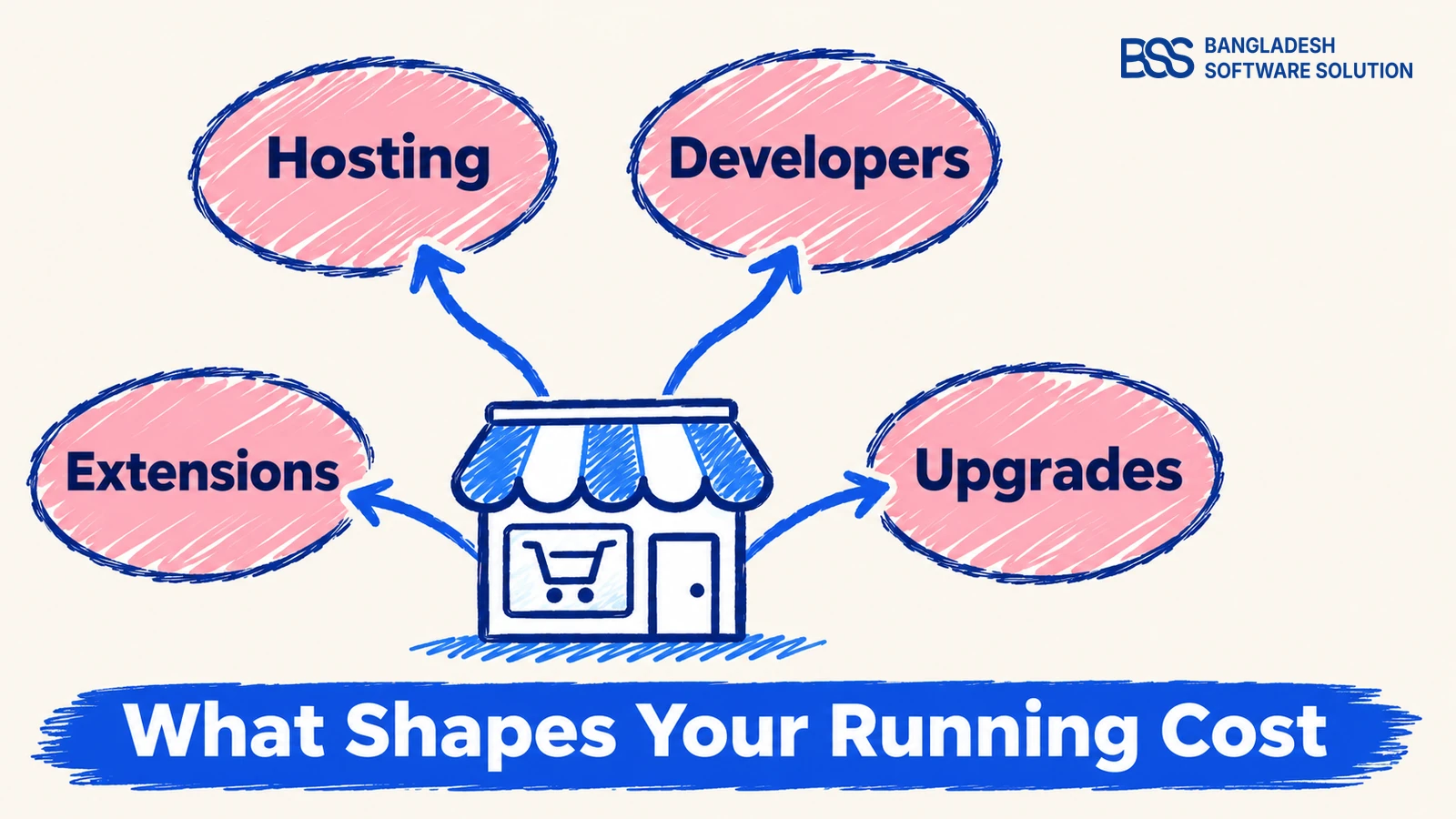
With upkeep in mind, let's talk money. The language itself is free on both sides. PHP and ASP.NET Core are both open source, so your real costs come from four places.
The fourth cost is upgrades, which we covered above. Hosting is often smaller than people expect, too. For Ladily, a skin care brand, we ran their nopCommerce store on a VPS instead of AWS or Azure.
Themes are the other place where costs creep in. On both stacks, a ready-made theme saves weeks of design work. Our nopCommerce themes come bundled with plugins, which keeps both the add-on list and the update list shorter.
The pain point nobody mentions: editing content
Be fair to WordPress here. If your team writes a lot of landing pages and blog posts, WordPress makes that very easy. Out of the box, nopCommerce gives you a plainer editor for pages and product descriptions.
That gap is why we built a visual editor for our own nopCommerce work. It doesn't change the stack decision, but it removes one of the most common reasons marketing teams push back on nopCommerce.

A no-code, drag-and-drop editor for nopCommerce product, category, topic, blog and email pages, with reusable blocks.
View the pluginIf ASP.NET Core is the right call but you don't have C# skills in-house, that's a common spot to be in. You can hire a .NET developer from BSS for the build and the upgrades, and keep your own team on products and marketing.
Which Stack Fits Your Business?
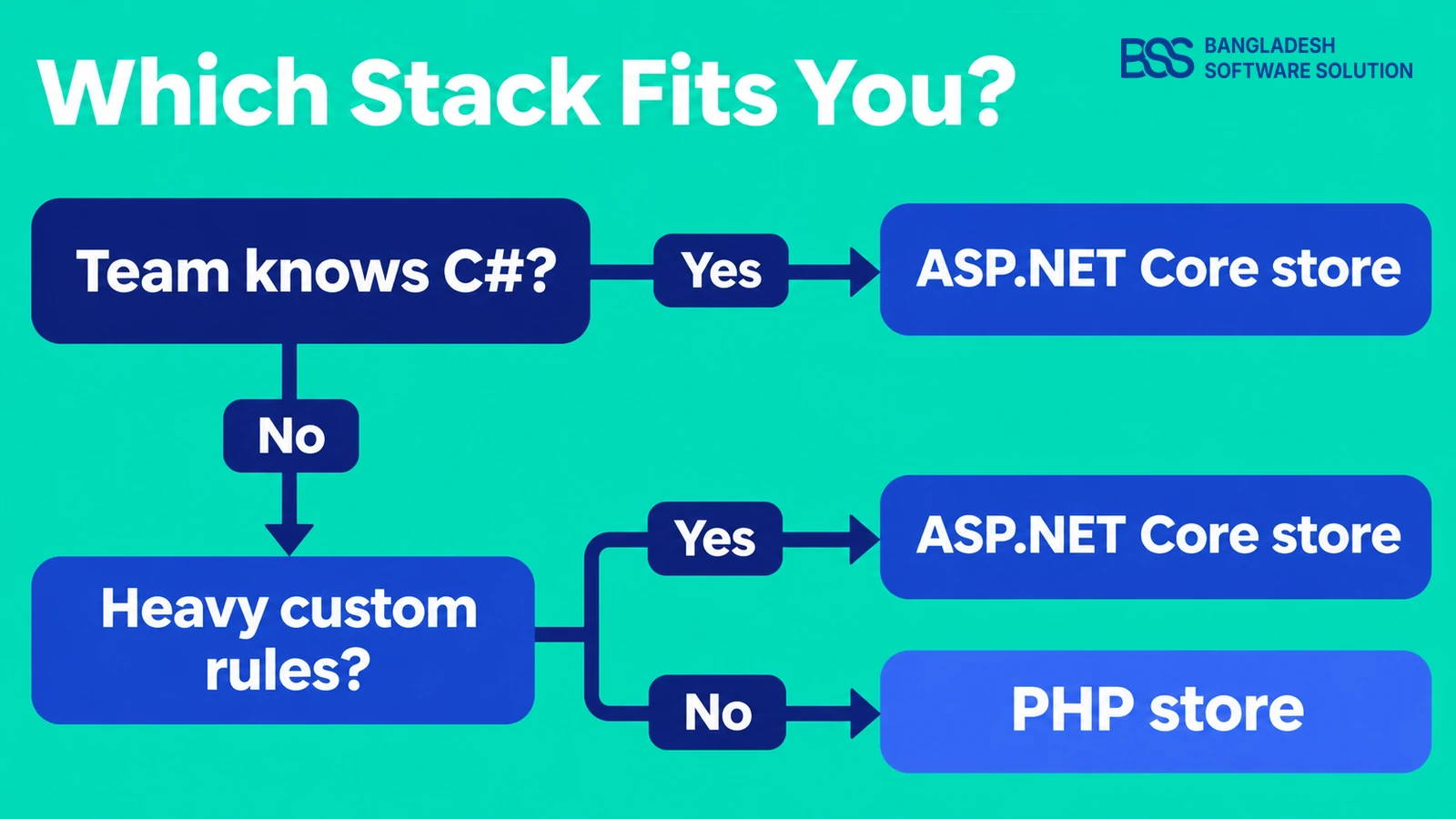
Back to those two quotes. Once you strip out the sales talk, the choice usually comes down to two questions: what your team already knows, and how much custom logic your store needs.
Ask both agencies these questions
-
Which PHP or .NET version will the store launch on, and when does its support end?
-
Who installs updates, how often, and what does that cost per year?
-
How many plugins will you install, and which ones charge every year?
-
What custom code will you write, and could another developer read it?
-
Can we export all products, customers and orders if we ever leave?
Already running a PHP store? Then the bar for switching is higher. A move costs time and money, so it only pays off if it fixes a problem you actually have, such as pricing rules you can't build or plugins that keep breaking.
An agency that answers these clearly, whatever stack it uses, is usually the safer pick. If you're comparing the two platforms head to head, our nopCommerce vs WooCommerce breakdown goes feature by feature.
When owners ask us to move them off a PHP store, we first ask what's actually broken. Sometimes the fix is fewer plugins, not a new stack. When a move does make sense, the redirects matter most, as our Magento to nopCommerce migration guide explains.
Chose ASP.NET Core? Work With the BSS Team
From nopCommerce store builds and custom plugins to upgrades and ERP links, our engineers work in .NET every day. Tell us what you sell and what the store must connect to.
Frequently Asked Questions
Final Thoughts
So, which of those two quotes should you sign? If your store is simple, content-led and run by a small team, the PHP route is usually the practical choice. Just keep it on a supported version and keep the plugin list short.
If your store has custom rules, B2B buyers, an ERP to talk to or a C# team, ASP.NET Core will usually serve you better over time. Either way, ask the five questions above. The agency with clear answers is the one to trust.
We build on both PHP and .NET platforms, so we have no reason to push one. Tell us about your store and we'll help you weigh it up.
Book a free consultation